
How to Become an Independent Insurance Agent: The Four Routes to Market
The short answer
A newly licensed agent picks one of four routes to market: a captive career agency, a direct carrier appointment, an aggregator or cluster, or an IMO/FMO downline. They differ on who holds the carrier contract, who keeps renewals when you leave, and who supplies prospects. Little else about the decision matters as much.
Which of the four routes to market should a newly licensed agent take?
A licence lets you sell. A route to market gives you carrier codes, a product shelf, and somebody who answers the phone when an application stalls in underwriting. There are four routes, and the recruiter calling you is selling exactly one of them, so learn all four names before the call.
A captive or career agency puts you inside one carrier's field force: the agency holds the appointment, sets the training, and supplies prospects, often an orphan book or company enquiries. A direct carrier appointment means you contract with the carrier in your own name with nobody above you. An aggregator or cluster, the dominant structure on the property and casualty side, holds market access you write under in exchange for fees and a share of commission. An IMO or FMO downline, the dominant structure in life and senior-market distribution, gets you carrier contracts in your own name and earns an override above you.
Compare them on five things only. Everything else a recruiting page tells you is downstream of these five.
Two of the columns below decide the next five years of your career: who owns renewals, and who supplies prospects. If the answer to the second is "nobody", you have just taken on an acquisition budget, which is the subject the rest of this section keeps returning to. Before you sign anything, read what an IMO actually is and where FMO, NMO and MGA sit above it, then read how carrier appointment and contracting paperwork actually moves.
| Route | Who holds the carrier contract | Who owns renewals if you leave | Who supplies prospects | Cost to leave | How fast you can start |
|---|---|---|---|---|---|
| Captive / career agency | The agency or carrier; you produce under its appointment | The agency, in most agreements; orphaned clients stay with the office | The agency: orphan book, company enquiries, sometimes a draw | Low in cash, high in restriction; non-solicit terms and training-cost repayment are common | Fastest: training, product and prospects are handed to you |
| Direct carrier appointment | You do; the appointment is written in your name | You do, on whatever vesting terms the contract states | Nobody; you buy, generate or earn them yourself | Low; you request a release, subject to the release clause | Slowest; most carriers want production history or a sponsoring entity |
| Aggregator / cluster (P&C-dominant) | Usually the aggregator, under its carrier codes | Split; ownership usually turns on who brought the account and on an exit schedule | You do; the aggregator supplies market access, not prospects | Highest friction; book-ownership schedules and fee obligations are the whole negotiation | Medium; application and membership, then codes |
| IMO / FMO downline (life and senior market) | You do; the IMO sits above you as upline | You do if the contract vests; the IMO earns an override, not your renewals | Varies widely; some sell or grant prospects, some supply only contracts and training | Depends entirely on the release policy; ask for it in writing first | Fast; contracting is paperwork, not an interview |
Captive or independent: which side should you start on?
Start captive if you need someone else's prospects and a structured first year more than you need ownership. Start independent if you can fund your own acquisition for several months and want the book in your name. That is the entire trade, and it is a cash-flow question disguised as an identity question.
The captive case is stronger than independent-agent marketing admits. Supplied prospects, a manager who reviews your calls, one product set to learn instead of twenty, and in some agreements a draw, all remove the two things that end new careers: no at-bats and no coaching. The cost is structural, not emotional: you produce on someone else's appointment, the renewals and the orphaned clients usually stay with the office when you go, and your effective contract level is lower than an independent's on the same product.
The independent case is also weaker than IMO recruiting decks admit. A higher contract level on a product you cannot get in front of anyone is worth nothing. Our own compensation analysis breaks agent income down by where the prospects come from, and the pattern is consistent: the source of prospects, not the contract level, tracks income most closely.
Decide with these, in this order:
- Runway. Count the months you can cover personal expenses with zero commission, then halve it. If the number is under three, a captive or an upline that supplies prospects is the honest answer.
- Coaching. Will anyone listen to your recorded calls in week two? If not, buy that some other way before you buy anything else.
- Ownership. Ask whether renewals vest, on what schedule, and what happens to them if you leave. Get the answer in writing.
- Product need. One carrier cannot cover impaired-risk, declined, or rated cases. If your natural market has health issues or unusual needs, a single shelf will cost you cases.
- Licence family. Life and health versus property and casualty determines which routes are even open to you, and that is a state-by-state question covered in the licensing guide.
- Exit terms. Non-solicit language, release policy, and training-cost repayment are the parts of the agreement people skip and later pay for.
Who profits from the route you pick, including us?
Every party explaining this career to you is paid by the route it recommends. A recruiter earns an override on your production, so its incentive is contracting volume, not your survival. A course seller earns on the course. An aggregator earns membership fees and a share of commission. And we sell leads, which means our bias runs toward you buying prospects rather than being handed them. That is worth knowing while you read the rest of this page.
InsureLeads takes no IMO, FMO or carrier referral fee, sponsorship, or affiliate commission. The carrier and distribution tables in this section name organisations and describe their structure; they never rank them, because a ranking we are not paid for still looks like one we were.
Override opacity is a measurable complaint, not a rhetorical one. In the structured producer interviews behind our compensation analysis, 31% of respondents named FMO/IMO override opacity as an operational pain point, and 51% named the time consumed by licensing, errors-and-omissions cover, and carrier or AHIP certification. Both figures come from the same interview set (40+ active producers, January to March 2026) that the analysis documents, combined with public sources and our own operational data. Neither is a controlled survey result, and we do not present them as one.
Who owns the renewals, and what does leaving actually cost?
Renewals are the asset. First-year commission pays this month's bills; the renewal stream is what makes an insurance career compound, and every route above treats it differently. Ask four questions before you sign, and ask for the answers in writing rather than on a call.
Does the contract vest renewals, and on what schedule? Vesting can be immediate, staged over a number of years, or absent. Who can move your contracts? In some downline structures the upline can transfer or block them. What is the release policy, in days and in conditions? A slow release means you cannot contract with the same carrier elsewhere while it runs, which quietly freezes your ability to leave. And what happens to an advance balance? If your commission is advanced rather than as-earned, unearned advances become a debit balance that follows you out of the door.
Chargebacks are the same exposure from the other end. Our format and product notes put the heaviest chargeback window in the first thirteen months on indexed universal life, and carrier chargebacks on life persistency were named by 58% of the interviewed producers. A route that pays you fastest is usually also the route that claws back hardest, which is a reason to learn one product properly before adding a second. The appointment and contracting process is where these terms are actually negotiated; contract-level and commission-rate mechanics are covered separately in our final expense commission guide.
What does it cost to start, in cash, before the first commission arrives?
The state-set part of starting is small and knowable. The discretionary part is what ends careers, and it is almost entirely prospect acquisition. Budget them separately, because only one of the two is fixed.
Prelicensing hours, and therefore the course bill, are set by your jurisdiction and vary more than most new agents expect. In the NAIC's Producer Education and Examination Requirements chart (PR-20, Spring 2024 edition, jurisdiction rows reviewed April 2024), Colorado requires 50 hours for life, accident and health, including 3 hours of ethics; California requires 20 hours for life and health plus 12 hours of ethics and insurance-code study; Texas carries no statutory prelicensing provision at all. There is no national course price because there is no national hour requirement. The state-by-state detail belongs in our state-by-state licensing and continuing-education guide, not here.
Exam and licence fees are published by each state's insurance department. As a worked example, California's Department of Insurance producer-licensing fee schedule lists a $188 application filing fee and a $55 examination fee for both the Life-Only Agent and the Accident and Health Agent licence (fee schedule as published, effective 3 March 2019). Those are regulator fees, not our prices, and your state's will differ; check your own department rather than an aggregator.
The rest of the pre-commission cash falls into five lines:
- Prelicensing course: vendor-priced and tied to your state's hour requirement. We do not quote course prices, and neither should a recruiter promising to reimburse one.
- Exam, licence application, fingerprints and background check: state-set. Fingerprint and vendor fees vary by jurisdiction; verify them with your department, not from a blog.
- Errors-and-omissions cover: most carrier and IMO contracts require it before your first appointment is issued. Premium depends on lines, limits and prior claims, so get a real quote rather than a rule of thumb.
- Certification, where your line requires it: Medicare selling adds an annual certification cycle (see the AHIP chapter), and Marketplace health selling adds federal registration (see the FFM chapter). Both fees are documented on those pages against primary sources.
- Software and prospects: a CRM the moment you have more than a notebook, and then the acquisition line. Our free CRM plan covers one user permanently, which removes the software line but not the one that matters.
Why the prospect line dwarfs everything above it
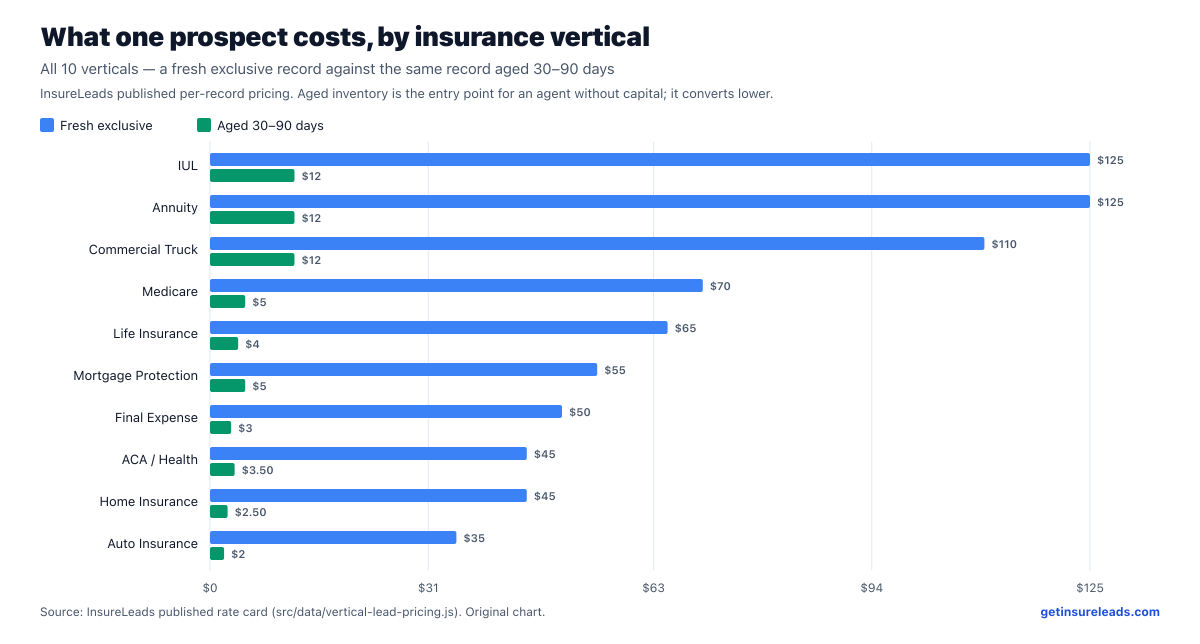
Sum the fixed items and you get a number most people can absorb once. The acquisition line recurs every month you are in business, and its shape depends on which format you can afford to practise on. Aged records in our flagship line run $3 each at 30 to 90 days old, against $50 for a fresh exclusive record in the same vertical.
That ratio, not either figure alone, is what a first-month budget turns on: cheap records buy dialling reps at a low close rate, fresh records buy conversations at a high one. New agents almost always need the reps first, which is why aged records are the practice inventory a first-month budget can actually carry. If you want to model the trade rather than guess it, our cost-per-acquisition calculator takes close rate and commission as inputs.
How long until money actually arrives?
Longer than the route to market suggests. Your runway is licensing weeks, plus contracting and appointment weeks, plus days to first sale, plus the carrier's issue and pay cycle. Only the third of those four is under your control, and it is the shortest.
Median time to first sale, by entry path, from the interview set behind our compensation analysis:
| Entry path | Median days to first sale | Note |
|---|---|---|
| New agent, purchased live transfers, trained scripts | 4 to 8 days | Fastest; the trade-off is a higher cost per acquisition until scripting improves |
| New agent, purchased exclusive web records | 12 to 21 days | Most common entry path; requires dialling discipline |
| New agent, aged records only | 21 to 45 days | Cheapest path but hardest conversion; high attrition |
| New agent, referrals and warm market | 30 to 90 days | Depends entirely on network depth |
| Experienced agent switching vertical | 3 to 10 days | Scripts and objection handling transfer quickly |
Read that table as a statement about practice volume rather than about product. The aged-only path is the cheapest and the slowest, and it carries the highest attrition in our own notes, which is the honest caveat attached to the cheapest inventory on this site. Whichever row you are in, do not resign paid work until you have written business on the books. Expectations, washout, and why agents leave the business are the subject of the reality chapter.
Where do you go next in this section?
Five chapters run the career sequence in order, plus two certification pages for the lines that gate selling behind an annual requirement. Each one is written for the same reader as this page: licensed or nearly licensed, no book, no downline, deciding where the next month goes.
- Training: which training is genuinely required versus sold to you, and how the licence choice narrows the routes above.
- Getting started: the first 90 days, from contracting paperwork to a working daily schedule.
- The reality: what the first year looks like, why agents quit, and which expectations are simply wrong.
- First prospects: how a new agent gets in front of anyone at all, and what each source costs in time versus cash.
- Carriers: getting appointed and contracted, step by step, including what a release actually requires.
- IMO, FMO, NMO and MGA: the distribution vocabulary, the tier structure, and where overrides come from.
- AHIP certification and FFM certification: the two annual gates on Medicare and Marketplace selling.
Which line should you sell first?
Pick the line whose licence you can hold, whose underwriting you can explain, and whose prospects you can afford to reach. Each guide below runs the same five-chapter journey for one line, with that line's own licence path, underwriting character and acquisition economics.
- Final expense: life licence, simplified-issue underwriting, smallest premiums, shortest path from first dial to a written application. See also the final expense line itself.
- Life insurance: life-only or life and health licence; the widest carrier shelf and the longest cycle on complex cases.
- Medicare: life and health licence plus an annual certification cycle before you may sell, and income concentrated around the enrolment calendar.
- ACA and health: accident and health licence plus federal Marketplace registration; the selling window is bounded by open enrolment.
- Annuities: life licence plus product-specific training and suitability documentation; largest cases, slowest cycle, highest acquisition cost.
- Indexed universal life: life licence plus illustration rules; our notes put the heaviest chargeback exposure of any line in the first thirteen months.
- Auto: property and casualty licence; the cheapest prospect inventory on this site and the thinnest commission per policy.
- Home: property and casualty licence; carrier appetite and coastal restrictions decide what you can actually bind.
- Commercial trucking: property and casualty licence plus motor-carrier filing literacy, and the narrowest field of competing specialists among our lines.
- Commercial multi-line: business owner's policies, general liability and workers' compensation, on a sales cycle measured in months.
Frequently asked questions
Do I need a licence before a carrier will appoint me?
Yes. Carriers appoint licensed producers, so the resident licence for your line comes first and the appointment second. Prelicensing hours and continuing-education requirements are set per jurisdiction and vary widely, which is why they live in our state-by-state licensing guide rather than on this page.
Can I go independent with no experience at all?
Structurally yes, practically it depends on the route. Contracting through an IMO or FMO downline is paperwork rather than an interview, so it is open to a brand-new licensee. A direct carrier appointment usually is not: most carriers want production history or a sponsoring entity before they write an appointment in your name.
How much cash should I have before my first commission arrives?
There is no single number, and anyone who gives you one is guessing. The fixed part (course, exam, licence, fingerprints, errors-and-omissions cover) is a one-off you can price exactly from your state's department. The recurring part, prospect acquisition, is larger and monthly. Plan runway in months, not weeks, and do not resign paid work before you have written business.
Does an IMO take a cut of my commission?
Not as a deduction from a fixed number. The IMO earns an override paid by the carrier above your contract level, so the cost normally shows up as a lower contract level than you could hold elsewhere rather than as a visible fee. Ask for your contract level in writing, per carrier and per product, before you contract.
What happens to my clients if I leave a captive agency?
In most captive and career agreements the renewals and the orphaned clients stay with the agency, and a non-solicit clause limits contacting them afterwards. That is the trade for supplied prospects and structured training. Read the ownership, non-solicit and training-cost repayment terms before you sign, not when you resign.
Is an aggregator or cluster the same thing as an IMO?
No. Aggregators and clusters are market-access groups, mostly on the property and casualty side, that hold carrier codes you write under in exchange for fees and a share of commission, with a book-ownership schedule governing exit. IMOs and FMOs sit in life and senior-market distribution: your carrier contract stays in your name and the upline earns an override.
Which is faster to start producing: captive or independent?
Captive, almost always, because training, product and prospects arrive together. Independent contracting can be completed quickly, but nothing arrives with it, so the practical start date is whenever you solve prospect supply. That gap is why acquisition budget, not licence date, sets a new independent agent's real timeline.
Sources
- https://content.naic.org/sites/default/files/model-law-chart-pr-20-producer-education-and-examination-requirements.pdf — NAIC PR-20 'Producer Education and Examination Requirements', Spring 2024 edition, jurisdiction rows reviewed 4/24. Fetched and text-extracted this session. Confirms verbatim: Colorado '50 hours life, A/H, P/C; must include 3 hours ethics'; California '20 hours L/H ... plus 12 hours ethics and insurance code study'; Texas prelicensing education 'No provision'.
- https://www.insurance.ca.gov/0200-industry/0045-lic-fees/index.cfm — California Department of Insurance producer licensing fee schedule (as published, effective 3 March 2019): $188 application/filing fee and $55 examination fee for both Life-Only Agent and Accident and Health Agent. Used as the single worked regulator-fee example in the cost-to-start section.
- https://www.ahipmedicaretraining.com/ — Fetched this session; the public page states course fees are transparent but publishes no figure without a login. Therefore NO AHIP fee is stated on this page; the figure is deferred to /agents/ahip-certification/.
- https://www.insurance.ca.gov/0200-industry/0050-renew-license/0300-fee-schedule/index.cfm — Fetched first; contains only a navigation link to the fee page, no figures. Recorded for provenance of how the CDI fee figures were reached.