
Insurance Agent Training: Which License Unlocks Which Book of Business
The short answer
Insurance agent training splits in two. A state producer license grants lines of authority — life, accident and health, property, casualty, personal lines, variable products — and decides what you may legally sell. Separate annual certifications, AHIP for Medicare Advantage and FFM for the ACA Marketplace, decide which markets you may actually enter.
What does insurance agent training actually cover?
Insurance agent training runs on two tracks that new agents routinely collapse into one. The first is licensure: a state producer license, issued by your resident state's insurance department, which grants specific lines of authority and unlocks the products you may legally solicit and sell. The second is certification: annual, market-specific programs run by a federal agency or a trade association, which gate entire markets no matter how broad your license is.
The distinction decides whether you sell this year or next. A life and health license unlocks Medicare on paper. AHIP certification and a carrier's own product training are what let you write a Medicare Advantage application in the current plan year, and both reset annually. The ACA Marketplace works the same way, except the gatekeeper is CMS itself rather than a private course.
One disclosure before the detail, because it changes how you should read everything below. InsureLeads sells insurance leads and a CRM. We do not sell prelicensing courses, exam prep, AHIP access, carrier contracts, or training of any kind, and we hold no referral, sponsorship, or affiliate relationship with any IMO, course vendor, or certification body. This page exists because almost everyone who explains licensing to a new agent is selling them the next step.
What does a life-only license unlock?
A life line is the shortest path into the industry and it unlocks the vertical this site was built around: final expense whole life at $10,000–$25,000 of face amount. The site's analysis puts first-year final expense commission at 90–120% of annual premium, so a $600-a-year policy sits around $540–$720 first year with a 3–5% residual running into years two through ten. Advances are common at contract level, and how contract levels and advances actually pay out is a separate mechanic worth understanding before you sign anything.
The same license unlocks term life at 50–90% of annual premium with a 1–3% residual and comparatively low chargeback exposure, and indexed universal life at 60–115% of target premium. IUL is the highest revenue per sale of anything a life-only agent can write and also the highest variance: the site's analysis flags heavy chargeback risk in months one through thirteen, and models a cost per acquisition of $1,600–$3,400 against $2,500–$6,500 of first-year commission. That math needs capital and patience, which is exactly what a month-two agent does not have.
What a life-only license does not unlock is the entire health half of the market. No Medicare Advantage, no Medicare Supplement, no ACA Marketplace. If your plan involves seniors, that limit arrives fast, because the same household that buys a $60-a-month final expense policy is usually already on Medicare.
What does adding accident and health unlock?
Adding the accident and health line unlocks the two largest recurring markets an independent agent can work, and introduces both of the annual certifications. On the Medicare side, CMS states the conditions without ambiguity on its own agent/broker compensation page: agents and brokers "must be licensed in the State in which they do business, annually complete training and pass a test on their knowledge of Medicare and health and prescription drug plans, and follow all Medicare marketing rules." That annual test is the requirement AHIP's Medicare course was built to satisfy.
On the ACA side the license is a hard gate on system access, not just on selling. CMS states that agents and brokers "who do not have an approved health-related Line of Authority (LOA), as determined by their resident state, do not have access to Marketplace systems and are not allowed to assist consumers with Marketplace enrollment." Get the line first, then register with the Marketplace; the order is not negotiable.
The structural argument for the health line is the shape of the money rather than its size. CMS's compensation page describes Medicare Advantage as an initial payment in the first year and "half as much for years two (2) and beyond if the member remains enrolled." Medicare Supplement runs 18–24% of annual premium with a 4–10% renewal. ACA pays $15–$25 per member per month for as long as the member stays enrolled — a three-person household at $20 is roughly $720 a year, arriving monthly. Health is the only line where persistency pays you every month instead of once a year.
When is property and casualty the right first license?
Property and casualty is a different exam, a different carrier universe, and a different daily job. It unlocks personal auto, homeowners, and the commercial side — general liability, business owners policies, and the trucking lines. Several states also issue a Personal Lines authority, which covers personal auto and home without the commercial half; it is a narrower license and a faster start if you never intend to quote a business.
The practical argument for P&C as a first license is at-bats per dollar. It is the cheapest inventory on this site: aged auto records 30–90 days old run $2 against $35 for a real-time exclusive auto lead. A new P&C agent can afford to be bad at the phone for longer than a new IUL agent can. The honest offset is that each policy pays a slice of a small premium, renewals rather than new business are where the income lives, and quoting competitively needs carrier appointments an unproven agent often cannot get on day one.
The one commercial slot where a new agent has genuine room is trucking, because the entry barrier is knowledge rather than tenure. Commercial truck sits on the casualty line and the qualifying conversation runs through operating authority and filings, which is learnable homework — the filings side is explained separately. It also carries the highest per-lead cost of any commercial vertical here, so it rewards preparation over volume.
Do you need a securities license too?
The sixth line NAIC names — Variable Life or Annuity Products — is the only one that pulls a second regulator into your career. Variable annuities and variable universal life are securities, and FINRA's Series 6 covers "the solicitation, purchase and/or sale of" mutual funds, variable annuities, variable life insurance, unit investment trusts, and municipal fund securities.
The exam itself is modest: 50 multiple-choice questions, a passing score of 70, a one-hour-thirty-minute limit, with the Securities Industry Essentials exam as a corequisite. The gate that actually stops independent agents is upstream of the exam. FINRA requires that candidates "must be associated with and sponsored by a FINRA member firm or other applicable self-regulatory organization (SRO) member firm to be eligible." You cannot sponsor yourself, which means the securities add-on is a consequence of joining a broker-dealer, not a credential you go collect first.
The lazy and correct answer for most new agents is to skip it. Nothing this site sells requires it, and whether a particular indexed product is a security is a question for the issuing carrier's compliance desk and your state department of insurance — not for a content page, ours included.
How many prelicensing and continuing-education hours does the license take?
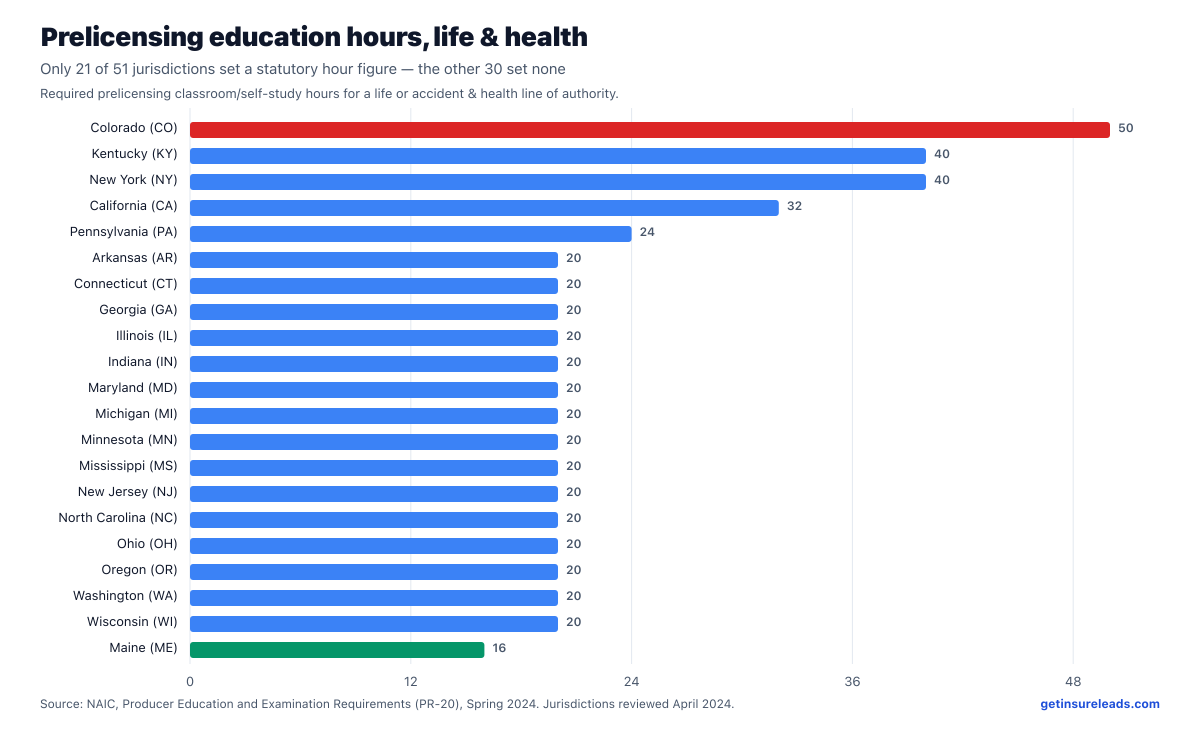
Less than the course vendors imply, and it varies enormously. The figures below come from this site's 51-jurisdiction licensing dataset, compiled from NAIC's PR-20 producer education and examination chart for the life and accident-and-health lines:
- 30 of 51 jurisdictions carry no statutory prelicensing hour figure at all for the life and accident-and-health lines. Passing the exam is the requirement.
- Where hours are mandated, they run from 16 to 50 for those lines.
- Continuing education runs from 10 to 48 hours per compliance period. South Dakota (10), New York (15), and Missouri (16) sit at the low end; Arizona (48), Massachusetts (45), and Iowa (36) at the high end.
- 45 of 51 jurisdictions carve out a specific ethics-hours requirement inside that CE total.
- Several jurisdictions exempt non-resident producers from prelicensing, from CE, or from both — the reason a multi-state footprint is cheaper to maintain than it looks.
Two things follow. First, prelicensing hours are a poor reason to choose a license — in most jurisdictions the exam is the gate and seat time is not mandated at all. Second, continuing education is the recurring cost, and it varies by a factor of nearly five between jurisdictions, which matters if you intend to carry non-resident licenses in a dozen states.
This page deliberately carries no state table. The state-by-state requirements, reciprocity, non-resident rules, and CE deadlines live in the state licensing reference. NAIC's own caution applies to any summary of this kind, including ours: the chart "does not constitute a formal legal opinion" and the statutes and regulations cited should be consulted for anything you are relying on.
Which certifications does your license not cover?
Two market-entry certifications sit on top of the accident and health line, and neither arrives with your license. Both are annual, both are separate from your CE hours, and missing either one closes a market for a full plan year.
AHIP certification is the private one. It is a paid course and exam — AHIP's "Medicare + Fraud, Waste, and Abuse (MFWA) Online Course" — whose final exam runs 50 questions at a 90% passing grade and resets each plan year. It exists because CMS requires annual training and testing of the agents who sell Medicare Advantage and Part D, and carriers need evidence you did it. The exam rules, the cost, and what CMS does and does not actually require are worth reading before you pay, because the 90% bar surprises people.
FFM certification is the federal one, and it is not a certificate in any normal sense. CMS states that agents and brokers "are required to complete Marketplace registration and training each year" — an Enterprise Portal account, remote identity proofing, an MLMS profile, the training, and accepting the Marketplace Agreements — before they may assist a consumer with an ACA enrollment. The registration sequence and the plan-year cycle run on their own calendar, tied to the enrollment window rather than to your license renewal.
There is a third layer nobody warns new agents about: carrier product training and appointment. Every carrier you intend to write requires its own product certification, and for most independents the contract that makes those available runs through an intermediary. What an IMO is and where it sits in the distribution chain is the piece of vocabulary that makes the rest of the process legible.
What training does not fix
A license plus certifications makes you legal. It does not make you paid, and the gap between those two states is where most first-year agents quit. The site's analysis puts median time to first sale at 12–21 days for a new agent working exclusive web leads, 4–8 days for a trained agent on live transfers, and 21–45 days for an agent working aged records only — described plainly as the cheapest path, the hardest conversion, and the one with high attrition.
The certification layer also has a real time cost that agents underestimate. In the producer interviews behind that analysis, 51% named time spent on licensing, E&O, and AHIP or carrier certifications as an operational pain point, ranking it behind only lead-quality inconsistency (72%) and rising cost per lead against commissions (64%). Budget the weeks, not just the fees.
Two things are actually affordable in the month you get licensed. One is a free single-user CRM, because the discipline that converts anything is callbacks on time and a dialing habit, and a spreadsheet loses that by week three. The other is cheap at-bats: aged records priced for practice volume — final expense at $3 for 30–90-day-old data against $50 for a real-time exclusive lead. Be clear about the trade you are making. Aged data closes at roughly 2–5%, so what you are buying is reps, not conversion. Spend on premium formats after your script survives a hundred conversations, not before.
Frequently asked questions
Can I buy insurance leads before my license comes through?
You can buy them; you cannot work them. NAIC's Producer Licensing Model Act frames licensure around the acts of selling, soliciting, and negotiating insurance, which is most of what a lead conversation is. Leads bought before your license issues age while you wait, and aged data converts worse. Time the purchase to the license, not to the exam date.
Should a new agent get a life-only license or life and health?
Life-only if you intend to sell final expense, term, or IUL and want to start fastest. Life and health if seniors are your market, because Medicare and the ACA Marketplace both require a health line — CMS blocks Marketplace system access entirely without an approved health-related line of authority. Most agents selling to households over 60 end up needing both.
Is AHIP certification part of my state insurance license?
No. AHIP is a private, paid, annual course and exam sold by a trade association, entirely separate from your state license and from your CE hours. CMS requires that Medicare agents annually complete training and pass a test; AHIP sells one course built to meet that requirement, and some carriers run their own instead. Confirm with the carrier before paying.
Do I need a FINRA license to sell annuities?
The variable products line is what pulls FINRA in. Variable annuities and variable universal life are securities, and FINRA's Series 6 requires that you be associated with and sponsored by a FINRA member firm before you may even sit the exam. Whether a specific indexed product is treated as a security is a question for the issuing carrier's compliance desk and your state department of insurance.
How many prelicensing hours do I need?
In 30 of 51 U.S. jurisdictions, no statutory prelicensing hour figure exists for the life and accident-and-health lines — the exam is the gate. Where hours are mandated they run from 16 to 50. Continuing education afterwards ranges from 10 to 48 hours per compliance period, with 45 jurisdictions requiring specific ethics hours inside that total.
Does a license in my home state let me sell in others?
Not automatically, but the framework is built for it. NAIC's Producer Licensing Model Act created a reciprocity system for producer licensing, and several jurisdictions exempt non-resident producers from prelicensing, CE, or both. The mechanics are state-specific and change; the state-by-state reference covers non-resident and reciprocity rules in detail.
Does InsureLeads sell licensing courses or exam prep?
No. We sell insurance leads and a CRM to licensed agents, and we take no referral, sponsorship, or affiliate money from any course provider, certification body, or IMO. That is the reason this page can tell you to skip the securities add-on and to spend nothing on premium lead formats in month one.
Sources
- https://content.naic.org/sites/default/files/inline-files/Chapter%202.pdf — NAIC State Licensing Handbook, Chapter 2: the Producer Licensing Model Act (#218) uniformity provisions, including the verbatim list of the six major lines of insurance (Life, Accident and Health, Property, Casualty, Personal Lines, Variable Life or Annuity Products) and the reciprocity system for producer licensing.
- https://www.finra.org/registration-exams-ce/qualification-exams/series6 — Series 6 scope (mutual funds, variable annuities, variable life insurance, UITs, municipal fund securities), 50 questions, passing score of 70, 1 hour 30 minutes, SIE corequisite, and the requirement that candidates be associated with and sponsored by a FINRA member firm.
- https://www.cms.gov/medicare/health-drug-plans/managed-care-marketing/medicare-marketing-guidelines/agent-broker-compensation — CMS verbatim requirement that agents/brokers be state-licensed, annually complete training and pass a test on Medicare and health and prescription drug plans, and follow Medicare marketing rules; plus the first-year payment / half-as-much-for-years-two-and-beyond compensation structure.
- https://www.cms.gov/marketplace/agents-brokers/registration-training — CMS statement that agents and brokers without an approved health-related Line of Authority do not have access to Marketplace systems and may not assist consumers with Marketplace enrollment.
- https://www.ahipmedicaretraining.com/ — AHIP's course name (Medicare + Fraud, Waste, and Abuse (MFWA) Online Course), that it is updated annually and currently offered for plan year 2027.
- https://www.ahipmedicaretraining.com/pluginfile.php/1312/block_html/content/Medicare%20FAQs.pdf — AHIP final exam: fifty (50) randomly selected questions from all five modules and a ninety percent (90%) passing grade.