
Insurance Lead Cost Calculator
Estimate your monthly lead investment and compare costs across verticals, formats, and volumes. See exactly what you will spend before you buy.
Planning bands, not our results. Any contact-, show-, close- or conversion-rate range on this page is a published planning band — an industry-typical range we publish so you can model a budget before you buy. These are not measured InsureLeads client outcomes: we hold no audited buyer-outcome dataset and publish no client outcome data. How we model lead performance.
How much do insurance leads cost?
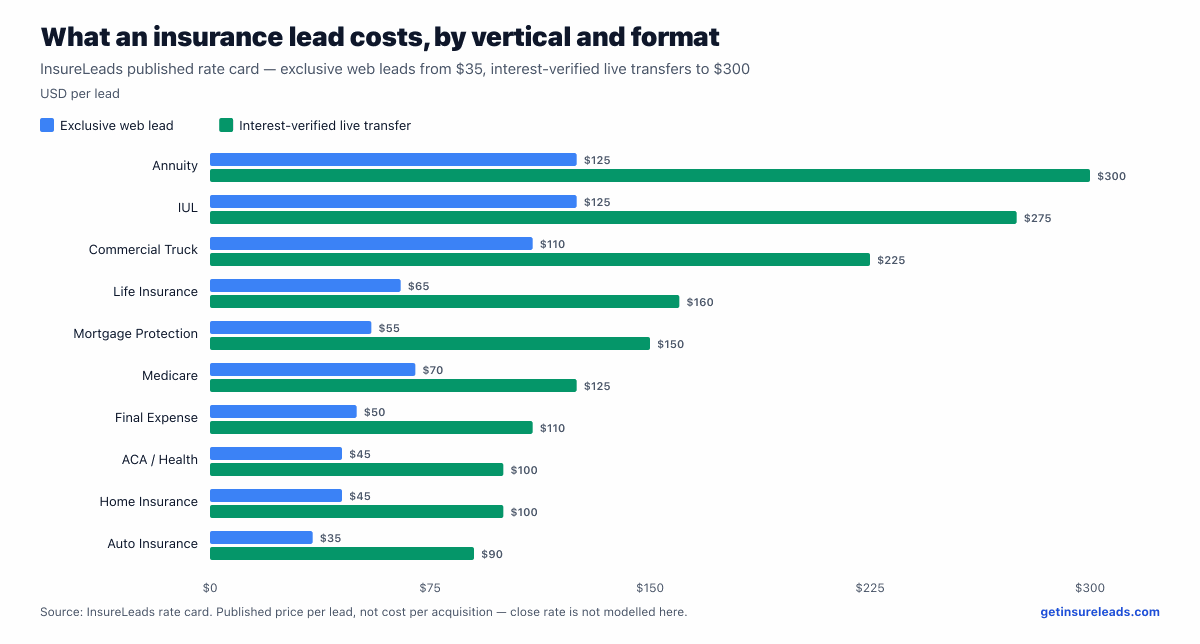
Insurance lead costs range from $0.25 to $300 per lead depending on vertical, format, and exclusivity. Aged leads start at $2–$12, exclusive web leads cost $35–$125, and interest-verified live transfers run $90–$300. Use the calculator below to estimate your exact monthly spend.
- Interest-verified live transfers: $90–$300 per connected call (highest close rate)
- Exclusive web leads: $35–$125 per lead (best balance)
- Aged leads: $2–$12 per lead at 30–90 days (budget-friendly option)
Your Final Expense Lead Cost Estimate
Exclusive Web Leads · 100 leads/month · Mid-range pricing
How Much Do Insurance Leads Cost in 2026?
Insurance lead pricing depends on three key factors: the insurance vertical (final expense, Medicare, ACA, life, auto, home, IUL, or commercial truck), the delivery format (live transfers, exclusive web leads, or aged leads), and your monthly volume. Higher-commission verticals like IUL command premium lead prices, while commoditized lines like auto insurance offer lower per-lead costs.
Interest-verified live transfer leads are the most expensive format, ranging from $90 for auto insurance to $300 for annuity. You pay more because a screener has already confirmed the prospect’s interest, age and state before transferring the call to you. The trade-off is worth it on the planning bands — 15–30% for live transfers against 5–15% for web leads.
Exclusive web leads offer a middle ground at $35–$125 per lead. These are form-fill leads delivered to a single agent in real time. The contact-rate planning band is 60–80% when you respond within 5 minutes, and the close-rate band 5–15%, depending on vertical and follow-up process.
Aged leads are the budget option at $2–$12 per lead in the 30–90 day band, down to $0.25 for records over a year old. While the contact-rate band drops to 20–40%, the low cost means your breakeven close rate can be under 2%. Agents with autodialers and strong drip sequences can generate significant ROI from aged leads.
Use the calculator above to model your specific scenario. Enter your vertical, preferred format, and monthly volume to see your projected total spend, cost per acquisition, and estimated ROI — before you commit a single dollar.
How Much Can You Afford to Pay Per Lead?
The cost question most agents ask is the wrong way round. What matters is not what a lead costs, but the maximum cost per lead you can afford before the campaign stops paying for itself. That number is your close rate multiplied by your average commission — and it is the one the calculator above now reports directly.
Suppose you close 10% of the leads you buy, and a closed policy pays you $600. Ten percent of $600 is $60, so $60 is your break-even lead price. Pay less and the campaign is profitable. Pay more and buying more leads only loses money faster.
Volume does not change the answer. This is the part agents most often get wrong when negotiating. Doubling your order doubles the revenue and the spend together, so the break-even price per lead is identical at 50 leads a month and at 500. Bulk pricing can lower what you pay, but it cannot raise what you can afford.
Two things do move it. The first is close rate, which is why a live transfer at the top of the $90–$300 band can be a better buy than an aged lead at $2–$12 — a higher close rate lifts the ceiling on what the lead is worth to you. The second is chargebacks. If you take advanced commission, every policy that lapses before it earns out claws back the unearned part of the advance, which lowers your true revenue per lead and therefore lowers the maximum price you can genuinely pay. An agent with weak persistency can afford materially less per lead than the headline arithmetic suggests, even at the same close rate.
Run your own numbers above, then compare the result against the current rate card. If the maximum you can afford sits below our price for a format, that format is the wrong one for your operation — and we would rather tell you that than sell you leads you cannot work profitably.
What Changes the Price of a Lead?
Four things move an insurance lead's price, and only one of them is the vertical. Knowing which lever you are pulling is what separates negotiating from guessing.
- Exclusivity. A lead sold once costs more than the same record sold to three or five agents. Every shared copy divides the prospect's attention and compresses your window to be first.
- Freshness. The same record costs $3 in the 30–90 day band and $0.25 once it passes a year. Nothing about the person changed — only the probability that someone already sold them.
- Verification depth. A form fill, a contact-verified record and a transferred live call are three different products. Each step adds screening labour before the record reaches you, and the price carries that labour.
- Commission ceiling. Annuity and IUL leads cost more than auto leads because the policy behind them pays more. Lead pricing tracks the size of the sale, not the difficulty of generating the enquiry.
The verification lever is the one agents most often misread. A live transfer is not simply “a better lead” — it is a different price tier, and the size of that step varies sharply by vertical:
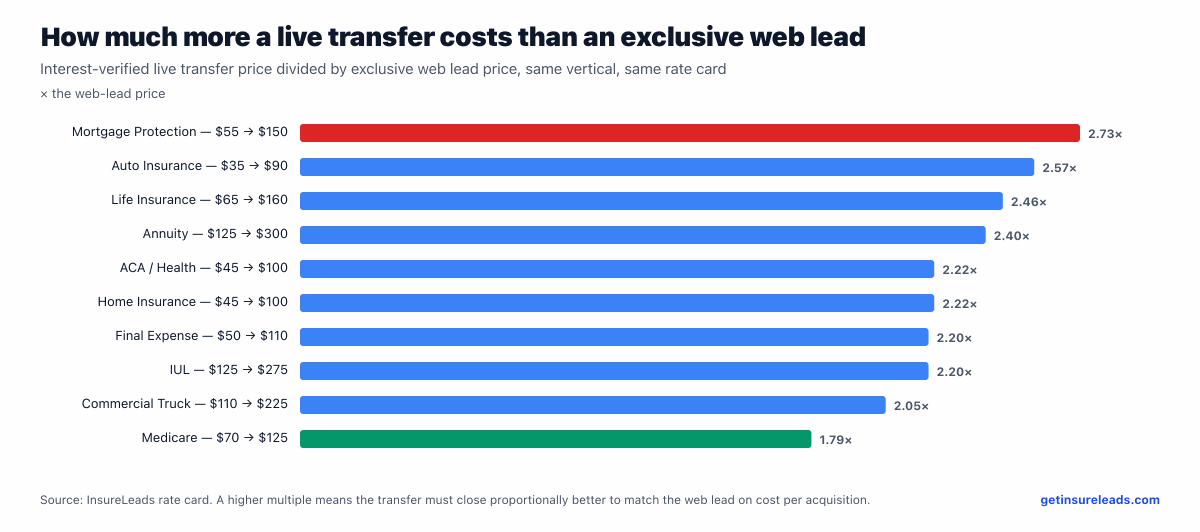
A transfer costs between 1.79× and 2.73× the web-lead price depending on the vertical, which means the close-rate improvement it has to deliver is also different by vertical. In Medicare a transfer has to close roughly 1.79 times better than a web lead to match it on cost per acquisition. In mortgage protection it has to close 2.73 times better. Same product decision, materially different bar.
How Chargebacks Change What You Can Afford
Chargebacks are the cost most lead maths leaves out, and they attack the affordability number directly. If you take advanced commission, a policy that lapses before it earns out claws back the unearned portion of the advance — so the revenue you used to justify the lead price was never fully yours.
The arithmetic is simple enough to do on paper. Take the share of policies that lapse, multiply by the advance per policy, then multiply by the fraction of the advance that was never earned. A book where 20% of policies lapse at month 3 of a 9-month advance claws back two thirds of the advance on each of those policies. At a 75% advance on a $600 commission, that is $300 returned per lapse — and across 10 sales, $600 gone from a figure that looked like profit.
Run that back through the affordability formula and the ceiling drops. The same close rate and the same commission now support a lower lead price, because revenue per lead fell without the lead price changing. Two agents with identical close rates can afford materially different amounts per lead purely on persistency.
Note on the calculator above: it reports pre-chargeback figures. To model the drag, use the ROI calculator on any vertical lead page, which exposes persistency, advance percentage, advance period and average month of lapse as inputs. If you sell as-earned rather than advanced, chargeback exposure is zero and the headline number already applies to you.
Which Lead Format Fits Your Operation?
Price is only half the decision. The right format depends on capacity you already have or do not have — dialer throughput, follow-up discipline, licensing footprint and cash flow. An agent who cannot work 400 aged records a week does not save money by buying them.
| If this describes you | Format that fits | Price band | Why |
|---|---|---|---|
| Limited hours, no dialer, want conversations not dials | Interest-verified live transfers | $90–$300 | Screening labour happens before the call reaches you, so your time goes to selling rather than dialling. |
| Consistent daily call block, respond within minutes | Exclusive web leads | $35–$125 | Single-buyer records reward speed. The advantage disappears if the record sits for hours. |
| Autodialer, drip sequences, tolerance for volume | Aged leads | $2–$12 | Low contact rates are survivable when the price is low enough that break-even sits under a couple of percent. |
| Testing a new vertical or state before committing | Aged leads first, then exclusive | from $0.25 | Aged carries no minimum spend, so it is the cheapest way to find out whether you can sell the vertical at all. |
The cash-flow dimension is the one most often ignored. Live transfers and exclusive campaigns concentrate spend into a smaller number of higher-value records, so a bad fortnight costs more. Aged leads spread the same budget across many more records, which lowers the variance of any single week at the cost of a lower contact rate. Neither is safer in the abstract — they fail differently, and which failure you can absorb depends on your reserve.
If you are unsure, the honest sequence is to price the format against the ceiling you calculated above, then read how orders are built and delivered before committing to a campaign.
InsureLeads Lead Pricing by Vertical
| Vertical | Live Transfers interest-verified | Exclusive Web Leads | Aged Leads 30–90 days | Avg Commission |
|---|---|---|---|---|
| Final Expense | $110 | $50 | $3 | $450 |
| Medicare | $125 | $70 | $5 | $600 |
| ACA / Health | $100 | $45 | $3.50 | $400 |
| Life Insurance | $160 | $65 | $4 | $800 |
| Mortgage Protection | $150 | $55 | $5 | $700 |
| Auto Insurance | $90 | $35 | $2 | $350 |
| Home Insurance | $100 | $45 | $2.50 | $400 |
| IUL | $275 | $125 | $12 | $5,000 |
| Commercial Truck | $225 | $110 | $12 | $1,400 |
| Annuity | $300 | $125 | $12 | $4,000 |
Single-buyer exclusive per-lead rates. Prices vary by state, filters and season; county, ZIP and narrow-filter targeting carry a surcharge. Average commission is a market figure, not an InsureLeads price.
Frequently Asked Questions
How much do insurance leads cost?
Insurance lead costs vary by type and vertical. Interest-verified live transfers range from $90–$300 per connected call, exclusive web leads from $35–$125, and aged leads from $2–$12 in the 30–90 day band. Final expense runs $3 aged and $50 exclusive, while annuity live transfers reach $300 due to higher commission potential.
What is the cheapest type of insurance lead?
Aged leads are the most affordable, starting at $2 per lead in the 30–90 day band and falling to $0.25 for records over a year old. These are leads generated days, weeks or months ago and sold at a discount. While contact rates are lower, they offer excellent ROI for agents with strong follow-up systems and autodialers.
Are live transfer leads worth the higher cost?
Yes, for most agents. Interest-verified live transfers cost 2–3x more than exclusive web leads but carry a 15–30% close-rate planning band against 5–15% for web leads. The higher close rate typically delivers a better cost per acquisition despite the higher per-lead price.
How do I calculate my cost per acquisition for insurance leads?
Divide your total lead spend by the number of policies written. For example, if you spend $5,000 on 100 exclusive final expense leads at $50 each and close 10 policies, your CPA is $500. Use our calculator above to model different scenarios based on your actual close rate and lead costs.
Should I buy exclusive or shared insurance leads?
Exclusive leads cost more but convert at 2–3x the rate of shared leads. Shared leads go to 3–5 agents simultaneously, creating competition. For most agents, exclusive leads deliver a lower cost per acquisition despite the higher per-lead price.
What is the maximum I can afford to pay per insurance lead?
Your close rate multiplied by your average commission. If you close 10% of leads and a policy pays $600, the most you can pay is $60 per lead. Above that the campaign loses money on every lead. The figure does not change with volume — buying more leads scales revenue and spend together — so bulk pricing can lower what you pay but never raises what you can afford.
Does buying more leads make them cheaper per acquisition?
No. Volume changes your total spend, not your cost per acquisition, because cost per acquisition is set by your close rate and your price per lead. Doubling an order doubles the deals and the spend in the same proportion. Volume discounts lower the price you pay, which does improve cost per acquisition — but the discount is the cause, not the volume.
How do chargebacks affect what I can pay for leads?
If you take advanced commission, a policy that lapses before it earns out returns the unearned part of the advance, so revenue per lead falls and the maximum affordable lead price falls with it. A book where 20% of policies lapse at month 3 of a 9-month advance gives back two thirds of the advance on each lapse. Agents selling as-earned carry no chargeback exposure and can pay the headline figure.