
What Is an IMO in Insurance? The Distribution Chain, Tier by Tier
The short answer
An IMO, or independent marketing organization, is a distribution layer that holds high-level carrier contracts and re-contracts agents underneath itself, taking an override on everything they write. FMO, NMO and MGA describe the same function at different heights. Federal Medicare rules never define "IMO" at all; they regulate the function as a TPMO.
Before the definitions: who pays for this page
InsureLeads sells insurance leads and a CRM to licensed agents. It does not sell IMO or FMO contracts. It receives no referral fee, override, sponsorship or marketing allowance from any IMO, FMO, NMO or general agency, and it is not recruiting anyone into a downline. Nobody's contract level moves because of anything written below.
That disclosure carries more weight on this page than anywhere else in this section. Search the question this page answers and look at who wrote the existing answers. Measured on 2026-08-10, every one of the seven sources Google's AI Overview cited for it was itself an IMO, an FMO or a brokerage general agency — organisations that earn an override when a reader signs with them. One of them puts a superlative about being the best insurance IMO in the title of its explainer. Another ranks IMOs on its own website. None of that is fraud; it is recruiting copy, and on that question it is nearly the whole corpus.
The conflict of interest here runs the other way, and it is worth stating so you can discount for it: agents who understand the chain tend to buy their own prospects at a published price instead of accepting upline leads at a contract-level discount, and some of those agents buy from us. That is what we get out of explaining this properly. Read the rest with that in view. If you are still deciding between a captive and an independent route, how new agents choose a route to market covers the layer above this one.
What an IMO actually is
IMO stands for independent marketing organization. FMO stands for field marketing organization. In practice the two labels describe the same job — sitting between the insurance carrier and the writing agent, holding the carrier contract, recruiting and contracting agents below it, and taking a share of their commissions — and no regulator defines either term or ranks one above the other. Any firm can call itself either one tomorrow.
What an IMO holds is a distribution contract with one or more carriers, usually at or near the highest commission level that carrier releases into that chain, together with the authority to build sub-hierarchies under it. That is the entire asset. Everything an IMO offers an agent — a contract level, product training, quoting tools, appointment paperwork, sometimes leads — flows from holding that contract and having room underneath it.
The term is absent from the federal rules that govern the largest vertical most new agents enter. Medicare Advantage marketing regulation does not define "IMO" or "FMO". What it defines instead is a third-party marketing organization: 42 CFR 422.2260 describes a TPMO as "organizations and individuals, including independent agents and brokers, who are compensated to perform lead generation, marketing, sales, and enrollment related functions as a part of the chain of enrollment." An IMO writing Medicare business sits inside that definition. So, for the record, does a lead vendor.
At state level the entity is licensed like any other producer. The NAIC describes an insurance producer as "an individual who sells, solicits, or negotiates insurance" and counts "more than 2 million individuals and more than 236,000 business entities licensed to provide insurance services in the United States." An IMO is one of those 236,000 business entities. That is its regulatory standing: a licensed entity, not a rank a regulator confers.
How the distribution chain is stacked
The chain is a compensation ladder, not an organisational chart. Each tier holds a contract with the tier above it and takes an override on the production of the tiers below it. Nothing in that structure is hidden or improper — carriers have always outsourced recruiting, contracting and field support to distributors rather than employing a national sales force. What matters to a new agent is arithmetic: the number of tiers between you and the carrier determines how much of the carrier's published compensation is still available to be offered to you.
Tier names are market vocabulary and are not standardised. The same firm can be an IMO in one carrier's hierarchy and an MGA in another's, and carriers name and number their own hierarchy levels differently. Treat the labels as a rough description of height, never as a credential.
The thing you cannot see from outside is how many tiers sit above the person recruiting you. That number, not the acronym on their website, decides how much spread exists to hand down. It is a fair question to ask in the first conversation, and the answer to it tells you more than any brochure.
| Tier | Also called | What it holds | How it earns | Who it contracts below it | What you trade to sit under it |
|---|---|---|---|---|---|
| Carrier | Home office, issuing company | The policy liability and the authority to appoint producers with the state | Premium | Distribution contracts at the top of each chain | Nothing — every commission dollar originates here |
| IMO / FMO | Independent or field marketing organization | A top-of-chain contract with one or more carriers, usually near the highest level that chain releases | The override between its level and yours, plus carrier bonuses and marketing allowances | NMOs, MGAs, agencies and individual producers | An override on everything you write for as long as it pays, plus a hierarchy you generally cannot change without a release |
| NMO | National marketing organization | A contract beneath an IMO or FMO, or a direct one, depending on the carrier | Override on its own hierarchy | Regional agencies and producers | One further layer of override between you and the carrier |
| MGA / BGA | Managing or brokerage general agency | Carrier contracts plus, at a BGA, a case-placement and underwriting-brokerage function | Override plus brokerage compensation on placed cases | Agencies and producers | Override, in exchange for the most tangible service in the chain if you write hard-to-place cases |
| Agency | Local agency, team, downline agency | A contract under one of the above; sometimes direct carrier contracts once it produces | Override on its producers plus its own production | Writing agents | Usually the largest single slice a new agent pays, bundled with leads, training and management |
| Producer | Writing agent, street-level agent | A state license and a carrier appointment | Commission at its own contract level | Nobody, until it starts building a downline | Nothing left — the ladder bottoms out here |
Do I need an IMO to get appointed with carriers?
Two different things get confused here. A licence comes from a state and authorises you to sell, solicit or negotiate insurance. An appointment comes from a carrier and authorises you to represent that carrier. The carrier files the appointment; your upline does not. South Dakota's Division of Insurance states the requirement plainly for its jurisdiction: "An insurer must appoint a producer or business entity as its agent within fifteen (15) days from the date the agency contract is executed." Deadlines and whether appointments are required at all vary by state, so check yours alongside your state's licensing requirements.
In Medicare the same division is federal. 42 CFR 422.2274(c)(1) requires a Medicare Advantage organization to employ as marketing representatives only individuals licensed by the state to conduct marketing and whom the organization has informed the state it has appointed. The following paragraph, (c)(2), requires the plan to report an agent or broker termination to the state, and the reason for it, as applicable state law requires. Neither provision mentions an IMO. The carrier appoints you and the carrier un-appoints you.
So the honest answer is: no, an IMO is not legally required, and in practice most brand-new producers still reach carriers through one. Carriers rarely open a direct contract to an agent with no production history — a commercial preference, not a rule written anywhere — so the hierarchy is the normal on-ramp. But "I need an upline" and "I need this upline" are different sentences, and only the first one is true. The mechanics of getting contracted, in order, sit on the appointment process step by step.
One consequence deserves its own sentence, because it is the single hardest thing on this page to undo. Your hierarchy is fixed at the moment the carrier processes your contract. Changing it later usually requires a release from the upline you signed with, or waiting out that carrier's no-production period. Decide before you submit paperwork, not after.
The vocabulary an upline will use without explaining it
Recruiting conversations run on a dozen words that nobody defines for a new agent, because being the only person in the room who knows what they mean is an advantage. Here they are, plainly. In our 2026 compensation analysis, 51% of the producers interviewed named time spent on licensing, E&O and carrier certifications among their operational pain points — the paperwork layer is exactly where an agent gets hurried past language they were never taught.
Actual percentages and dollar figures belong elsewhere: how commission levels and contract percentages actually work carries the rate mechanics, and this page deliberately carries none of them. What you need here is the meaning of the words, so a quoted number can be understood when you see one.
- Street level — the baseline commission level a carrier releases to an independent producer, the reference point every other level is quoted against. "Street" is market shorthand, not a carrier-defined constant; two uplines can quote different numbers as street.
- Contract level — the level your commissions are actually paid at. This is the thing being negotiated when you are told you are getting a good deal.
- Override — the difference between your contract level and your upline's, paid to the upline on your production, for as long as the policy pays. You are not invoiced for it and it will never appear as a line item.
- Upline / hierarchy — the chain of contracts between you and the carrier. Set when the carrier processes your contract, not when you sign the recruiting agreement.
- Vesting — whether renewal and residual income stays yours if you stop writing or leave. Ask whether it is immediate, graded over years, or conditional on remaining contracted, and read it in the document rather than hearing it.
- Release — written permission from your upline to re-contract with the same carrier under a different hierarchy. Without one, moving that carrier's business generally means sitting out a no-production period defined by the carrier, not by your upline. Ask both parties what that period is.
- Advance versus as-earned — an advance pays you a percentage of expected first-year commission up front and is a loan against premium not yet received. As-earned pays you as the premium arrives. Advances feel like income and behave like debt.
- Chargeback — the reversal of an advance when a policy lapses, cancels or is rescinded inside the advance window. On any product where early lapse is common, this is the dominant risk to a new agent's cash flow.
- Debit balance — the negative balance chargebacks create, carried against your future commissions. Ask whether the carrier reports unpaid debit balances to a database other carriers check before contracting an agent; the answer determines how long one bad month follows you.
- Persistency — the share of your policies still in force after a set period. It drives bonuses, contract-level increases, and whether a carrier keeps you at all. Uplines talk about production; carriers are ultimately paying for persistency.
What to ask an IMO before you sign
Teaching the questions is defensible where ranking the firms is not. Every item below has a right answer for you specifically, and every one of them is answerable in writing by a firm that intends to treat you well. Ask for the answers in the contract or in an email, not in a call.
A firm that answers all nine in writing has told you more about itself than any comparison table could.
- Is the carrier contract held in my name, or assigned to you? Assignment of commissions changes who the carrier pays and who controls the relationship.
- What is your release policy? Granted on request, granted at your discretion, or not granted? Get the standing policy, not a reassurance about how it has never come up.
- Is my vesting immediate, graded, or conditional on staying contracted with you?
- What happens to my in-force renewals if I leave — do they follow me, stay with the hierarchy, or stop?
- How many tiers are above you in each carrier's hierarchy? This determines how much spread exists to offer me.
- Am I required to write exclusively through you, and on which carriers?
- If you provide leads, how are they paid for — a lower contract level, an advance against production, a fee, or a condition on staying? Name the mechanism.
- Who owns the lead data, the CRM records and the consent records if I leave?
- Am I on advance or as-earned, at what percentage, and how are chargebacks and any resulting debit balance handled?
Why this page will not tell you the best IMO
"Who is the best IMO?" is one of the questions Google surfaces above every organic result for this topic, and it does not have an answerable form. The variables that decide whether a given IMO is good for a given agent — your contract level, your release terms, your vesting schedule, how many tiers sit above your recruiter — are negotiated agent by agent and published nowhere. There is no public dataset of contract levels by firm, no regulator-published release-rate figure, and no audited persistency-by-hierarchy table. A ranking built on none of those is either recruiting copy or an untested opinion.
The opacity is itself a measured complaint. In our 2026 compensation analysis, 31% of the producers interviewed cited FMO/IMO override opacity as an operational pain point — they could not see what their hierarchy was taking. That is the problem a ranking cannot fix and a written answer to question 5 above can.
We could publish a ranked list. It would rank well, and it would be the same act every incumbent on this SERP is performing, with a different product sitting behind it. Instead, use the nine questions, get the answers in writing, and compare the answers. Two firms with identical marketing will diverge sharply on question 2 and question 4.
What the override costs you, and the part you can control
The override is not a fee. It is a discount on your own income, applied before you ever see a number, which is why agents accept it without pricing it. Over a career the cumulative effect is larger than any single decision about lead spend — but lead spend is the part you can change this month, and the two are connected on purpose. When an upline supplies leads, it is buying your acceptance of a lower contract level with something that feels free at the point of use.
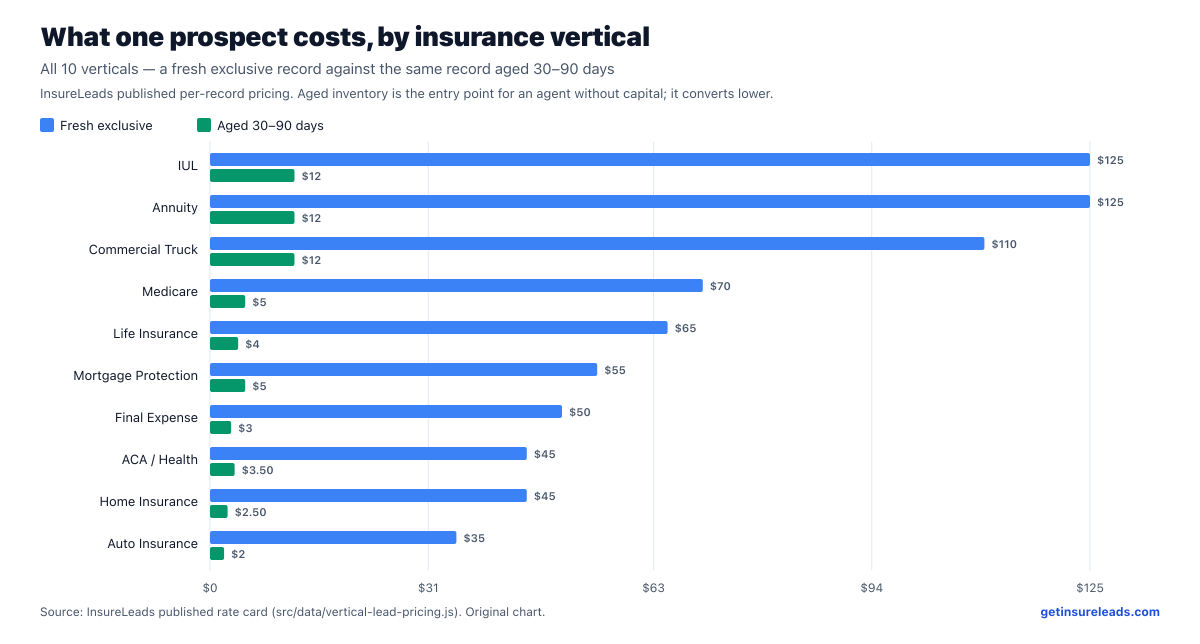
So price the alternative. Buying your own prospects at a published per-record price makes the trade visible: aged final expense records 30 to 90 days old run $3 each and aged Medicare records in the same age band run $5, which is why aged records priced per lead are the only inventory a genuinely new agent should be buying. They convert far worse than fresh exclusive leads and you should expect that. What they buy is at-bats you own, at a cost you can put in a spreadsheet — run the cost-per-acquisition math yourself before you accept anyone's free-lead programme.
Ownership of the data matters for the same reason a release matters. If your prospects, dispositions and consent records live in your upline's system, then a hierarchy dispute becomes a data dispute, and you will lose it. Keeping your book in a free single-user CRM you control costs nothing and removes one lever from the negotiation.
There is a directional signal in our own analysis worth knowing before you accept an inherited book as compensation for a lower contract level. Estimated median income for agents working primarily an orphan or inherited book came in at $71,000, against $118,000 for agents working referrals and a repeat book, and the analysis notes orphan arrangements are often tied to captive or IMO structures that cap out earlier. These are modelled estimates from public sources, our operational data and producer interviews rather than a controlled survey — treat them as direction, not a forecast of your year.
Frequently asked questions
Is an IMO the same as an FMO?
For most practical purposes, yes. IMO stands for independent marketing organization and FMO for field marketing organization, and no state or federal regulator defines either term or places one above the other. Treat both as "a distribution layer between you and the carrier", then ask how many layers sit above it — that answer is meaningful, the acronym is not.
Do I need an IMO to sell insurance?
No. You need a state licence and a carrier appointment. 42 CFR 422.2274(c)(1) requires a Medicare Advantage organization to use only marketing representatives licensed by the state and whom it has informed the state it has appointed; it says nothing about IMOs. Most new agents still go through a hierarchy because carriers rarely open direct contracts to producers with no production history, which is a commercial preference rather than a legal requirement.
What does an IMO cost me?
Nothing you will ever be invoiced for. An IMO is paid the override, which is the spread between its contract level and yours, taken from commissions before you see them. It functions as a permanent discount on your income rather than a bill, which is precisely why it is easy to agree to without pricing it.
What is a release, and why does everyone warn me about it?
A release is written permission from your upline to re-contract with the same carrier under a different hierarchy. Without one, moving that carrier's business generally means waiting out a no-production period set by the carrier. Ask for the standing release policy before you submit contracting paperwork, because your hierarchy is fixed the moment the carrier processes it.
Will I keep my renewals if I leave my IMO?
That depends on the vesting language in your carrier contracts and the assignment terms in your agreement with the IMO, not on anything said verbally during recruiting. Ask whether vesting is immediate, graded over a number of years, or conditional on remaining contracted, and read the answer in the document.
Who is the best IMO?
We do not publish an answer, and we would ask what any publisher of one earns from it. The variables that decide whether an IMO suits you — contract level, release policy, vesting, how many tiers sit above your recruiter — are negotiated individually and disclosed publicly by nobody, so no ranking measures them. Compare written answers to the nine questions on this page instead.
Is an IMO regulated?
The entity is: it holds a business-entity producer licence, one of the more than 236,000 business entities the NAIC counts as licensed to provide insurance services in the United States. The tier itself is not — "IMO" is market vocabulary, not a regulatory rank. In Medicare, the regulated category is the third-party marketing organization defined at 42 CFR 422.2260, and an IMO writing Medicare business falls inside it.
Sources
- https://www.law.cornell.edu/cfr/text/42/422.2260 — Verbatim federal definition of a third-party marketing organization (TPMO) — "organizations and individuals, including independent agents and brokers, who are compensated to perform lead generation, marketing, sales, and enrollment related functions as a part of the chain of enrollment" — used to show that federal Medicare marketing rules define TPMO and never define "IMO". Fetched via Cornell LII because ecfr.gov returned a 302 to unblock.federalregister.gov and govinfo's CFR PDF was not machine-readable.
- https://www.law.cornell.edu/cfr/text/42/422.2274 — 42 CFR 422.2274(c)(1): an MA organization may employ as marketing representatives only individuals licensed by the state to conduct marketing and whom it has informed the state it has appointed; (c)(2): the plan reports an agent or broker termination, and the reason, to the state as applicable state law requires. Supports the claim that the carrier — not the IMO — appoints and un-appoints the agent.
- https://content.naic.org/insurance-topics/producer-licensing — NAIC definition of an insurance producer ("an individual who sells, solicits, or negotiates insurance") and the counts "more than 2 million individuals and more than 236,000 business entities licensed to provide insurance services in the United States" — used to establish that an IMO's regulatory standing is a business-entity producer licence, not a conferred rank.
- https://dlr.sd.gov/insurance/producers/appointments_terminations.aspx — South Dakota Division of Insurance, verbatim: "An insurer must appoint a producer or business entity as its agent within fifteen (15) days from the date the agency contract is executed." Used as a state-regulator primary source that the insurer files the appointment; presented as South Dakota's rule with an explicit note that requirements vary by state.