
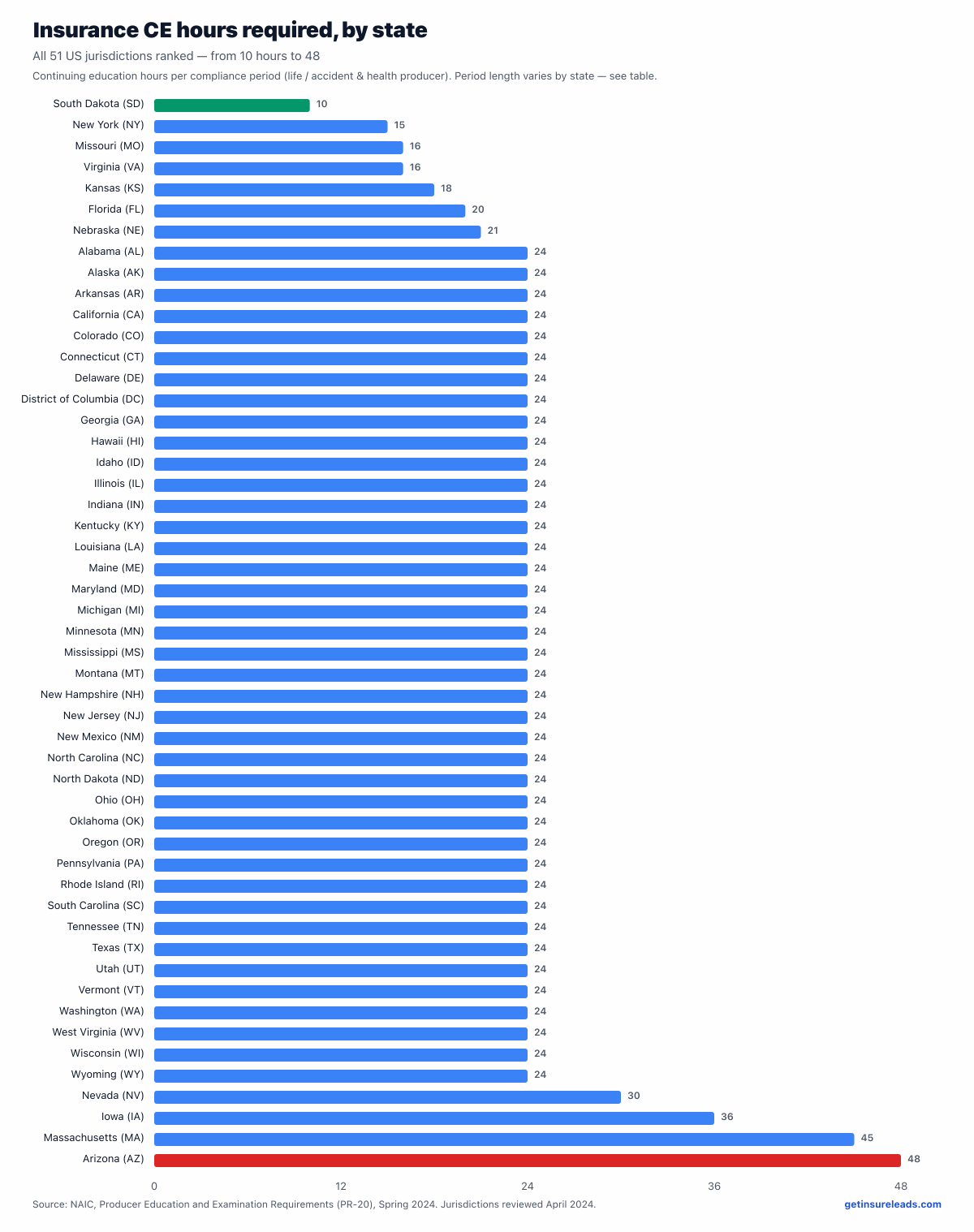
Insurance producer licensing is set by each state, not federally, and the requirements differ more than most agents expect. Across the 51 US jurisdictions, 30 set no statutory prelicensing education requirement at all, while the 21 that do range from 16 hours to 50. Continuing education runs from 10 hours to 48 per compliance period.
What every state requires
Every US jurisdiction builds a producer licence from the same four parts: prelicensing education, a state examination, an application with a background check, and continuing education to keep the licence active. The parts are universal. The amounts are not, and that is where agents planning a multi-state footprint lose time.
Three findings from the 51-jurisdiction dataset below are worth stating plainly, because they contradict the way licensing is usually described. If you have not yet chosen a line of authority, which licence unlocks which book of business is the decision that comes before any of these hour counts:
- 30 of 51 jurisdictions set no statutory prelicensing hour requirement. A majority of states require no classroom hours before the exam — the course most new agents buy is exam preparation, not a legal prerequisite. Nevada repealed its requirement outright.
- Prelicensing hours and CE hours are inversely related in several states. New York requires 40 prelicensing hours and only 15 CE hours per biennium. Massachusetts requires no prelicensing education at all, then 45 hours every three years after a 60-hour first cycle.
- The compliance period is not always two years. Most states run a biennium, but 4 run annually and 3 run on a three-year cycle — which changes the real annual burden even when the headline number looks identical.
Prelicensing hours by state
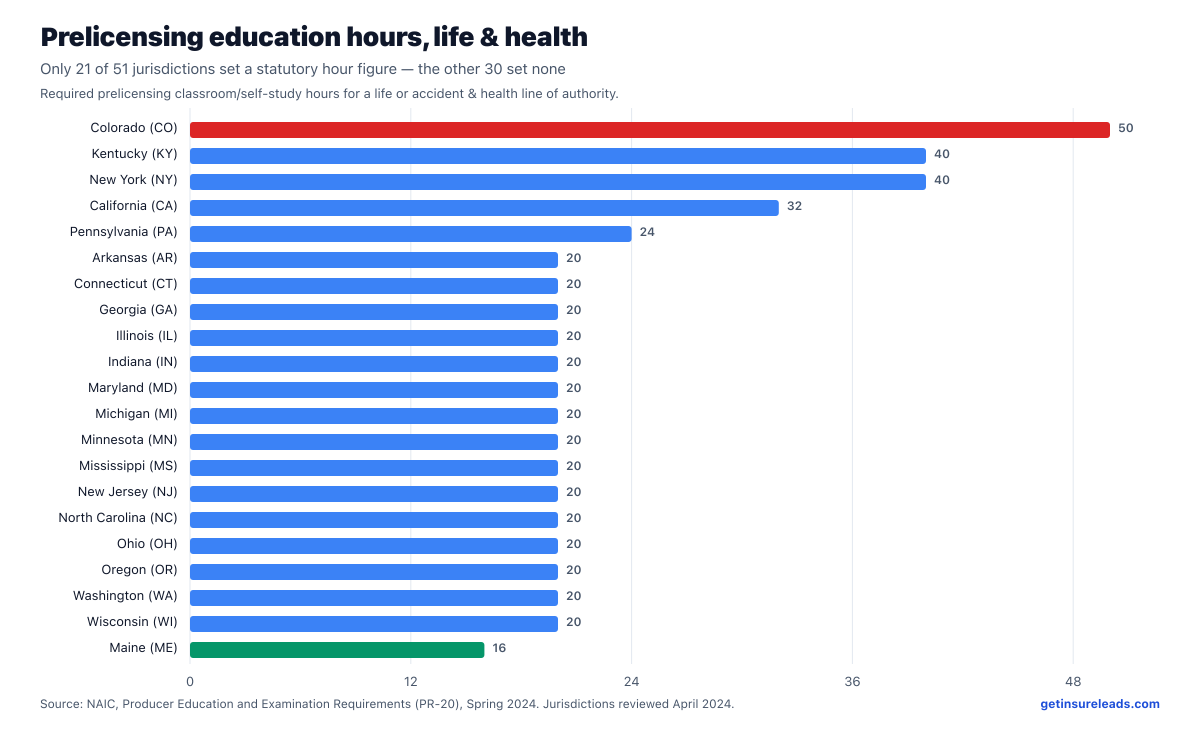
Colorado sets the heaviest prelicensing requirement for a life and accident/health line of authority at 50 hours, and requires 3 of those hours in ethics plus 4 on insurance law. Maine sets the lightest at 16 hours, and uniquely allows six months of documented full-time insurance experience to substitute for the coursework entirely.
| State | Hours | What the statute requires |
|---|---|---|
| Colorado | 50 | 50 hours for life and accident/health, including 3 hours ethics and 4 hours on insurance laws and regulations |
| Kentucky | 40 | 40 hours for life and health, or 20 hours for each line of authority where applicable |
| New York | 40 | 40 hours for life/health (90 hours for property/casualty) |
| California | 32 | 20 hours life/health, plus 12 hours ethics and insurance code study |
| Pennsylvania | 24 | 24 hours; CLU, CPCU and CIC are exempt |
| Arkansas | 20 | 20 hours of classroom or electronic instruction |
| Connecticut | 20 | 20 hours for each line of insurance, or equivalent experience/training as determined by the commissioner |
| Georgia | 20 | 20 hours per line of authority |
| Illinois | 20 | 20 hours for life and 20 hours for accident and health; 7.5 hours of each prelicensing course must be completed in a classroom or webinar setting |
| Indiana | 20 | 20 hours for life or health individually; 40 hours for a combined life and health licence |
| Maryland | 20 | 20 prelicensing course hours, or one year of experience |
| Michigan | 20 | 20 hours per line; 40 hours for life/health or property/casualty |
| Minnesota | 20 | 20 hours per line; exempt with an insurance degree or certain professional designations |
| Mississippi | 20 | 20 hours per line of authority |
| New Jersey | 20 | 20 hours life or health; 40 hours for a life/health combination |
| North Carolina | 20 | 20 hours life/health or property/casualty; 20 hours health; 10 hours long-term care or Medicare supplement |
| Ohio | 20 | 20 hours of insurance study for all licensees; may include classroom, online and self-study; waived for an insurance degree |
| Oregon | 20 | 20 hours; CPCU, CLU, limited class and title are exempt |
| Washington | 20 | 20 hours per line for personal, life, disability and property/casualty; the course must include Washington laws and rules relevant to the line |
| Wisconsin | 20 | 20 hours; exempt with a 2-year vocational insurance degree or a 4-year business degree with an insurance emphasis |
| Maine | 16 | 16 credit hours of prelicensing education, or a certificate showing at least 6 months of relevant full-time equivalent experience with an insurer or producer |
Continuing education by state
Continuing education is the requirement that follows an agent for the rest of their career, and it varies by nearly a factor of five. South Dakota requires 10 hours per biennium for a single line. Arizona requires 48, with 6 of those hours in ethics. Georgia requires 24 hours every year for producers licensed under 20 years, which is the heaviest sustained load in the country once you annualise it.
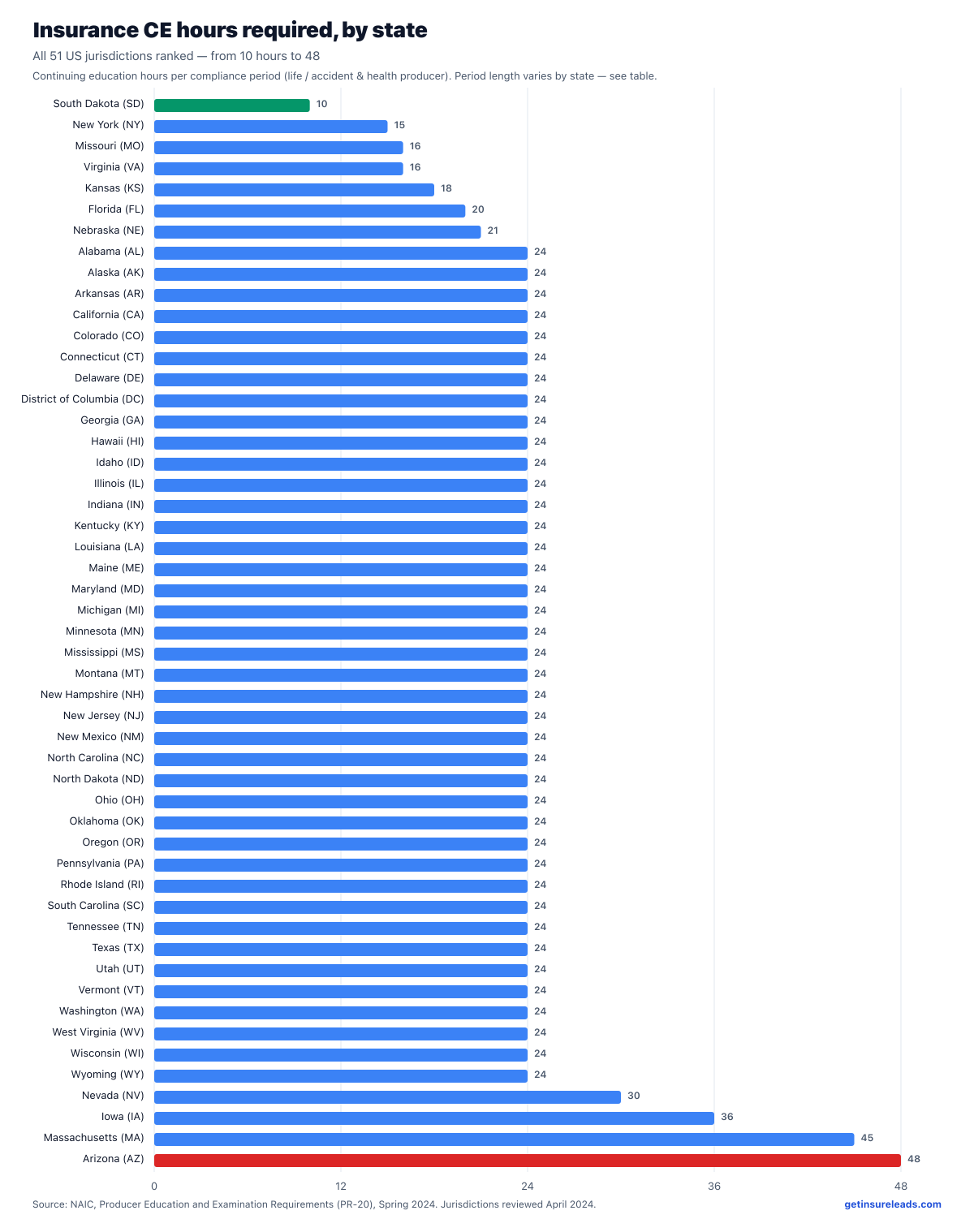
The five lightest and five heaviest:
| Jurisdiction | CE hours | Per | Note |
|---|---|---|---|
| South Dakota | 10 | biennium | The lowest single-line CE requirement in the country at 10 hours per biennium. Licensees over 65 with at least 10 years licensed are exempt. |
| New York | 15 | biennium | Inverts the usual trade-off: among the heaviest prelicensing requirements at 40 hours, and the lightest biennial CE at 15. |
| Missouri | 16 | compliance period stated in regulation | The lowest CE hour figure of any jurisdiction in the chart. Waivers available for serious illness, active military duty, overseas producers, or age over 70. |
| Virginia | 16 | biennium | Caps insurer- or agency-sponsored courses at 75% of required credits — a restriction on who may supply CE that few states impose. |
| Kansas | 18 | biennium | One of the lightest biennial CE loads in the country at 18 hours, and it accepts regulatory compliance in place of ethics. |
| Wyoming | 24 | biennium | Specifies classroom hours, and the CE requirement does not apply to nonresident producers. |
| Nevada | 30 | 3 years | Explicitly repealed its prelicensing requirement. CE reciprocity does not extend to nonresidents. |
| Iowa | 36 | 3-year term | One of only three jurisdictions on a three-year cycle. Nonresident reciprocity applies only if the agent’s home state has a CE law in force. |
| Massachusetts | 45 | 3 years | The heaviest first-cycle CE load in the country — 60 hours before a new producer’s first renewal, despite requiring no prelicensing education at all. |
| Arizona | 48 | compliance period stated in statute | Carries the highest CE hour figure in the NAIC chart, and requires double the usual ethics component. |
45 of 51 jurisdictions carve out a specific ethics component inside the total. New Hampshire is the only one that sets both a floor and a ceiling on it — at least 3 hours, no more than 10.
The full 51-jurisdiction table
Every jurisdiction, with the statutory rule that distinguishes it. The final column exists because the hour count alone is misleading: two states requiring 24 hours can impose very different obligations once carryover, classroom minimums, and tenure exemptions are applied.
| Jurisdiction | Prelicensing | CE hours | Per | Ethics | The rule that makes it different |
|---|---|---|---|---|---|
| Alabama | None set | 24 hrs | biennium | 3 hrs | Newly licensed producers are exempt from CE for 12 months following their license effective date. |
| Alaska | None set | 24 hrs | 2-year period | 3 hrs | Up to 8 hours may be carried over to the next license period. Exam scores are valid for one year only. |
| Arizona | None set | 48 hrs | compliance period stated in statute | 6 hrs | Carries the highest CE hour figure in the NAIC chart, and requires double the usual ethics component. |
| Arkansas | 20 hrs | 24 hrs | biennium | 3 hrs | Certificate of completion must be presented before sitting the exam. Agents licensed before 7/1/03 are exempt at age 60 or after 15 years licensed. |
| California | 32 hrs | 24 hrs | 2-year license term | 3 hrs | Adds a separate annuity track: 8 hours of training before soliciting annuities, then 4 hours before each renewal. CE exempt at age 70+ with 30 continuous years licensed. |
| Colorado | 50 hrs | 24 hrs | biennium | 3 hrs | The heaviest prelicensing requirement of any state for life/health at 50 hours. No more than 12 CE hours may be carried forward. |
| Connecticut | 20 hrs | 24 hrs | biennium | 3 hrs | Allows up to a full 24 hours to be carried over into the next biennium — the most generous carryover in the chart. |
| Delaware | None set | 24 hrs | biennium | 3 hrs | Drops to 12 hours CEU after 25 years licensed. Long-term care sellers add 3 LTC hours; flood writers carry a 21-hour requirement with 2 NFIP hours. |
| District of Columbia | None set | 24 hrs | renewal period | 3 hrs | Prelicensing is discretionary rather than fixed by statute — one of the few jurisdictions where the commissioner sets it. |
| Florida | None set | 20 hrs | 2 years | not stated | The only state whose CE burden falls twice with tenure, and the only one pairing a reduced elective load with a mandatory update course. |
| Georgia | 20 hrs | 24 hrs | year | 3 hrs | Annual rather than biennial — over a two-year window that is 48 hours, the largest sustained CE load of any state. |
| Hawaii | None set | 24 hrs | year | 3 hrs | Producers licensed in both life/health and property/casualty split the same 24 annual hours 10 / 11 / 3 across L/H, P/C and ethics. |
| Idaho | None set | 24 hrs | 2-year licensing period | 3 hrs | Up to 4 hours may come from courses approved for adjusters. The completion certificate must be presented at renewal. |
| Illinois | 20 hrs | 24 hrs | 2-year renewal period | 3 hrs | Courses exceeding 12 credit hours are not counted toward CE, and the classroom/webinar mandate applies to both prelicensing and the ethics hours. |
| Indiana | 20 hrs | 24 hrs | compliance period stated in statute | 3 hrs | Explicitly disqualifies sales-motivation content from most of the CE requirement. A producer cannot sell long-term care until completing 8 hours of LTC education. |
| Iowa | None set | 36 hrs | 3-year term | 3 hrs | One of only three jurisdictions on a three-year cycle. Nonresident reciprocity applies only if the agent’s home state has a CE law in force. |
| Kansas | None set | 18 hrs | biennium | 3 hrs | One of the lightest biennial CE loads in the country at 18 hours, and it accepts regulatory compliance in place of ethics. |
| Kentucky | 40 hrs | 24 hrs | biennium | 3 hrs | Professional designation coursework may be applied toward the commissioner’s CE standards. |
| Louisiana | None set | 24 hrs | biennium | 3 hrs | Sets separate CE tracks per licence class, and grants up to 4 hours’ credit for membership of a national insurance association. Carryover is capped at 10 hours per line. |
| Maine | 16 hrs | 24 hrs | biennium | 3 hrs | The only state offering a documented work-experience substitute for prelicensing education outright. |
| Maryland | 20 hrs | 24 hrs | renewal period | 3 hrs | The 25-year reduction is pinned to a fixed historical date (10/01/2008) rather than a rolling tenure. |
| Massachusetts | None set | 45 hrs | 3 years | 3 hrs | The heaviest first-cycle CE load in the country — 60 hours before a new producer’s first renewal, despite requiring no prelicensing education at all. |
| Michigan | 20 hrs | 24 hrs | 2 years | 3 hrs | The commissioner may waive CE for military service or agent hardship — an explicit statutory hardship waiver few states carry. |
| Minnesota | 20 hrs | 24 hrs | licensing period | 3 hrs | Adds 8 hours of training on top of the 24 before a producer may sell long-term care insurance. |
| Mississippi | 20 hrs | 24 hrs | year | 3 hrs | Uses a months-licensed threshold rather than a renewal cycle to set the CE tier — a new producer’s load doubles at 18 months. |
| Missouri | None set | 16 hrs | compliance period stated in regulation | 3 hrs | The lowest CE hour figure of any jurisdiction in the chart. Waivers available for serious illness, active military duty, overseas producers, or age over 70. |
| Montana | None set | 24 hrs | biennium | 3 hrs | Requires a dedicated Montana-law hour inside the 24, and reciprocity is conditional on submitting proof of course completion. |
| Nebraska | None set | 21 hrs | biennium | 3 hrs | The only state that layers per-line hours on top of a base figure and then caps the total — the cap, not the base, is what most multi-line producers hit. |
| Nevada | None set | 30 hrs | 3 years | 3 hrs | Explicitly repealed its prelicensing requirement. CE reciprocity does not extend to nonresidents. |
| New Hampshire | None set | 24 hrs | biennium | 3 hrs | The only state that sets a ceiling as well as a floor on ethics hours — ethics above 10 hours does not count. |
| New Jersey | 20 hrs | 24 hrs | licensing term | 3 hrs | Accepts insurance fraud training in place of ethics — a substitution most states do not permit. |
| New Mexico | None set | 24 hrs | biennium | 3 hrs | CPCU and CLU designation holders are exempt from the resident exam. |
| New York | 40 hrs | 15 hrs | biennium | not stated | Inverts the usual trade-off: among the heaviest prelicensing requirements at 40 hours, and the lightest biennial CE at 15. |
| North Carolina | 20 hrs | 24 hrs | 2 years | 3 hrs | Carries a dedicated 10-hour prelicensing track for long-term care and Medicare supplement — directly relevant to senior-market producers. |
| North Dakota | None set | 24 hrs | 2 years | 3 hrs | Uses a combined age-plus-tenure exemption: from 1/1/2010, a producer at least 62 whose age plus continuous years licensed totals 85 is exempt. |
| Ohio | 20 hrs | 24 hrs | 2 years | 3 hrs | Counts self-study toward prelicensing without a classroom minimum, unlike Illinois or Colorado. |
| Oklahoma | None set | 24 hrs | biennium | 3 hrs | States the requirement as 21 + 3 rather than 24 inclusive, so ethics does not consume line-of-authority hours. Members of the legislature are exempt. |
| Oregon | 20 hrs | 24 hrs | 2 years | 3 hrs | Producers licensed more than 10 years, or holding CLU or CPCU, drop to 12 hours annually. Life-only producers aged 58 or older may request an exemption. |
| Pennsylvania | 24 hrs | 24 hrs | 2-year period | not stated | One of the few states with no ethics-hour carve-out stated in the chart, and a legacy exemption for anyone continuously licensed since 1971. |
| Rhode Island | None set | 24 hrs | biennium | 3 hrs | No resident exam is required. Exemption at 25 years licensed and age 55, or 20 years licensed and age 60 as of 7/3/04. |
| South Carolina | None set | 24 hrs | biennium | not stated | No resident exam is required. Designation holders may apply the same hours used to maintain the designation. |
| South Dakota | None set | 10 hrs | biennium | not stated | The lowest single-line CE requirement in the country at 10 hours per biennium. Licensees over 65 with at least 10 years licensed are exempt. |
| Tennessee | None set | 24 hrs | biennium | 3 hrs | No resident exam is required where the applicant was previously licensed for the same lines elsewhere. |
| Texas | None set | 24 hrs | compliance period stated in statute | 3 hrs | Requires 50% of CE in a classroom setting. Agents continuously licensed for 20 years are exempt. Up to 4 hours credit for active insurance-association participation. |
| Utah | None set | 24 hrs | 2 years | 3 hrs | At least half the hours must be classroom. Credit may be granted for authoring an insurance book, course or article — a route almost no other state recognises. |
| Vermont | None set | 24 hrs | 2 years | 3 hrs | Property/casualty producers carry a one-time 3-hour NFIP/flood requirement; life and health producers do not. |
| Virginia | None set | 16 hrs | biennium | 3 hrs | Caps insurer- or agency-sponsored courses at 75% of required credits — a restriction on who may supply CE that few states impose. |
| Washington | 20 hrs | 24 hrs | compliance period stated in regulation | 3 hrs | Requires state-specific law content inside the prelicensing course itself, rather than as a separate CE hour. |
| West Virginia | None set | 24 hrs | biennium | not stated | The chart states no ethics sub-requirement for West Virginia, unlike the large majority of states. |
| Wisconsin | 20 hrs | 24 hrs | biennium | 3 hrs | Nonresidents are exempt from the prelicensing requirement entirely. |
| Wyoming | None set | 24 hrs | biennium | 3 hrs | Specifies classroom hours, and the CE requirement does not apply to nonresident producers. |
Reciprocity and non-resident licensing
An agent obtains a resident licence in their home state first, then applies for non-resident licences elsewhere. The NAIC chart records reciprocity separately for prelicensing, examination, and continuing education, and the three do not always move together — a state may waive the exam for a non-resident while still enforcing its own CE rules.
Several jurisdictions state the CE position explicitly. Alaska exempts non-residents from its CE requirement. Wyoming's requirement does not apply to non-resident producers. Wisconsin exempts non-residents from prelicensing. Nevada, by contrast, does not extend CE reciprocity to non-residents, and Iowa grants it only where the agent's home state has a CE law in force. Applications for both resident and non-resident licences are processed through the National Insurance Producer Registry (NIPR).
Agents planning multi-state expansion usually care about which states they can sell into rather than which they can live in — our state-by-state market pages cover demand and demographics for each.
What this guide does not cover
Two exclusions, stated so the gaps are not mistaken for completeness.
- Licence fees are not listed here. The NAIC chart this guide is built from does not carry fee data, and fees change by legislative session. Publishing fifty figures we have not each verified against a primary source would be worse than omitting them. Fee amounts should be confirmed against your state's Department of Insurance or NIPR at the time you apply.
- Per-state application walkthroughs are not included. Each state's Department of Insurance publishes its own procedure, and that is the authoritative source for it. This guide exists to answer the question a single DOI page structurally cannot: how does your state compare with the other fifty?
The figures above describe the life and accident/health lines of authority, since that is the market we serve. Property and casualty requirements differ, sometimes substantially — Florida's general lines prelicensing requirement and New York's 90-hour property/casualty requirement are both far heavier than their life-side equivalents.
After the licence: what the first year actually looks like
Passing the exam is the cheapest part of starting. Earnings depend on the line you sell and how you source clients, which we cover in our analysis of insurance agent compensation, modelled from BLS, NAIC, LIMRA and CMS data rather than recruiter claims. The contract vocabulary a new agent meets in week one — street level, vesting, chargebacks, persistency, advance versus as-earned — is defined in our insurance agent glossary.
On the practical side, two things are worth setting up before the first appointment rather than after. A place to keep contacts and follow-ups: our free insurance CRM is free for one user and one vertical with no time limit, which is the realistic starting point when there is no book yet. And a low-cost way to practise the phone: aged final expense leads start at a few dollars each, which is where most new agents should build call reps before committing to exclusive lead spend.
Source and vintage
Every figure in this guide comes from one source: the NAIC's Producer Education and Examination Requirements (PR-20) chart, Spring 2024 edition, in which every jurisdiction carries a review date of April 2024. Statutory citations are reproduced per jurisdiction in the table above so any figure can be checked at source.
This chart does not constitute a formal legal opinion by the NAIC staff on the provisions of state law and should not be relied upon as such. Every effort has been made to provide correct and accurate summaries to assist the reader in targeting useful information. For further details, the statutes and regulations cited should be consulted. — NAIC
Requirements change. Confirm against your state's Department of Insurance before you rely on any figure here for an application.