
FFM Certification: How CMS Marketplace Registration Actually Works
The short answer
FFM certification is not a certificate a school issues. It is annual registration with the CMS Federally-facilitated Marketplace: a CMS Enterprise Portal account, remote identity proofing, an MLMS profile, the Marketplace training, and accepting the Marketplace Agreements. CMS then lists your NPN on the Registration Completion List.
What is FFM certification?
Agents say "FFM certification" or "ACA certification." CMS calls it Marketplace registration and training. All three name the same annual process: the one that grants an agent or broker access to Federally-facilitated Marketplace systems and permits them to assist consumers with Marketplace enrollments. There is no FFM license, no proctored FFM exam centre, and no school. CMS runs it itself, through the Marketplace Learning Management System (MLMS) on the CMS Enterprise Portal.
The prerequisite is state licensure with the right line of authority, and CMS enforces it at the system level rather than at the sale. CMS states that agents and brokers "who do not have an approved health-related Line of Authority (LOA), as determined by their resident state, do not have access to Marketplace systems and are not allowed to assist consumers with Marketplace enrollment." A life-only license does not get you in. Which license unlocks which market is the decision underneath this whole page.
For clarity about who is telling you this: InsureLeads sells insurance leads and a CRM to licensed agents. We are not a CMS-approved training vendor, we do not sell Marketplace training, and we earn nothing from your registration. Every factual statement below is quoted from CMS or HealthCare.gov and cited at the foot of the page.
What are the steps to complete FFM registration?
CMS publishes two sequences depending on whether you already have an account. Agents new to the Marketplace — and anyone who did not complete the previous plan year — build the account first, then run the registration. In CMS's own wording:
- Create a CMS Enterprise Portal account at portal.cms.gov and set up a Multi-factor Authentication (MFA) device for log in
- Request the Agent Broker Training Access Role
- Complete remote identity proofing through the Identity Management (IDM) system
- Complete your agent/broker profile on the MLMS via the CMS Enterprise Portal
- Log in to the CMS Enterprise Portal
- Update your information on your MLMS agent/broker profile
- Complete the Marketplace training requirement on the MLMS via the CMS Enterprise Portal or through a CMS-approved vendor
- Read and accept the applicable Marketplace Agreement(s)
- Print your Registration Completion Certificate
Completion is not the last step, and this is where agents get caught out. CMS instructs agents to confirm their National Producer Number appears on the Registration Completion List and is "checked as 'Valid' in the current year column reviewed against the National Insurance Producer Registry (NIPR) 7–10 business days following training completion." There is a lag of up to two weeks between finishing your training and being verifiably registered. If a carrier or a lead source needs to confirm your status, that lag is your problem to plan around, not theirs.
Returning agents skip the first four steps and start at the portal login, but still update the MLMS profile, complete the training requirement, read and accept the applicable Marketplace Agreements, and print the certificate. CMS directs registration and training questions to the Marketplace Service Desk at 1-855-267-1515.
How much training do you have to redo each year?
CMS scales the requirement to whether you kept your registration current, and the gap between the two paths is roughly an afternoon against an hour. Letting a plan year lapse is not a neutral event: it puts you back on the full course.
Two details worth noting from CMS's description. The returning curriculum "consists of one required training module and one required exam," so there is an exam in the short path — CMS does not publish a passing score for it on the pages cited here, and you should not assume it mirrors the 90% bar on the AHIP Medicare exam. And CMS states plan year 2027 Marketplace training will be available in English and Spanish, which matters if you are building a bilingual book in a Marketplace-heavy market.
| Your status | What CMS requires for the plan year |
|---|---|
| New to the Marketplace | The full Individual Marketplace training, taken on the MLMS or through a CMS-approved vendor |
| Did not complete the previous plan year | Treated as new — the full Individual Marketplace training |
| Completed the previous plan year | Automatic enrolment in "Marketplace Training for Returning Agents and Brokers," an abbreviated course CMS says can be completed in approximately sixty minutes, consisting of one required training module and one required exam, plus optional review modules. You may opt into the full course if you want it |
| Selling SHOP (small group) | An MLMS profile and an executed SHOP Privacy and Security Agreement. CMS strongly encourages the associated training but states it is not required |
Why FFM registration expires every plan year
CMS states the rule without qualification: agents and brokers "are required to complete Marketplace registration and training each year to participate in the Marketplace and assist consumers with enrolling in Marketplace coverage." Registration is a plan-year credential, and there is no grace period that lets last year's completion cover this year's enrollments.
The cycle is administrative as much as educational, which is why the calendar can bite you even when you are organised. CMS takes the MLMS offline between plan years. As of the most recent update to CMS's registration and training page, plan year 2026 registration and training was closed and "currently offline while CMS performs scheduled maintenance and prepares for Plan Year 2027 Marketplace registration and training." CMS had not published an opening date for plan year 2027 registration at the time of writing, so the practical instruction is to watch the CMS page rather than to trust a date you read on an agent forum.
The other half of the ledger is termination, which agents rarely read about until it applies to them. Alongside the Registration Completion List — which CMS posts "as frequently as daily" — CMS publishes an Agent and Broker FFM Registration Termination List containing the NPNs of agents and brokers "whose FFM agreements and registration have been terminated by CMS," a process described in regulation at 45 CFR 155.220(f)-(g). Your registration is a CMS agreement, and agreements can be ended.
How the enrollment window shapes an ACA year
HealthCare.gov defines the Open Enrollment Period as "The yearly period (November 1 – January 15) when people can enroll in a Marketplace health insurance plan." Every operational decision an ACA agent makes is downstream of that window, including when registration has to be finished. Complete it late and you do not get a second run at the volume — you get whatever the special-enrollment path yields for the remaining ten months.
That path exists and is workable, but it is a different sales motion. HealthCare.gov states that outside Open Enrollment a consumer "may still be able to enroll in Marketplace coverage if you have certain life events, like getting married, having a baby, or losing other health coverage, or based on your estimated household income." Qualifying-event business converts well because the need is urgent, and it is documentation-gated, which slows the enrollment down relative to an in-window application.
The economics make the timing more consequential than it first looks. In this site's 2026 compensation analysis, ACA and under-65 health commission runs $15–$25 per member per month, paid at the same rate for as long as the member stays enrolled — a three-person household at $20 is roughly $720 a year, recurring. A missed plan year does not cost you one season of new business; it costs you the compounding base that the next several years would have been built on. The same analysis records 37% of interviewed producers naming seasonal income concentration and dependence on the enrollment windows as an operational pain point, which is the honest downside of a market with a legislated selling season.
What FFM registration does not give you
Registration grants Marketplace system access. It is not a license, and it is not a carrier appointment. Your state license is what makes you a producer; CMS registration is what lets that producer touch Marketplace systems; a carrier or an intermediary contract is what lets you get paid for the business you write. Agents who complete registration and then find they cannot submit an application have usually skipped the third one — how appointments and contracting actually work covers that sequence.
It also does not necessarily travel. What CMS describes on its registration page is the Federally-facilitated Marketplace. States that operate their own exchange run their own onboarding, which CMS's page does not describe, so do not assume an RCL entry satisfies a state-based marketplace. Check the requirements published by that state's exchange before you promise a client anything.
And it produces no prospects. Registration is compliance infrastructure. The pipeline is a separate problem, and it is the one that decides whether the registration was worth the afternoon.
What to do with the weeks between registration and Open Enrollment
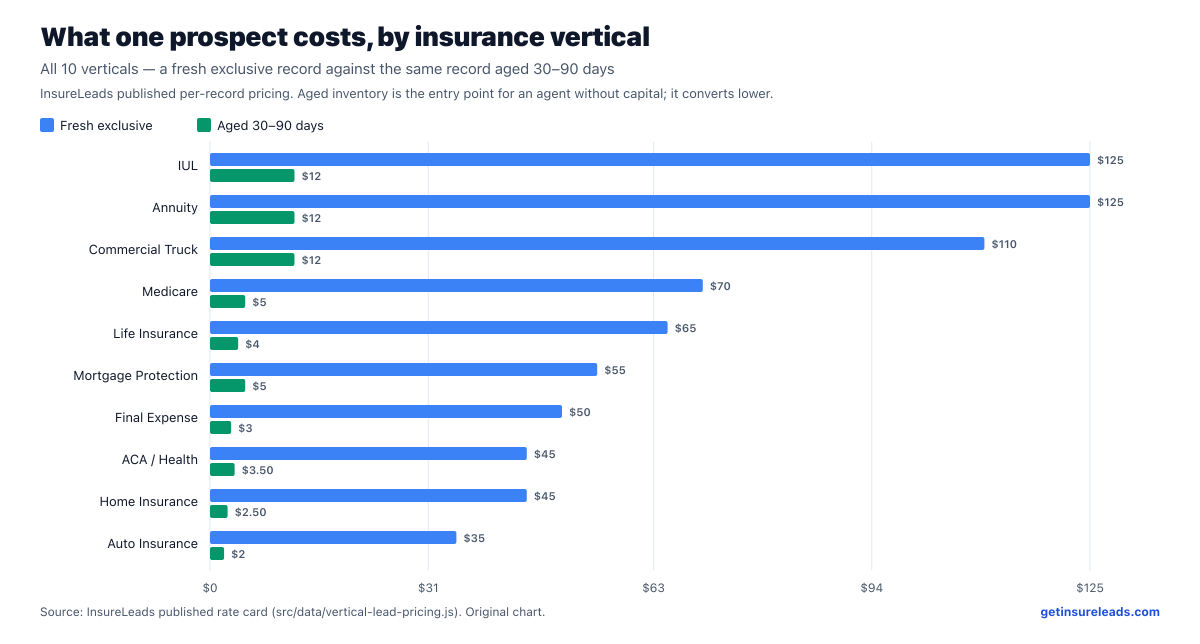
The gap between finishing registration and November 1 is the only cheap practice window an ACA agent gets, and it is the right place to be bad at the phone. Aged ACA records 30–90 days old run $3.50 on this site, against $45 for a real-time exclusive lead. Be honest about what that buys: aged inventory closes at roughly 2–5% by the site's own analysis. It is dialing repetitions and special-enrollment outreach at a price that survives a bad script, not a conversion strategy.
The practice window is also measurably what shortens your ramp. The site's analysis puts a new agent's median time to first sale at 12–21 days on exclusive web leads and 21–45 days working aged records only, described plainly as the cheapest path and the hardest conversion. Doing the cheap version in September so the expensive version works in November is the whole point. Keep the callbacks honest with a free single-user CRM rather than a spreadsheet, because an ACA book lives or dies on follow-up during a compressed window.
When the window opens, the market itself changes shape — how ACA and Marketplace lead supply behaves through the enrollment season is worth understanding before you commit a budget to it, since capacity in the highest-converting formats sells out early. The wider career path, from license to first Open Enrollment, is laid out in the health insurance agent guide, and how a newly licensed agent gets prospects at all covers the options before you have a budget.
Frequently asked questions
Is FFM certification the same as ACA certification?
Yes — they are agent shorthand for the same thing. CMS calls it Marketplace registration and training, run through the Marketplace Learning Management System on the CMS Enterprise Portal. "FFM" refers to the Federally-facilitated Marketplace. Nobody issues an "ACA certification" separate from CMS registration; if a vendor implies otherwise, they are selling training, not a credential.
Do I need an insurance license before FFM registration?
Yes, and specifically a health-related one. CMS states that agents and brokers without an approved health-related Line of Authority, as determined by their resident state, "do not have access to Marketplace systems and are not allowed to assist consumers with Marketplace enrollment." A life-only license is not sufficient. Get the accident and health line first, then register.
How long does the returning-agent training take?
CMS says returning agents and brokers who completed the previous plan year are automatically enrolled in "Marketplace Training for Returning Agents and Brokers," an abbreviated course that "can be completed in approximately sixty minutes" and consists of one required training module and one required exam, with optional review modules. You can opt into the full course instead if you want the refresher.
Is there an exam in FFM registration?
Yes. CMS describes the returning-agent curriculum as one required training module and one required exam, and the full Individual Marketplace training carries its own assessment. CMS does not publish a passing score on the registration pages cited here, so do not assume it matches the 90% bar on the AHIP Medicare exam. Plan for a test, not a click-through.
How do I prove I completed FFM registration?
Two ways. You print a Registration Completion Certificate at the end of the process, and CMS publishes the Registration Completion List of NPNs that completed registration for the current year, updated as frequently as daily. CMS tells agents to confirm their NPN appears and is checked as "Valid" in the current-year column 7–10 business days after finishing training.
When does plan year 2027 registration open?
CMS had not published an opening date at the time of writing. Its registration page states that plan year 2026 registration and training is closed and the MLMS is "currently offline while CMS performs scheduled maintenance and prepares for Plan Year 2027 Marketplace registration and training." Watch the CMS registration and training page directly rather than relying on secondhand dates.
Does FFM registration cost anything?
CMS publishes no fee for MLMS training on the registration pages cited here, and it notes training "may be available through CMS-approved vendor(s)" who set their own prices. Confirm before paying anyone. InsureLeads is not a CMS-approved training vendor, sells no Marketplace training, and earns nothing from your registration either way.
Can I sell Marketplace plans outside Open Enrollment?
Sometimes. HealthCare.gov defines Open Enrollment as November 1 – January 15 and states consumers may still enroll outside it with certain life events such as marriage, a birth, or losing other coverage, or based on estimated household income. That special-enrollment business is genuine year-round volume, but it is documentation-gated and slower to close than an in-window application.
Sources
- https://www.cms.gov/marketplace/agents-brokers/registration-training — Plan year 2026 registration and training closed with the MLMS "currently offline while CMS performs scheduled maintenance and prepares for Plan Year 2027 Marketplace registration and training"; new vs returning training requirements; PY2027 training available in English and Spanish; SHOP requirement of an MLMS profile plus an executed SHOP Privacy and Security Agreement with training strongly encouraged but not required; the Registration Completion List posted as frequently as daily; the Registration Termination List and 45 CFR 155.220(f)-(g); and the requirement for an approved health-related Line of Authority to access Marketplace systems. Page last modified 07/13/2026.
- https://www.agentbrokerfaq.cms.gov/s/article/What-are-the-steps-for-completing-Marketplace-registration-and-training — The verbatim numbered steps for new and returning agents (CMS Enterprise Portal account and MFA, Agent Broker Training Access Role, remote identity proofing through IDM, MLMS profile, training on the MLMS or via a CMS-approved vendor, accepting the Marketplace Agreements, printing the Registration Completion Certificate); the 7–10 business day RCL/NIPR verification lag and the "Valid" current-year column; the returning curriculum of one required training module and one required exam completable in approximately sixty minutes; the Marketplace Service Desk number 1-855-267-1515. Published 25 November 2025.
- https://www.agentbrokerfaq.cms.gov/s/article/Do-I-need-to-re-complete-the-full-Marketplace-training-curriculum-each-year — CMS verbatim: agents and brokers "are required to complete Marketplace registration and training each year to participate in the Marketplace and assist consumers with enrolling in Marketplace coverage"; the abbreviated returning-agent training of approximately sixty minutes; and the option to enrol in the full course instead.
- https://www.healthcare.gov/glossary/open-enrollment-period/ — HealthCare.gov definition of the Open Enrollment Period as "The yearly period (November 1 – January 15) when people can enroll in a Marketplace health insurance plan," and that outside it consumers may still enroll with certain life events such as marriage, a birth, or losing other coverage, or based on estimated household income.