
How to Get Clients as a New Insurance Agent
The short answer
Five prospect sources are open to a newly licensed agent: leads supplied by an upline, your warm market and any orphan list, door-knocking, ads you run yourself, and purchased leads. The upline offer costs contract level permanently. Purchased leads cost capital most new agents lack, so aged records are the realistic entry point.
What prospect sources can a new agent actually use?
Five sources supply prospects to an agent with no book, no referrals and little capital: leads handed down by an upline, your own warm market plus any orphan list you inherit, door-knocking and other in-person canvassing, ads you buy and run yourself, and leads you purchase from a vendor. Each one costs something — cash before the first conversation, calendar time, a skill you do not have yet, or a permanent share of your own commission. The source that costs the least cash is never the source that costs the least overall, and that is the whole difficulty of month one.
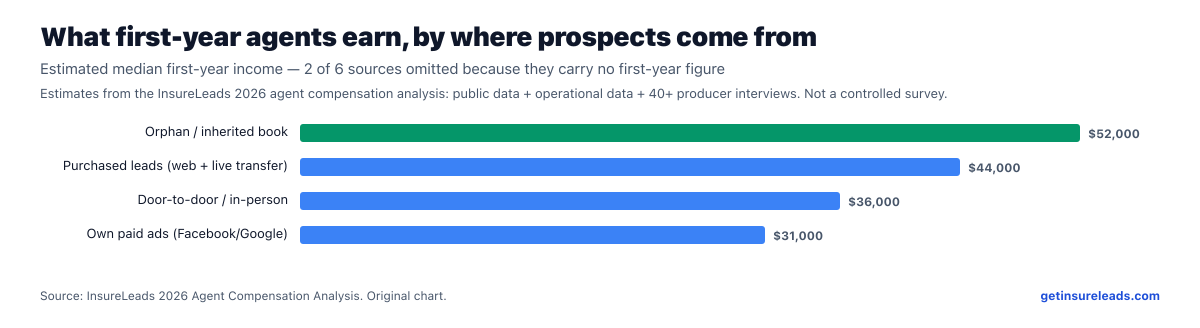
Our compensation analysis of agent income by lead source tracks median income by the agent's primary source and carries a separate first-year column, which is the column that matters here. The result that surprises most new agents: those working an inherited or orphan book posted the highest first-year median in the dataset — above agents buying leads. Referrals and personal-brand agents post the two highest all-experience medians and no first-year figure at all, for a structural reason. A first-year agent has no book to generate referrals from.
Read the table as what it is. That analysis combines public sources, InsureLeads operational data from our buyer base, and structured interviews with active producers. It is not a controlled survey with a disclosed sampling frame, and the medians are estimates rather than measurements. It is still the only per-source first-year data we have, and it points the same direction every experienced manager will tell you: cheap at-bats first, expensive at-bats once you can convert them.
| Primary source | First-year agent median | All-experience median | Cash before the first conversation | The catch (analysis note) |
|---|---|---|---|---|
| Orphan / inherited book | $52,000 | $71,000 | None | Often tied to captive/IMO arrangements; caps out earlier. |
| Purchased leads (web + live transfer) | $44,000 | $82,000 | Highest — a minimum order lands before the first dial | Scales with budget; requires capital to run at volume. |
| Door-to-door / in-person | $36,000 | $64,000 | Fuel and your entire calendar | Dominant in rural final expense and some Medicare markets. |
| Own paid ads (Facebook / Google) | $31,000 | $96,000 | Ad budget plus build time | Highest variance; requires marketing skill or a contractor. |
| Referrals & repeat book | n/a in the dataset | $118,000 | None | Veteran-dominant; slow to build but highest persistency. |
| Social media organic / personal brand | n/a in the dataset | $142,000 | None in cash; funded entirely by time | Small but fast-growing segment; power-law distributed. |
What do "free leads" from your upline actually cost?
The free-lead offer is the first one a new agent hears and the least honestly explained. An IMO, FMO or agency offers to supply leads at no invoice in exchange for writing your business through their hierarchy at a specified contract level. The leads are usually real. The payment is real too — it is the gap between the contract level you are offered with leads and the level you could hold if you funded your own flow, and that gap is charged against every policy you write at that level.
A lead invoice ends when the batch ends. A contract level does not. Where the hierarchy governs renewals and residuals as well as first-year commission, the reduced level costs you on business you wrote years earlier, for as long as you remain in that hierarchy — and leaving is governed by the release terms you signed, not by your preference. That is the asymmetry: you are trading a one-time cash cost for a recurring one, and the recurring one compounds in the wrong direction as your production grows. The mechanics of how a contract level translates into an actual commission rate belong to our breakdown of final expense commission and contract levels; the point here is only that the cost is permanent and almost nobody sitting across from a new agent volunteers it.
Being honest in both directions: for an agent with genuinely no capital, a free-lead contract may be the only route to at-bats, and at-bats are the only thing that produces a first sale. The trade is defensible for the first six to twelve months. It stops being defensible the month you could fund your own lead flow and are still writing at the reduced level out of inertia — which is where a large share of second-year agents quietly sit. If you do not yet know how these hierarchies are structured, read our explainer on how IMOs, FMOs and MGAs sit between you and the carrier before you sign anything. We take no referral or sponsorship money from any of them, which is why we can put this in writing.
- What contract level am I offered with leads supplied, and what level would I be offered without them?
- Are the leads charged per lead, deducted from commission, or "free" against a reduced level?
- Do renewals and residuals pay at the same level as first-year business, or a lower one?
- What is the release policy, and how long after my last written policy does it take effect?
- Is the level reviewable on production, on a written schedule, or at someone's discretion?
- Who owns the lead data and the client record if I leave the hierarchy?
- Am I required to accept a minimum lead volume to hold the level?
Get the level in writing before the first lead arrives
Ask the seven questions above by email and keep the reply. Not because anyone is necessarily acting in bad faith, but because a verbal contract-level promise made to an unlicensed or newly licensed agent is the single most common dispute in this business, and the version you remember will not be the version in the carrier's hierarchy file.
Why the cheapest source in the data is a list somebody left behind
An orphan or inherited book is a set of existing policyholders whose writing agent left, retired or was terminated. The policies are in force, the carrier relationship exists, and you have an actual reason to call that is not a pitch. That combination is why orphan-book agents posted the highest first-year median of any source in our analysis at $52,000 — above the $44,000 median for first-year agents buying leads. Zero acquisition cost with a warm reason to dial beats paid cold volume in year one, consistently.
The catch is in the same dataset: orphan books are "often tied to captive/IMO arrangements" and "cap out earlier." You rarely get handed one as an independent. You get it by taking a contract that limits where else you can write, which routes straight back to the contract-level trade above. Ask whether the orphan list is assigned to you permanently or on a production condition, and whether you keep the clients if you leave.
Your warm market is the other zero-cash source, and "write down a hundred people you know" remains the standard first-week assignment because it works — for about six weeks. Then it is exhausted, and the referral engine that eventually produces the dataset's highest median ($118,000 all-experience) has not started yet because nobody starts it on policy one. One useful compliance note while you are working known contacts: the Telemarketing Sales Rule's do-not-call prohibition does not reach a person with whom the seller has an established business relationship, or who has given express written agreement to be called (16 CFR 310.4(b)(1)(iii)(B)). A cold number pulled off a list has neither.
Does door-knocking still work for a new agent?
Door-knocking posts a $36,000 first-year median against a $64,000 all-experience median in our analysis. Look at that pair rather than either number alone: it is the narrowest first-year-to-veteran gap of any source with a first-year figure. A narrow gap means the ceiling is lower and the floor is reached faster — twenty years of canvassing does not make you three times more productive per door, because the constraint is doors per day, not skill. The analysis notes it remains dominant in rural final expense and parts of the Medicare market, which is exactly where phone contact rates are worst and where a face still opens a conversation a call will not.
The real cost is your calendar, and it does not compound. A day of knocking produces conversations that day and no asset afterwards — no consent record, no data you can re-work, no list that improves. It is also geography-bound and weather-bound, and municipal solicitation permits and no-soliciting ordinances vary locally in ways this page cannot summarise; check your city and county before you plan a route. What door-knocking is genuinely good for is the thing a new agent lacks most and can buy least: unscripted reps with real objections, at a cash cost of fuel. If your washout risk is the thing keeping you awake, our chapter on what the first two years actually look like and why agents quit puts that in context.
Should you run your own ads in your first year?
Agents whose primary source was their own paid advertising posted the lowest first-year median in the dataset — $31,000 — against the second-highest all-experience median at $96,000. That gap is the clearest signal in the whole table. Running acquisition profitably pays extremely well once you can do it and badly while you are learning, and you learn on your own money at the same time you are learning to sell. Two jobs, both new, one bank account. The analysis note is blunt about it: highest variance, and it requires marketing skill or a contractor you have to pay.
There is a second cost that does not show up as spend. When you generate the lead, you own the compliance surface: the disclosure language, the consent capture, the record you would have to produce if the consent were ever challenged. That is a real operational obligation, not a formality, and it is one of the things you are actually buying when you buy a lead instead. Before you commit a month of budget to it, price the alternative honestly — our lead cost and acquisition calculator will take your close rate and target cost per acquisition and show you what your own ads would have to achieve to beat simply buying the same volume. Most first-year agents find the answer is not close.
The defensible version of own-ads in year one is small and instrumental: one landing page, one offer, a spend you can lose without leaving the business, run as an experiment while a cheaper source keeps your dial count up. The indefensible version is making it your primary source before you have a proven script.
When does buying leads make sense, and what does it require?
Purchased leads produced the second-highest first-year median in our analysis at $44,000, and the fastest path to a first sale in our time-to-first-sale benchmarks. Both of those are true and both are conditional on capital. Fresh exclusive inventory is priced per lead and sold against a minimum order, so the money leaves before the first dial and before you know whether you can convert. Final expense exclusive web leads run $50 each; the premium verticals are multiples of that, with IUL at $125. A newly licensed agent who buys a handful of leads at those prices, converts none because the script is not built yet, and runs out of budget has learned nothing except that leads are expensive.
This is the honest position for a lead vendor to take: most brand-new agents should not start on fresh exclusive inventory. Aged records — enquiries that have passed out of the fresh window — cost $3 per record in the 30-to-90-day band and carry the lowest minimum order of any product on our card, which makes them the only inventory a first-year budget can absorb in volume. Our own vertical data puts aged close rates at 2 to 5 percent with a higher disconnect rate, and the benchmark below shows aged-only agents taking the longest to a first sale with high attrition. So do not model income off them.
Model reps off them instead. At that cost per record you can afford several hundred conversations, which is what actually builds a dialing habit, an objection library and a script you own — and those transfer directly when you later move budget to exclusive inventory. Two conditions before you place any order. First, be contracted with a carrier who will accept the business, because a lead you cannot write is money burned. Second, have somewhere to put the records: a batch of five hundred aged leads with no follow-up system is five hundred wasted leads, and our free single-user insurance CRM removes the excuse for dialing out of a spreadsheet. If final expense is your entry vertical, our guide to selling final expense over the phone is the script layer this section deliberately does not duplicate.
| New-agent profile | Median days to first sale | Trade-off noted in the analysis |
|---|---|---|
| Purchased live transfers, trained scripts | 4–8 days | Fastest; higher cost per acquisition until scripting improves. |
| Purchased exclusive web leads | 12–21 days | Most common entry path. Requires dialing discipline. |
| Aged records only | 21–45 days | Cheapest path but hardest conversion; high attrition. |
| Referrals / warm market | 30–90 days | Depends entirely on network depth. |
What rules govern the calls you make?
Your choice of source decides your compliance surface, which is why this belongs on a page about building a first pipeline rather than in a footnote. A purchased lead arrives with a consent record attached — on our funnels that means TrustedForm or Jornaya capture at the point of enquiry. A list scraped from a directory, bought off a forum, or exported from somebody's old spreadsheet arrives with nothing, and the federal obligations attach to you, the caller.
Three requirements are worth knowing verbatim before your first dialing day. Under the Telemarketing Sales Rule, a seller or telemarketer must use a version of the National Do Not Call Registry obtained from the Commission no more than thirty-one days prior to the date any call is made (16 CFR 310.4(b)(3)(iv)) — a scrub from six weeks ago is not compliant. Outbound calls to a person's residence are restricted to the hours between 8:00 a.m. and 9:00 p.m. local time (16 CFR 310.4(c)), and the FCC's parallel rule prohibits telephone solicitation before 8 a.m. or after 9 p.m. local time at the called party's location (47 CFR 64.1200(c)(1)). Separately, when a person asks you not to call again, that request must be honored for five years (47 CFR 64.1200(d)(6)) — an internal suppression list is not optional bookkeeping.
The phrase "local time at the called party's location" is the one that catches new multi-state agents. A 7:30 p.m. block from an Eastern-time desk is already past 9 p.m. for nobody, but a 6:45 a.m. start is before 8 a.m. on the West Coast, and a Pacific-licensed agent working Eastern records at 7 p.m. local is calling at 10 p.m. theirs. Build your dialing blocks around the called party's clock, per state, from day one. State registries and state-level telemarketing rules sit on top of this federal floor and differ materially; this page does not attempt to summarise them, and none of it is legal advice.
What order should a first pipeline be built in?
The sequence matters more than the source. Almost every expensive mistake in a first year is a step taken out of order — buying leads before being contracted, accepting a reduced contract level before asking what the alternative was, or scaling spend before there is a script to scale.
- Get contracted first. A lead you cannot write is a wasted lead, and appointments take longer than new agents expect — see our chapter on getting appointed with carriers.
- Settle the contract-level question in writing before accepting any free-lead offer. This is the only decision on the list that is close to permanent.
- Put the system in before the volume. A free single-user CRM and two fixed dialing blocks on the calendar, built around the called party's local time.
- Work the zero-cash sources first — warm market and any orphan list you can get assigned. They carry the highest first-year median in our data.
- Buy reps, not revenue. A small aged batch, measured on contact rate and objections encountered rather than income produced.
- Move budget to fresh exclusive inventory only once your contact-to-appointment rate has stabilised, and run the acquisition math before the order, not after.
- Start asking for referrals on policy one. The highest-median source in the dataset has no first-year figure because nobody begins it early enough.
Frequently asked questions
Can a new insurance agent get free leads?
Yes. IMOs, FMOs and agencies routinely supply leads at no invoice in exchange for writing through their hierarchy at a specified contract level. The cost is that reduced level, charged against every policy you write there — and, where the hierarchy governs renewals, against business you wrote years earlier. Get the level, the release policy and the renewal treatment in writing before the first lead arrives.
How much money do you need before you can buy insurance leads?
Enough to survive the learning curve, not enough for one order. Fresh exclusive inventory is priced per lead against a minimum order, which is why most first-year agents cannot fund it at a volume that teaches them anything. Aged records carry the lowest minimum order on our card and are the realistic entry point. Run your own numbers through the lead cost calculator before committing.
What is the fastest way for a new agent to make a first sale?
Purchased leads, on our benchmarks. New agents working live transfers with trained scripts reached a first sale in a median of 4 to 8 days, and exclusive web leads in 12 to 21 days, against 21 to 45 days on aged records only and 30 to 90 days working a warm market. Speed costs capital, and the fastest options also carry the highest cost per acquisition while your scripting is still weak.
Are aged leads worth it for a brand-new agent?
For practice, yes. For income, no. Our vertical data puts aged close rates at 2 to 5 percent with higher disconnect rates, and aged-only agents post the slowest time to first sale with high attrition. Their value is that they make several hundred real conversations affordable, which is what builds a script and an objection library. Do not build an income forecast on them.
Should a new agent run their own Facebook or Google ads?
Rarely as a primary source in year one. Agents whose main source was their own paid advertising posted the lowest first-year median in our analysis at $31,000, against $96,000 across all experience levels — the widest learning-curve gap in the dataset. You would be learning acquisition and selling simultaneously on your own money, and you would own the consent and disclosure obligations yourself.
Do I still have to scrub the Do Not Call registry if I bought the leads?
Assume yes unless an exemption clearly applies. The Telemarketing Sales Rule requires a registry version obtained no more than thirty-one days before any call (16 CFR 310.4(b)(3)(iv)). Its do-not-call prohibition does not reach someone with an established business relationship with the seller or who gave express written agreement (16 CFR 310.4(b)(1)(iii)(B)) — which is precisely why the consent record attached to a purchased lead matters. State rules apply on top, and this is not legal advice.
Is door-knocking better than calling for a new agent?
It is cheaper in cash and more expensive in calendar. Door-knocking posts a $36,000 first-year median against a $64,000 all-experience median — the narrowest gap of any source, meaning the productivity ceiling arrives early. It remains strong in rural final expense and parts of the Medicare market. It produces no reusable asset: no consent record, no data you can re-work, no list that improves.
When should I stop taking free leads from my upline?
The month you could fund your own lead flow and are still writing at the reduced level. Up to that point the trade buys you at-bats you could not otherwise afford, which is a defensible reason. After that point you are paying a recurring cost to avoid a one-time one, and the cost grows with your production. Check the release terms early — they, not your intent, set your exit timeline.
Sources
- https://www.govinfo.gov/content/pkg/CFR-2023-title16-vol1/xml/CFR-2023-title16-vol1-sec310-4.xml — 16 CFR 310.4(b)(3)(iv) — registry version obtained no more than thirty-one (31) days prior to any call; 310.4(c) — outbound calls to a residence only between 8:00 a.m. and 9:00 p.m. local time; 310.4(b)(1)(iii)(B) — established business relationship / express written agreement exception to the do-not-call prohibition.
- https://www.govinfo.gov/content/pkg/CFR-2023-title47-vol3/xml/CFR-2023-title47-vol3-sec64-1200.xml — 47 CFR 64.1200(c)(1) — no telephone solicitation before 8 a.m. or after 9 p.m. local time at the called party's location; 64.1200(d)(6) — a do-not-call request must be honored for 5 years.
- https://docs.fcc.gov/public/attachments/DA-25-312A1.pdf — Fetched but the PDF text was not extractable. No claim on this page rests on it — the FCC consent-revocation 'ten business days' rule was therefore OMITTED rather than cited from secondary coverage.
- https://www.govinfo.gov/content/pkg/FR-2025-02-28/html/2025-03306.htm — Fetched and discarded — the document turned out to be unrelated (Bureau of Engraving and Printing currency accessibility notice), not TCPA revocation. No claim rests on it.