
How to Become a Health Insurance Agent
The short answer
A health insurance agent needs a state accident-and-health licence plus annual CMS Marketplace (FFM) registration, which is free and NPN-specific. The harder constraint is timing: most marketplace enrollment happens between November 1 and January 15, so a licence earned in spring earns from Special Enrollment Periods until autumn.
What does a health insurance agent have to hold before selling a marketplace plan?
Two credentials stand between you and your first marketplace enrollment, and they come from different authorities. Your state department of insurance issues the accident-and-health line of authority: prelicensing coursework, an exam, background and fingerprinting in most jurisdictions, then continuing education on a recurring cycle. Those hours are set jurisdiction by jurisdiction, and we keep them in a state-by-state breakdown of prelicensing and CE requirements rather than restate them here.
CMS controls the second credential, and it is the one new agents underestimate. Marketplace registration and training is annual, tied to your National Producer Number, and CMS confirms it is offered at no cost for plan year 2026. Training is required only for Individual Marketplace participation — agents who intend to work SHOP employer business are encouraged to complete it but not required to. You pick one curriculum: the Marketplace Learning Management System inside the CMS Enterprise Portal, or an HHS-approved vendor. CMS names HealthSherpa and INSXCloud as approved vendors, and requires you to reach their training through the Enterprise Portal rather than going directly to the vendor's own website.
Completion is not a certificate you file and forget. CMS publishes the Agent and Broker FFM Registration Completion List (RCL), which carries the NPNs of everyone who has finished registration for the current year and is updated daily. Before you touch a consumer's application, confirm your NPN appears on the RCL and that the "NPN Valid (Current Year Only)" field reads "Y". A practical note with a shelf life: as of this writing, CMS has taken the plan year 2026 MLMS registration and training offline for scheduled maintenance while it prepares plan year 2027, so check availability before you build a start date around it. The mechanics, screen by screen, sit on our FFM registration walkthrough.
One thing this sequence does not include: any product-specific certification comparable to what Medicare demands. There is no annual carrier-by-carrier exam gauntlet on the ACA side. That makes health a faster credential to acquire than Medicare — and, as the next section explains, a slower one to monetise.
| Gate | Authority | Cadence | What it costs you |
|---|---|---|---|
| Accident & health line of authority | State department of insurance | Initial licence, then CE cycle | Course + exam + licence fees, set by your state |
| Marketplace (FFM) registration & training | CMS | Annual, per NPN | No cost for plan year 2026, per CMS; your time |
| Carrier appointments | Each carrier, usually via an IMO/FMO | Per carrier, per state | Usually free to the agent; background review |
| State-based Exchange certification | The SBE, in states running their own exchange | Annual, on top of FFM | Varies by exchange |
How does the enrollment calendar set a new health agent's cash flow?
Marketplace selling is not a year-round business with seasonal bumps. It is a ten-week business with a nine-month tail. On HealthCare.gov, Open Enrollment runs November 1 to January 15; December 15 is the last day to enroll for coverage starting January 1, and enrollments completed December 16 through January 15 take effect February 1. Outside that window a consumer can only enroll through a Special Enrollment Period triggered by a qualifying life event.
The scale inside the window is real. CMS reported 23.1 million consumers selected a plan or were automatically re-enrolled through HealthCare.gov and State-Based Exchanges during the 2026 Open Enrollment Period — about 1.2 million fewer than the 2025 period, a 5% decrease, but still near record levels. That is the pool. The problem for a new agent is that you can only be paid for the slice of it you personally enroll, and marketplace carriers pay per member per month as earned, not as a lump sum at application.
Run the two facts together and the first-year picture stops being abstract. Our own analysis puts on-exchange compensation at roughly $15 to $25 per member per month, continuing while the member stays enrolled — commission that begins landing 60 to 90 days after the enrollment, not on the day you write it. So an agent licensed in March has no OEP to work, builds a small SEP book through summer at delayed as-earned pay, and does not see a meaningful monthly figure until the following February or March. That is a fourteen-month runway, and it is the single most common reason a new health agent quits in month five.
The honest implication: if you are licensing in the first half of the calendar year, plan on a second income source or a second vertical through your first summer, and treat OEP as the quarter you have been training for. If you are licensing in September, you have caught the vertical at its best possible moment and your constraint becomes capacity, not demand.
| Period | What you can sell | What lands in the bank |
|---|---|---|
| Nov 1 – Dec 15 | OEP, all comers; deadline for Jan 1 effective dates | Nothing yet — as-earned PMPM starts after the effective date |
| Dec 16 – Jan 15 | OEP, for Feb 1 effective dates | First PMPM from your earliest January-effective members |
| Feb – Apr | SEP only (job loss, marriage, birth, move, income change) | OEP book now paying monthly; this is the first real month |
| May – Sep | SEP only; thinnest stretch of the year | Steady PMPM from the standing book, little new revenue |
| Oct | Pre-OEP prep: SBE certifications, carrier grids, capacity | Standing book only |
What is the difference between on-exchange and off-exchange business?
On-exchange means the plan is bought through HealthCare.gov or a State-Based Exchange, with the consumer's advance premium tax credit applied at the point of sale. That subsidy is the product. CMS reported that in the 2026 Open Enrollment Period nearly half of enrollees — 46% — had household incomes between 100% and 150% of the federal poverty level, and that plan selection shifted toward Bronze: 40% Bronze, 43% Silver, 17% Gold, with Bronze up 10 percentage points and Silver down nearly 14 against the prior year. You are selling to a subsidy-sensitive household making a monthly-premium decision, and the metal-level mix moves year to year with how the subsidy math lands.
On-exchange work is what FFM registration exists to authorise, and it is the half that auto-renews. That renewal is the compounding asset in this vertical: a household you enroll once can pay you PMPM for years without a second sale, which is why retention touches in November matter more than new-business volume for an agent in year three.
Off-exchange is everything you sell the same household without the exchange: ancillary and supplemental products, dental and vision, hospital indemnity and accident plans, short-term products where a state permits them, and ICHRA-adjacent work with small employers. It does not require FFM registration — only your state licence and the carrier appointment — and it is not bound to the OEP calendar. For a new agent licensed in the wrong half of the year, off-exchange is the honest answer to "what do I sell in May".
The trap is treating them as interchangeable. Off-exchange products carry no premium tax credit, so the affordability conversation is completely different, and a subsidy-eligible household steered into an unsubsidised product is both a bad outcome and a complaint waiting to happen. Quote the exchange first, always from the live shopping experience rather than memory, then layer off-exchange coverage on top of what the subsidy already bought.
| On-exchange | Off-exchange | |
|---|---|---|
| Credential required | State A&H licence + annual CMS FFM registration (+ SBE certification where applicable) | State A&H licence + carrier appointment |
| Who the buyer is | Subsidy-eligible households; 46% at 100–150% FPL in the 2026 OEP per CMS | Anyone the product fits, including above-subsidy households |
| When you can sell | OEP (Nov 1 – Jan 15) plus qualifying-event SEPs | Year-round |
| How you are paid | Per member per month, as earned, roughly $15–$25 PMPM on bronze/silver by our analysis | Varies by product; often percentage of premium |
| What renews itself | Marketplace plans auto-renew, so the book compounds | Depends entirely on the product |
What should a new health agent do in the first 90 days?
The sequence matters more than the speed. Every item below unlocks the next one, and skipping ahead to prospecting before your appointments and certifications are live produces conversations you cannot close.
- Get the resident A&H licence issued, then decide deliberately how many states you want. Multi-state licensing is the main lever on how much OEP volume you can absorb — and the main cost of a first year, because every non-resident licence carries its own fee and renewal.
- Complete CMS Marketplace registration and training for the current plan year, then verify your NPN on the Registration Completion List with the "NPN Valid (Current Year Only)" field reading "Y" before you speak to a consumer.
- Add State-Based Exchange certification for any SBE state you intend to work. Twenty states and the District of Columbia ran their own exchanges for the 2026 plan year, and each sets its own broker requirements on top of FFM.
- Get appointed with the carriers that actually have plans on the shelf in your counties — read them off the live shopping experience for your ZIP codes rather than a national list, because on-exchange participation is county-level and changes annually.
- Stand up the operational floor before you buy a single prospect: somewhere to store contacts and dispositions, call recording, and a place to file enrollment consent. A free single-seat CRM is sufficient at this stage; a paid stack is a month-six decision.
- Run your first 200 conversations on cheap volume, not on your best inventory. Script reps are the deliverable in month one, not enrollments.
- Book your OEP capacity before October. Real-time and transfer inventory in this vertical is capacity-constrained at peak, and the agents who go into November without pre-booked volume spend December bidding against everyone else.
Where does a new health agent's first prospects come from?
There are four honest sources in year one: the people you already know, the ones you find yourself with organic effort or paid media, marketplace foot traffic if you work under an agency with walk-in volume, and purchased records. Most new agents end up on purchased records because it is the only source with a dial tone on day one, and the mistake they make is buying the expensive kind first.
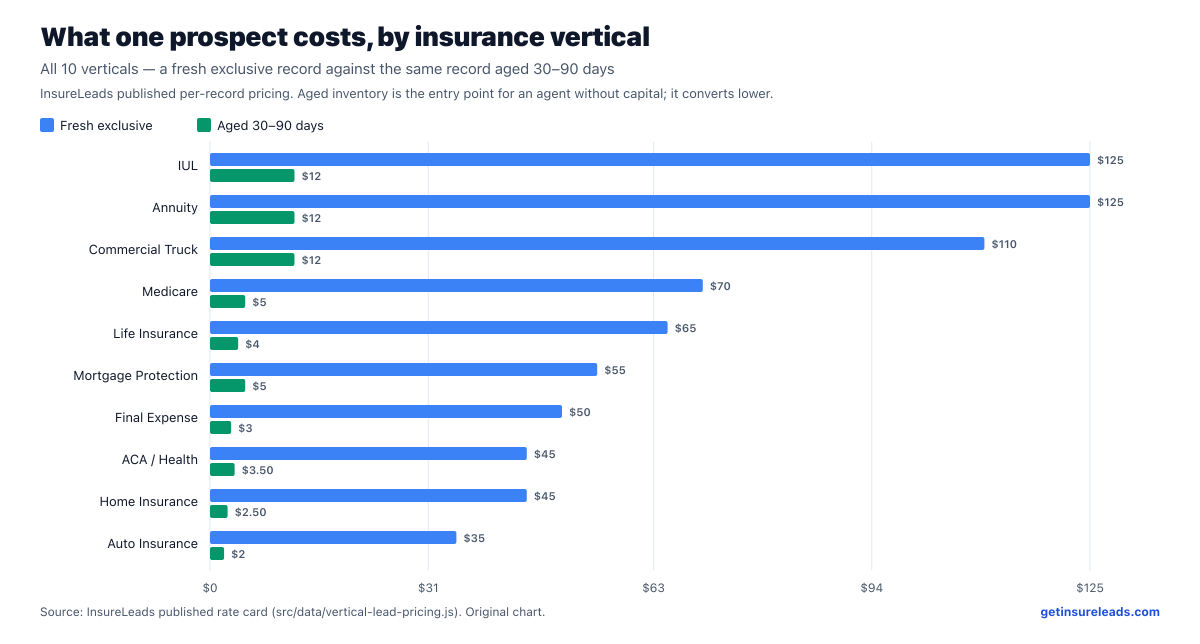
The arithmetic is not subtle. Exclusive real-time marketplace records run $45 and, against the close-rate planning band we publish, convert at 5–12% for a competent agent with fast follow-up. Records 30 to 90 days old run $3.50 and convert at 2–5%. For a new agent, the cheap file is the better purchase for a reason that has nothing to do with return: at ten times the volume per dollar you get ten times the reps, and reps are what move you from the bottom of that 5–12% band to the top of it. Buy conversation volume in month one and conversion quality in month four. Our aged-record pricing and age bands lay out what each vintage costs; the current rate for real-time marketplace inventory sits on the ACA and health inventory page.
One nuance specific to this vertical: outside OEP, a record is only workable if the household has a qualifying event. Records screened for a documented event convert appreciably better than unscreened off-season files — our observations put them at 10–18% against 5–12% for general exclusive records — because the consumer has a coverage gap right now rather than a vague intention to shop in November. If you are working May through September, screening for the event is worth more than paying for recency.
Speed to contact does the rest, and it does more here than in any other line we sell, because OEP enrollment conversations run 30 to 45 minutes and the consumer who cannot reach you moves to the next name. Route new records into your dialer automatically, answer inside five minutes, and record every call.
| Source | Planning-band close rate | Cost posture | Fit in year one |
|---|---|---|---|
| Aged records, 30–90 days | 2–5% | $3.50 | Best first purchase — buys reps, not enrollments |
| Exclusive real-time records | 5–12% | $45 | Right once your close rate has stabilised |
| SEP-screened records | 10–18% | Premium to real-time | The off-season answer, Feb–Oct |
| Live transfers | 15–25% | $100 | Only with live phone coverage and a working script |
| Warm market / referrals | Highly variable | Time | Real but slow; will not fill an OEP calendar |
What does the first year actually pay?
Two numbers matter and they measure different things. The Bureau of Labor Statistics puts the median annual wage for insurance sales agents at $60,370 as of May 2024, with the lowest 10% under $36,390 and the highest 10% above $135,660, and projects 4% employment growth from 2024 to 2034. That figure covers the whole occupation — captive and independent, every line of business, agents in year one and year thirty. It is not a first-year expectation.
Our own analysis of first-year producers puts the 0–1 year cohort's median considerably lower, and shows purchased-lead-driven agents outperforming door-based ones on median income while running the higher cost base. The full income-by-experience and income-by-lead-source tables live in our compensation analysis, which is where every income figure on this site belongs; this page deliberately does not restate them.
The structural fact specific to health is concentration. In our interview data, 37% of producers named seasonal income concentration — dependence on OEP and AEP — as an operational pain point, and 72% named inconsistent prospect quality. Both hit a first-year health agent harder than a veteran, because a veteran has a renewal book absorbing the off-season and you do not. Your first year is not a bad year that gets better; it is a year with one earning window in it.
What that argues for, concretely: a second line of business you can sell in May. Under-65 supplemental, ancillary products, or an adjacent senior-market vertical will carry a health agent through the trough far more reliably than trying to squeeze more out of SEP volume that structurally is not there.
How does a health agent actually get appointed?
Appointment runs through the carrier, but almost never directly. For most new agents the route is an IMO or FMO that holds the contracts, submits your paperwork, and takes an override on your production in exchange. That is a legitimate arrangement and often the only practical way in — but it is a commercial relationship with terms, and the terms are where new agents give away money without noticing.
What to read before you sign: whether your contract is assignable if you leave, whether there is a release policy and how long it takes, whether the override is disclosed, and whether any training or lead "support" is conditioned on writing exclusively through that organisation. Override opacity showed up in our interview data as a recurring complaint, and it is the item most often glossed over at recruitment. We explain the tier structure and the vocabulary — IMO, FMO, NMO, MGA — in our breakdown of how the distribution chain works.
A disclosure that shapes everything on this page: InsureLeads has no referral, sponsorship, or affiliate relationship with any IMO or FMO. We are not paid to send you anywhere, which is precisely why we can tell you to read the release clause. Anyone who is paid for the referral has an incentive not to.
Sequence the appointments to the calendar. Carrier onboarding, FFM registration and SBE certification all take weeks, and all of them are congested in October. An agent who starts appointment paperwork in mid-October is an agent who spends the first three weeks of OEP unable to submit.
Where do new health agents get into trouble?
Marketplace compliance is not a theoretical risk in this vertical, and CMS has made that explicit. In 2025, CMS reported ending advance premium tax credit payments or coverage for nearly 1.5 million people found either ineligible for financial assistance or enrolled without their authorisation. Unauthorised enrollment and plan-switching is the enforcement priority, and appointment termination is the enforcement tool. A new agent with no book is exactly the profile that loses everything to one sloppy consent trail.
The habits that keep you out of it are unglamorous and cheap:
- Capture explicit, documented consent immediately before you submit or change any enrollment — time, method, and the specific plan selected.
- Quote from the live shopping experience with the consumer on the line, never from memory. A misquoted subsidy is a complaint, and complaints are what trigger review.
- Collect qualifying-event documentation up front on every SEP case; the exchange will ask for it before coverage activates, and chasing it later loses the case.
- Keep prior express written consent on file before any autodialer or prerecorded contact, and treat state mini-TCPA statutes as stricter than the federal floor rather than equivalent to it.
- Record calls and keep the recordings. In a he-said-she-said with an enrollment complaint, the recording is the only thing that speaks for you.
Frequently asked questions
How long does it take to become a health insurance agent?
The licence itself is typically a matter of weeks — prelicensing coursework, exam, and state processing. CMS Marketplace registration and training adds days, not weeks. Carrier appointments and any State-Based Exchange certification are the slow parts, and all of them congest in October. Budget six to ten weeks from decision to first submitted enrollment, and start well before autumn.
Does FFM certification cost anything?
CMS states it will continue to offer Marketplace registration and training for agents and brokers at no cost for plan year 2026. You choose between the Marketplace Learning Management System in the CMS Enterprise Portal or an HHS-approved vendor — CMS names HealthSherpa and INSXCloud — accessed through the Enterprise Portal rather than the vendor's own site. Your state licence fees are separate and are not free.
Do I have to redo FFM registration every year?
Yes. Marketplace registration and training is an annual requirement tied to your NPN. Confirm completion on the CMS Agent and Broker FFM Registration Completion List, which is updated daily, and check that the "NPN Valid (Current Year Only)" field reads "Y" before assisting any consumer with an enrollment.
Can I sell health insurance outside Open Enrollment?
On-exchange, only to consumers with a qualifying life event — job loss, marriage, divorce, birth or adoption, a move, or an income change that shifts subsidy eligibility. Off-exchange products such as ancillary, dental, vision, and hospital indemnity are not calendar-bound, which is why most year-round health agents carry both.
Is health insurance a good first vertical for a brand-new agent?
It is a good vertical with a bad on-ramp if you time it wrong. The credential is fast to obtain and the book auto-renews, which compounds well. But roughly one enrollment window carries the year, commission is paid per member per month as earned, and a spring licence means a fourteen-month wait for a meaningful monthly figure. Licence in late summer, or carry a second line.
What is the difference between the FFM and a state-based exchange?
The Federally-facilitated Marketplace is HealthCare.gov, used by most states; the rest run their own State-Based Exchanges. For the 2026 plan year CMS counted 30 states on HealthCare.gov and 20 states plus the District of Columbia on SBEs. FFM registration does not automatically authorise you on an SBE — those set their own broker certification on top.
How much should a new health agent budget for prospects?
Buy volume before quality. Records 30 to 90 days old cost $3.50 and convert at 2–5% by our observations; exclusive real-time records cost $45 and convert at 5–12%. The cheap file buys the conversation reps that move you up the second band. Shift the mix once your close rate has held steady for a month.
Sources
- https://www.cms.gov/marketplace/agents-brokers/general-resources/new-agents-brokers-guide-plan-year-2026-marketplace-registration-training — Plan year 2026 FFM registration steps for new agents; training offered at no cost; MLMS registration currently offline for maintenance while CMS prepares plan year 2027
- https://www.cms.gov/marketplace/agents-brokers/registration-training — Annual registration and training requirement; training required only for Individual Marketplace, encouraged but not required for SHOP; HHS-approved vendors HealthSherpa and INSXCloud must be accessed via the CMS Enterprise Portal
- https://www.agentbrokerfaq.cms.gov/s/article/What-are-the-steps-for-completing-Marketplace-registration-and-training — Registration Completion List (RCL) contains NPNs of agents who completed registration for the current year, updated daily; "NPN Valid (Current Year Only)" must read "Y" before assisting consumers
- https://www.healthcare.gov/quick-guide/dates-and-deadlines/ — Open Enrollment runs November 1 to January 15; December 15 is the deadline for January 1 coverage; December 16–January 15 enrollments take effect February 1
- https://www.cms.gov/newsroom/press-releases/exchange-coverage-remains-near-record-high-23-1-million-enroll-2026-reflecting-continued-strength — 23.1 million consumers selected or were automatically re-enrolled during the 2026 OEP; about 1.2 million fewer than 2025 OEP, a 5% decrease; 40% Bronze / 43% Silver / 17% Gold; 46% of enrollees at 100–150% FPL; CMS ended APTC or coverage for nearly 1.5 million people in 2025
- https://www.cms.gov/newsroom/fact-sheets/marketplace-2026-open-enrollment-period-report-national-snapshot — 2026 OEP platform split — plan selections on HealthCare.gov (30 states) versus State-Based Exchanges (20 states and DC)
- https://www.bls.gov/ooh/sales/insurance-sales-agents.htm — Median annual wage for insurance sales agents $60,370 (May 2024); lowest 10% under $36,390; highest 10% above $135,660; 4% projected employment growth 2024–2034