
How to Become a Commercial Truck Insurance Agent
The short answer
A commercial truck insurance agent works under an ordinary property and casualty licence — no trucking-specific licence exists. The licence takes weeks. Market access through a wholesale broker or MGA takes months, and it is the real gate. Premiums per account dwarf personal lines; the sales and learning curve are both longer.
What does a commercial truck insurance agent actually sell?
The buyer is a motor carrier, not a driver. FMCSA counted 787,189 interstate motor carriers and intrastate hazardous-materials carriers with recent activity in its 2024 Pocket Guide to Large Truck and Bus Statistics, drawn from a Motor Carrier Management Information System snapshot dated 29 December 2023. Of that population, 519,420 were for-hire carriers and 197,563 were private carriers. The same publication counts 418,526 carriers operating a single power unit — the one-truck owner-operator who is, in practice, a sole proprietor buying business insurance on a personal cell phone.
A trucking account is never one policy. The agent assembles a program, and the parts interact: raising a cargo limit changes nothing about the liability filing, but writing a leased owner-operator instead of an authority holder changes which coverages are even relevant. That is the substantive difference between this line and personal auto, where a rater produces a price and the conversation ends.
Every account also carries a document obligation. Certificates of insurance go to brokers and shippers continuously, mid-term vehicle additions arrive by text at 6pm, and a lapse has a regulatory consequence rather than just a coverage one. Before deciding this is your line, read the call-and-submission mechanics of a trucking sale, which covers the technique this page deliberately does not repeat.
- Primary auto liability, carrying the MCS-90 endorsement for interstate for-hire operations
- Physical damage on the tractor and on the trailer, often at different values and deductibles
- Motor truck cargo, with limits driven by what the carrier hauls and for whom
- Non-trucking liability (bobtail) for owner-operators leased to someone else's authority
- Trailer interchange, where the carrier pulls equipment it does not own
- Truckers general liability, for premises and loading-dock exposure
- Occupational accident or workers compensation, depending on state law and lease structure
What licence does a truck insurance agent need — and why the licence is the easy part
No jurisdiction issues a trucking licence. Commercial trucking is written under the same property and casualty authority that covers a homeowners policy. The Bureau of Labor Statistics states the split plainly in its Occupational Outlook Handbook: "Separate licenses are required for agents to sell life and health insurance and property and casualty insurance." That is the only line that matters — life-and-health producers moving into trucking are starting a new licence, not adding a filter.
Florida shows what the P&C side involves in practice. The state's 2-20 Resident General Lines licence covers Property, Casualty, Surety, Marine, Health and Miscellaneous Lines in one authority, and its own Department of Financial Services qualification sheet lists workers compensation and bonds among the licence's common uses. The default route is a department-approved 200-hour course in property and casualty insurance completed within four years of application, followed by the state examination. Alternative routes exist and they are worth knowing, because they are how agency staff get promoted into producer roles.
One clause on that same Florida sheet explains the whole career structure: the 2-20 "requires an appointment to be valid" and "will expire if unappointed for 48 months." A licence with no carrier behind it is a piece of paper with a countdown on it. Continuing education runs 24 hours biennially, due by the end of the licensee's birth month. Requirements and hour counts differ substantially by jurisdiction — requirements jurisdiction by jurisdiction is the right place to check yours, and how appointments are actually granted covers the step that the licence only makes possible.
- Complete a 200-hour approved property and casualty course within four years, then pass the state exam
- Complete one year within the last four in full-time responsible insurance duties across property, casualty, surety, health and marine, then pass the exam
- Complete one year as a licensed and appointed Customer Representative (4-40), Personal Lines Agent (20-44) or Service Representative (0-55) plus a 40-hour approved course, then pass the exam
- Hold an insurance degree including at least 18 semester hours in property, casualty, health and commercial insurance — exam-exempt
- Hold the Chartered Property Casualty Underwriter (CPCU) designation — exam-exempt
- Move to Florida holding an equivalent resident licence for at least one continuous year and apply within 90 days — exam-exempt
Which federal rules do you have to know before your first trucking quote?
The limits are not a market convention you negotiate. 49 CFR 387.9 sets minimum levels of financial responsibility by cargo and vehicle weight, and an operation cannot be compliant below them. Learn this table before you learn a single carrier's appetite, because it determines what "cheap" is allowed to mean on a quote.
Proof of that responsibility runs through 49 CFR 387.7, which requires the endorsement titled "Endorsement(s) for Motor Carrier Policies of Insurance for Public Liability Under Sections 29 and 30 of the Motor Carrier Act of 1980" — Form MCS-90 — issued by the insurer and maintained at the carrier's principal place of business. Agents routinely misdescribe the MCS-90 as coverage. It is a public-protection guarantee sitting on top of the policy, and explaining it correctly is one of the cheapest ways to sound like you belong on the call.
The filings themselves are not yours to make. FMCSA's own registration-modernization FAQ defines the parties: "Financial responsibility filers are insurance companies, surety companies, or financial institutions that register with FMCSA to file proof of insurance (i.e., BMC-91, BMC-91X, BMC-85) for entities applying for operating authority." Your job is producing an accepted submission fast enough that the filer can transmit it — the mechanics of which are laid out in how the BMC-91 and MCS-90 actually get filed.
Two live changes are worth tracking in 2026. First, FMCSA is sunsetting its legacy registration tools: per the same FAQ, systems supporting registration actions were "impacted beginning Thursday, May 14, 2026 at 8:00 PM ET," the Unified Registration System is "permanently offline," the FMCSA Portal's registration options are permanently disabled, and filings were unavailable for roughly four days during migration to the new Motus: USDOT Registration System, which launched to all users in May 2026. Second, FMCSA "has proposed no longer assigning MC Numbers," with the USDOT Number becoming the sole identifier and operating-authority types shown as suffixes — C for property carrier operating authority, B for broker, F for freight forwarder, H for household goods. That proposal is not in effect: it awaits a Notice of Proposed Rulemaking, it "will not go into effect with the first release of the new registration system," and FMCSA states existing MC Numbers "will not be replaced by USDOT Numbers." Say it that way to a carrier and you will be more accurate than most incumbents.
| Operation | What is carried | Minimum |
|---|---|---|
| For-hire, interstate or foreign commerce, GVWR 10,001 lbs or more | Property (nonhazardous) | $750,000 |
| For-hire and private, interstate or foreign commerce in any quantity, or intrastate in bulk only, GVWR 10,001 lbs or more | Oil listed in 49 CFR 172.101; hazardous waste, hazardous materials or hazardous substances | $1,000,000 |
| For-hire and private, specified hazardous materials in bulk | Listed hazardous materials in bulk | $5,000,000 |
| For-hire and private, interstate or foreign commerce, GVWR under 10,001 lbs | Certain Division 1.1, 1.2, 1.3, 2.3 and 6.1 materials, or highway route controlled quantities of a Class 7 material | $5,000,000 |
Why trucking pays more per account and still starves a new agent
A single power unit generates a four-figure annual premium and a fleet generates five or six, against a personal auto policy measured in hundreds. Commercial commission is a percentage of that premium, paid by the carrier or the wholesaler, and it renews annually while the account stays put. That is the argument for the line, and it is real.
We are not going to print a commission percentage here. No verified trucking commission band exists in our own records, and the figures circulating in this niche are quoted without a source. Ask the specific wholesaler you are contracting with, in writing, for the schedule by line and by market — that answer is worth more than any published range.
What we can quantify is the conversion side, from our own operational data across trucking buyers. Live transfers close at 10–20%, exclusive real-time web records at 5–12%, shared records at 3–7%, and aged records at 2–5%. Market access and submission turnaround explain more of that spread than the record source does: an agent quoting one market will lose to an agent quoting six, on identical prospects.
The pool is also not growing. FMCSA's active-carrier count fell from 813,844 in 2022 to 787,189 in 2023, with interstate freight carriers down from 763,867 to 735,895 over the same year. Freight cycles park trucks, and parked trucks drop to non-trucking liability or cancel. Anyone telling you trucking demand only goes up is not reading the federal data.
For the income question, hold two numbers side by side. BLS reports a median annual wage of $60,370 for insurance sales agents in May 2024, with the lowest 10 percent under $36,390 and the highest 10 percent above $135,660. Our own compensation analysis puts first-year agents in a $24,000–$56,000 interquartile range across all lines — see our analysis of what producers earn by experience and lead source. Trucking raises the ceiling of that distribution. It does nothing for the first ninety days, when you are learning filings instead of binding accounts.
How a new truck agent gets in front of motor carriers
Sequence this the boring way: markets first, workflow second, prospects third. Buying inbound records before you know which vehicle classes and radii your markets will write produces a folder of conversations you cannot finish. Tow, dump and car-hauler records are worthless to an agent whose wholesaler declines those classes.
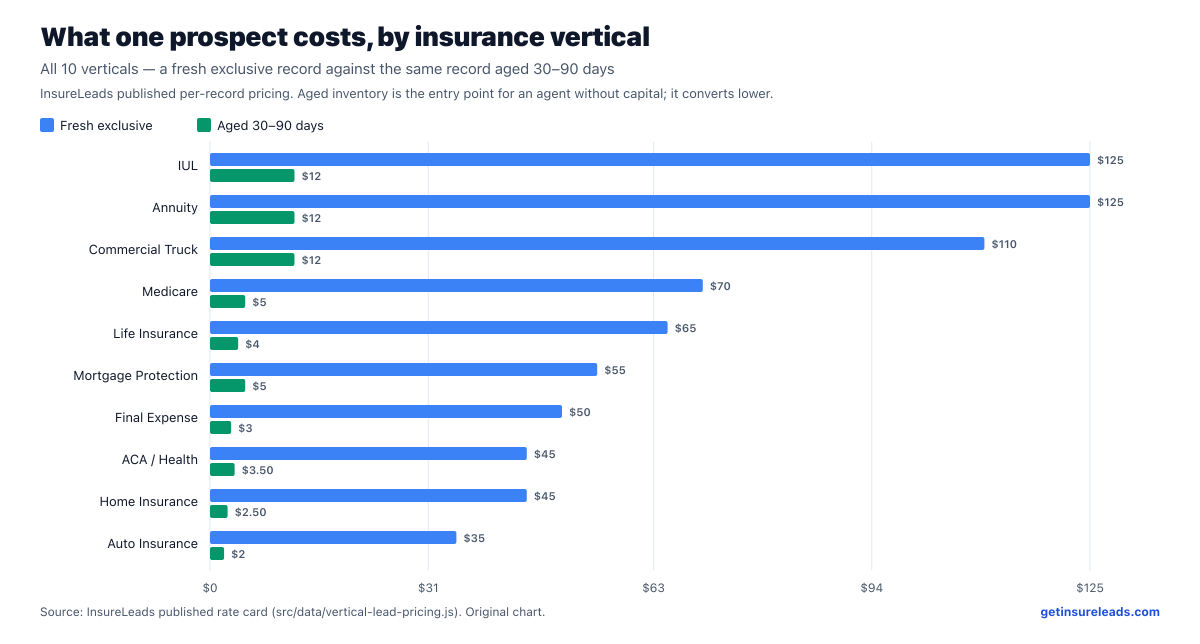
Once appetite is mapped, aged records are the cheapest way to make your first fifty mistakes. Trucking records aged 30–90 days run $12 each, close at 2–5%, and are best used against renewal anniversaries rather than as an income plan — older records sold at a fraction of real-time price explains what that inventory is and is not. Real-time exclusive trucking records are $110, and interest-verified live transfers $225 per connected call; what a trucking prospect record actually contains lists the fields, including power units, radius and expiring coverage.
Trucking is priced above every consumer vertical on our card for a structural reason: the premium and the renewal stream behind each account are larger. That also means a wasted record costs more, which is precisely why the market-mapping step comes first rather than second.
Whatever the source, the operational requirement is the same: a renewal calendar. Trucking renews annually, so every quote you lose is a dated prospect rather than a dead one, and the agent who calls sixty days before expiry beats the agent who calls on the day. A no-cost single-user CRM is enough to hold x-dates and attempt history for a first book — spreadsheets fail at exactly the moment your pipeline becomes worth something.
| Format | Close rate | What it demands of you |
|---|---|---|
| Interest-verified live transfer | 10–20% | Live phone coverage and same-day quoting; the operator is already on the line |
| Exclusive real-time web record | 5–12% | Fast first contact and markets across several vehicle classes |
| Shared / co-registration record | 3–7% | High call volume and tolerance for competing agents on the same prospect |
| Aged record, 30–90 days | 2–5% | Volume, patience, and a renewal-anniversary cadence rather than a same-week expectation |
| Preset appointment | 18–30% | Preparation; the operator has committed time, so a thin quote shows |
How trucking contracting differs from life and health
Agents arriving from the senior market look for an IMO and do not find one. That distribution layer — IMO, FMO, NMO — is a life and health construct, and the vocabulary of that distribution chain does not map onto commercial P&C. Trucking runs through wholesale: program managers, managing general agents, and surplus-lines brokers who hold the carrier paper and let you access it.
Two consequences follow. First, direct carrier appointments generally require production history you do not have, so the realistic first move is either employment inside an agency that already holds appointments or a wholesale relationship that asks for no volume commitment. Second, your effective market is whatever your wholesaler's appetite is, which makes the choice of wholesaler a bigger career decision than the choice of carrier.
Two costs are non-optional. Errors and omissions coverage is a condition of nearly every appointment and a genuine necessity on a line where a missed filing has regulatory consequences. A surplus-lines licence or a broker who holds one is required for non-admitted markets, which is where a large share of new-authority business is placed.
Do not start here if you cannot survive a slow first quarter, cannot get any market access, or want a script you can run five hundred times. Those are honest disqualifiers, not motivation problems. The broader multi-line route — the wider commercial property and casualty path — reaches the same place through business owners policies and workers compensation, with less federal regulation to absorb up front.
Frequently asked questions
Do you need a special licence to sell commercial truck insurance?
No. Trucking is written under a standard property and casualty or general-lines licence — the same authority that covers personal auto and homeowners. BLS notes that property and casualty and life-and-health are separate licences, so an agent coming from Medicare or final expense is starting a new licence rather than adding a line. The practical barrier is not the licence; it is carrier or wholesaler appointment. In Florida, for example, the 2-20 General Lines licence requires an appointment to be valid and expires if unappointed for 48 months.
What liability limits does FMCSA require on a trucking policy?
Under 49 CFR 387.9, for-hire carriers of nonhazardous property in interstate or foreign commerce with a GVWR of 10,001 pounds or more must carry $750,000. Carriers of oil listed in 49 CFR 172.101, hazardous waste, hazardous materials or hazardous substances must carry $1,000,000. Specified hazardous materials carried in bulk require $5,000,000, as do certain Division 1.1, 1.2, 1.3, 2.3 and 6.1 materials and highway route controlled quantities of Class 7 material in vehicles under 10,001 pounds GVWR.
Who actually files the BMC-91 — the agent or the insurer?
The insurer or surety does. FMCSA calls them financial responsibility filers and defines them as "insurance companies, surety companies, or financial institutions that register with FMCSA to file proof of insurance (i.e., BMC-91, BMC-91X, BMC-85) for entities applying for operating authority." The agent's job is producing a bindable submission quickly enough for the filer to transmit, and confirming the filing was accepted before telling a carrier they can run.
Is FMCSA getting rid of MC numbers?
Not yet. FMCSA states it "has proposed no longer assigning MC Numbers," with the USDOT Number becoming the sole identifier and registration types indicated by suffixes such as C for property carrier operating authority or B for broker. That change is under consideration, will be open to comment through a Notice of Proposed Rulemaking, and "will not go into effect with the first release of the new registration system." FMCSA also confirms existing MC Numbers "will not be replaced by USDOT Numbers."
What changed for trucking registration in May 2026?
FMCSA moved to Motus: USDOT Registration System, which launched to all users in May 2026. Legacy registration actions were impacted beginning Thursday, 14 May 2026 at 8:00 PM ET; the Unified Registration System is permanently offline, the FMCSA Portal's registration options are permanently disabled, and registration changes were unavailable for roughly four days during data migration. FMCSA states that filings could not be submitted during the transition, and that after launch insurance filings can be back-dated using the effective-date field.
Can a brand-new agent realistically start in commercial trucking?
Yes, with two conditions. You need wholesale market access across the vehicle classes you intend to quote, and you need enough runway to spend the first several weeks learning filings rather than earning. Our published planning band puts aged trucking records at a 2–5% close rate and exclusive real-time records at 5–12%, so a newcomer should expect practice volume before income. Agents who fail at this line usually fail because they bought prospects in classes no market of theirs would write.
Is the trucking market growing?
Not currently, by the federal count. FMCSA's active motor carrier population fell from 813,844 in 2022 to 787,189 in 2023, and interstate freight carriers fell from 763,867 to 735,895 over the same period. The line is still large — 519,420 for-hire carriers, and 418,526 carriers operating a single power unit — but freight cycles shrink the buying pool, and a career plan for this vertical should assume that rather than ignore it.
Sources
- https://www.govinfo.gov/content/pkg/CFR-2024-title49-vol5/xml/CFR-2024-title49-vol5-sec387-9.xml — The four minimum financial-responsibility limits printed in the table: $750,000 nonhazardous for-hire property at GVWR 10,001 lbs or more; $1,000,000 oil/hazardous waste/hazardous materials; $5,000,000 for specified bulk hazardous materials and for certain Division 1.1/1.2/1.3/2.3/6.1 and Class 7 quantities under 10,001 lbs.
- https://www.govinfo.gov/content/pkg/CFR-2024-title49-vol5/xml/CFR-2024-title49-vol5-sec387-7.xml — The full title of Form MCS-90 and the requirement that the endorsement be issued by an insurer and maintained at the motor carrier's principal place of business.
- https://www.fmcsa.dot.gov/registration/modernization-faqs — FMCSA's definition of financial responsibility filers and the BMC-91/BMC-91X/BMC-85 filings; the 14 May 2026 8:00 PM ET legacy sunset, URS going permanently offline, the roughly four-day filing pause, back-dating via the effective-date field, and Motus launching to all users in May 2026; the proposal to stop assigning MC Numbers, the USDOT suffix scheme (C, B, F, H), and the statements that it awaits an NPRM, will not take effect at first release, and that existing MC Numbers will not be replaced.
- https://www.fmcsa.dot.gov/registration/motus-usdot-number-suffixes — Corroborates the MC-number proposal wording and the MAP-21 basis for USDOT Number suffixes; page last updated 16 April 2026.
- https://www.fmcsa.dot.gov/sites/fmcsa.dot.gov/files/2025-09/FMCSA%20Pocket%20Guide%202024-v6%20508%20.pdf — 787,189 active interstate and intrastate HM carriers; 519,420 for-hire and 197,563 private; 418,526 carriers with one power unit; the 2022-to-2023 decline from 813,844 to 787,189 total and 763,867 to 735,895 interstate freight carriers. MCMIS snapshot 29 December 2023.
- https://www.bls.gov/ooh/sales/insurance-sales-agents.htm — May 2024 median annual wage of $60,370 for insurance sales agents, lowest 10 percent under $36,390, highest 10 percent above $135,660; and the quoted statement that separate licences are required for life-and-health versus property and casualty.
- https://www.myfloridacfo.com/docs-sf/insurance-agents-and-agency-services-libraries/agents-docs/licensure/agents-adjusters/2-20-resident-general-lines.pdf — Florida 2-20 Resident General Lines licence scope (Property, Casualty, Surety, Marine, Health and Miscellaneous Lines), workers compensation and bonds among its common uses, the 200-hour prerequisite course and all five alternative qualification routes, 24 hours of CE biennially by end of birth month, and that the licence requires an appointment to be valid and expires if unappointed for 48 months.