
How to Become a Commercial Insurance Agent
The short answer
Commercial lines are written under the ordinary property and casualty licence — there is no separate commercial insurance agent licence anywhere in the United States. The real barriers are carrier appointments, underwriting judgment, and a twelve-month renewal cycle that pays a newcomer very little for the first two quarters.
Is there a commercial insurance agent licence?
No. Search volume for "commercial insurance agent license" is real, and the honest answer disappoints everyone selling a course: no jurisdiction issues one. Commercial lines sit inside the same property and casualty authority as personal auto and homeowners. The Bureau of Labor Statistics states the only split that exists: "Separate licenses are required for agents to sell life and health insurance and property and casualty insurance."
Florida's licence structure shows how broad that single authority is. The 2-20 Resident General Lines licence covers Property, Casualty, Surety, Marine, Health and Miscellaneous Lines, and the state's own qualification sheet lists writing workers compensation and writing bonds among the licence's common uses — alongside insuring cars, boats and homes. One licence, personal and commercial together. The default prerequisite is a department-approved 200-hour course in property and casualty insurance taken within four years of application, followed by the state exam, with several alternative routes for people already working in an agency.
What varies by state is the hour count and the exam structure, not the principle. Some states issue property and casualty as two separate lines of authority; some, like Florida, bundle them and issue a narrower personal-lines-only licence (20-44) as a separate, lesser credential. Check yours against requirements jurisdiction by jurisdiction before you buy any prelicensing course.
The clause that actually shapes a commercial career is on the same Florida sheet: the licence "requires an appointment to be valid" and "will expire if unappointed for 48 months." Licensing is a four-figure, few-week problem you solve alone. Appointment is a relationship problem you cannot solve alone, and everything difficult about entering commercial lines lives there.
What does a commercial agent actually place?
Commercial is not one product with a business-shaped rater. It is a small set of lines that answer different questions about the same business, and a newcomer becomes useful by learning which question a given prospect is being asked by whom — a landlord, a lender, a general contractor, a state agency, or a customer's procurement department.
The business owners policy is where most new commercial agents start, because it packages property and general liability for small, low-hazard accounts and because it is the one commercial line a personal-lines producer can learn in a week rather than a quarter. Workers compensation is where most new agents get humbled, because it is priced off payroll and classification codes and audited afterwards, so a sloppy application produces a retroactive bill and an angry client.
Workers compensation also demolishes the idea that commercial rules are national. The Texas Department of Insurance states it directly for its jurisdiction: "In Texas, private employers can choose to carry workers' compensation insurance coverage, but it is not required in most cases." Employers that decline — the state calls them non-subscribers — must report that they have no coverage and must report work-related injuries involving more than one day of lost time, plus all illnesses and deaths, to the Division of Workers' Compensation. An agent who recites a national mandate in Texas has just told the room they do not know the market.
| Line | The question it answers | Who asks for it first | Why it matters to a newcomer |
|---|---|---|---|
| Business owners policy (BOP) | Is the premises and the operation covered together? | Small retail, office and service businesses | The realistic first commercial sale; packaged, quotable, and a route into the rest of the account |
| General liability | Who pays if we injure a third party or damage their property? | Contractors, anyone signing a customer or landlord contract | Certificate requests come with it, which is how you learn account service |
| Workers compensation | Who pays for an injured employee? | Any employer with payroll — mandatory in most states, elective for private employers in Texas | Payroll-and-class-code driven and audited after the fact; the fastest way to lose trust if done carelessly |
| Commercial auto | Is the vehicle covered while it is working? | Anyone with a titled vehicle in the business name | The natural bridge from a personal-lines background, and the door into trucking |
| Commercial property | What replaces the building, stock or equipment? | Owners and tenants with real assets | Valuation and coinsurance are where inexperience shows up at claim time |
| Umbrella / excess | What sits above the primary limits? | Accounts with contractual limit requirements | Usually a same-conversation add-on rather than a separate sale |
Why the commercial sales cycle punishes volume tactics
Commercial policies renew on a fixed date, and that date is the whole game. You cannot move a prospect's expiry, which means the productive window on any account is the sixty to a hundred and twenty days before it. Work a good prospect in the wrong month and you have not lost them — you have scheduled them for next year.
That reverses the habits an agent brings from consumer lines. In final expense or Medicare, more dials produces more at-bats today. In commercial, more dials produces a longer calendar, and the agent who wins is the one whose expiry dates are recorded accurately and surfaced on time. This is why commercial producers talk about x-dates the way telesales producers talk about contact rate.
The middle of the process is also not yours to control. Commercial submissions go to an underwriter, not a rater: loss runs, an experience modifier, supplementals, sometimes a site visit. Days pass. A newcomer reads that silence as failure and stops following up, which is the single most common self-inflicted loss in the first year.
Two practical consequences. Keep the pipeline somewhere with dates and attempt history in it — a free single-user CRM is sufficient for a first commercial book and considerably better than the spreadsheet that collapses the month it starts mattering. And treat every declined or lost account as a dated record rather than a dead one, because it re-enters your pipeline on a known day next year.
- Record the expiry date, the current carrier and the decision-maker on first contact, even if nothing else happens
- Re-engage 90 to 120 days before expiry — early enough to gather loss runs, not so early the prospect forgets
- Collect loss runs, payroll or receipts, and vehicle schedules before you approach a market, not after
- Submit to the markets whose appetite actually matches the class; a scattergun submission burns wholesaler goodwill
- Deliver the proposal with coverage differences shown, not just a price; commercial buyers compare structure
- Diarise the next renewal the day you bind, because the account is now yours to lose on a known date
How a commercial book actually pays
Commercial rewards patience because the money compounds behind you. Renewals arrive annually without new acquisition cost, and accounts move less than consumers do, because switching means new certificates, new loss-run history and a new relationship for a business owner whose attention is elsewhere. Our own compensation analysis estimates that for agents licensed ten years or more, renewal and residual income accounts for roughly 45–55% of total compensation — the structural reason a commercial book outgrows a new-business-only practice.
The corollary is a brutal front end. The same analysis puts first-year agents across all lines in a $24,000–$56,000 interquartile range, and commercial's twelve-month cycle sits worse inside that range than a consumer line does, because your first two quarters produce submissions rather than commissions. BLS reports a May 2024 median annual wage of $60,370 for insurance sales agents, with the top 10 percent above $135,660 — commercial producers cluster toward the upper half of that spread over time, and near the bottom of it at the start. Our analysis of what producers earn by experience and lead source carries the full distribution.
We are not going to publish a commercial-lines commission table. No verified figures exist in our records, commission varies by line, by carrier, by wholesaler and by whether business is new or renewal, and the percentages circulating on agency blogs are quoted without sourcing. Get the schedule in writing from the specific carrier or wholesaler you contract with; that document is worth more than any published average.
If you want to test the arithmetic of any acquisition channel before committing money to it, run the cost-per-acquisition math with your own close rate rather than an optimistic one. Commercial's larger premiums tolerate a higher acquisition cost per account, but the longer cycle means you carry that cost for months before it converts.
How you actually get appointed in commercial lines
Direct carrier appointments are granted on production history, which a new agent does not have. That is the whole obstacle, and no amount of licensing solves it. There are four honest routes around it, and choosing one is a bigger career decision than choosing a carrier.
Employment inside an established agency is the most common and the fastest. The agency already holds the appointments, the wholesaler relationships and the service infrastructure, and you get an underwriter who will take your call. BLS's employment mix reflects how normal this is: 62 percent of insurance sales agents work in insurance agencies and brokerages, and 13 percent are self-employed. Most commercial producers are inside a firm because commercial requires infrastructure that a solo newcomer cannot assemble.
The wholesale route — managing general agents, program managers and surplus-lines brokers — gives an independent agent market access without a production commitment, at a lower commission split and with less control. A cluster or aggregator pools small agencies to reach carrier volume thresholds, in exchange for fees and some ownership constraints on your book; read those agreements carefully, because they govern what happens to your renewals if you leave. Program markets specialising in one class are often the easiest single door for a genuine specialist.
Two costs are not optional. Errors and omissions coverage is a condition of nearly every appointment and a real necessity on a line where an inadequate limit surfaces years later. A surplus-lines licence, or a broker who holds one, is required for non-admitted markets — which is where a disproportionate share of new and hard-to-place commercial business goes. How appointments are actually granted covers the process end to end.
What the first two years look like, honestly
The occupation itself is stable rather than booming. BLS counted 568,800 insurance sales agent jobs in 2024 and projects 4 percent growth through 2034, about 21,100 additional jobs, with roughly 47,000 openings a year — most of them replacing people who leave the occupation. That last clause is the honest headline: this is a field with continuous openings largely because people exit it.
Newcomers to commercial exit for predictable reasons. Income arrives late because the cycle is annual. Rejection is impersonal and slow, arriving as an underwriter's decline weeks after the effort. And a commercial buyer can tell within two minutes whether you understand their operation, so the learning curve is publicly humiliating in a way that a consumer sale is not.
What survives that is narrow specialisation. An agent who knows one class — restaurants, small contractors, trucking, non-profits — can articulate the exposures without hedging, gets recommended inside that class's own network, and earns underwriter trust quickly because their submissions are clean. Generalist newcomers compete on price with people who have better markets, and lose.
If you are choosing between routes to market at all, the independent-agent route to market compares the captive and independent structures before you commit to either. That decision constrains which appointments are even available to you.
The most accessible commercial niche for a newcomer
Commercial trucking is the unusual case where a newcomer has a structural advantage, and it is worth understanding even if you end up elsewhere. Four features make it accessible: the purchase is legally compelled rather than discretionary; the required limits are defined federally rather than negotiated, so there is a fixed body of knowledge you can simply learn; a large share of the market is sole proprietors rather than procurement departments; and new registrants have no incumbent agent to displace.
The scale is real. FMCSA counted 787,189 interstate and intrastate hazardous-materials motor carriers with recent activity as of a December 2023 MCMIS snapshot, of which 418,526 operate a single power unit — the one-truck owner-operator. Under 49 CFR 387.9, a for-hire carrier of nonhazardous property at 10,001 pounds GVWR or more must carry $750,000 in financial responsibility, and it cannot lawfully run until proof is on file. That is a deadline no personal-lines prospect ever gives you.
The honest counterweights: the active-carrier population fell from 813,844 in 2022 to 787,189 in 2023, so the pool contracts with freight cycles; the filings are a genuine body of technical knowledge; and the class only places if your wholesaler writes it. The trucking entry route walks the licence, the federal layer, the new-authority segment and the first-year numbers in full.
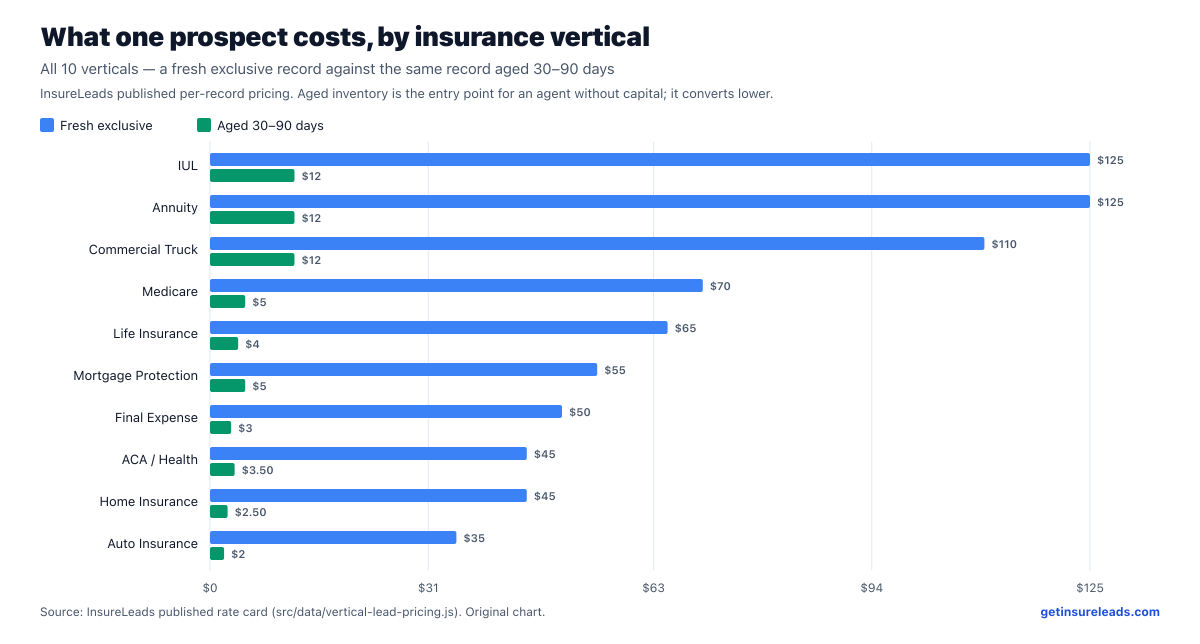
On prospecting: whichever commercial niche you pick, practise on inventory that costs little enough to waste. Discounted older prospect records exist for exactly that purpose — trucking records aged 30–90 days run $12 each against $110 for a real-time exclusive record. Aged inventory closes in the low single digits, so treat it as reps and renewal-calendar building rather than as an income plan, and do not buy a class your markets will decline.
Frequently asked questions
Is there a commercial insurance agent licence?
No. Every U.S. jurisdiction licenses producers by line of authority — property and casualty, and life and health — not by whether the buyer is a business or a household. Commercial lines are written under the property and casualty authority. Florida, for example, issues a single 2-20 General Lines licence covering Property, Casualty, Surety, Marine, Health and Miscellaneous Lines, whose common uses include workers compensation and bonds as well as personal auto and homeowners.
Can I sell commercial insurance with a personal-lines-only licence?
Generally not, and where states issue a narrower personal-lines credential the limitation is explicit. Florida's Personal Lines Agent licence (20-44) is a separate, lesser authority from the 2-20 General Lines licence, and Florida lists one year as an appointed 20-44 plus a 40-hour approved course as one qualifying path up to the full general-lines licence. Check your own state's lines of authority rather than assuming; the structure differs materially between jurisdictions.
How long does it take to get licensed for commercial lines?
The education requirement dominates the timeline and varies widely by state. Florida's default route for its 2-20 General Lines licence is a department-approved 200-hour property and casualty course completed within four years of application, plus the state examination, fingerprinting and an appointment. Candidates with an insurance degree including at least 18 semester hours in property, casualty, health and commercial insurance, or the CPCU designation, are exempt from the state exam in Florida.
Do I have to learn workers compensation?
If you intend to write businesses with employees, yes — and you have to learn it state by state rather than nationally. The Texas Department of Insurance states that in Texas private employers can choose to carry workers' compensation coverage and that it is not required in most cases; employers without coverage, called non-subscribers, must report that fact to the state and must report work-related injuries involving more than one day of lost time, along with all work-related illnesses and deaths. Most other states impose a mandate. Workers compensation is also payroll-and-classification rated and audited afterwards, so application accuracy has financial consequences for the client.
How long before a commercial book starts paying?
Longer than a consumer line, because policies renew annually and you can only sell into the window before an expiry date you cannot move. Expect the first two quarters to produce submissions rather than commissions. The compensating structure is renewal income: our compensation analysis estimates that renewal and residual income makes up roughly 45–55% of total compensation for agents licensed ten years or more.
What do commercial insurance agents earn?
BLS reports a May 2024 median annual wage of $60,370 for insurance sales agents overall, with the lowest 10 percent under $36,390 and the highest 10 percent above $135,660. Our own analysis places first-year agents across all lines in a $24,000–$56,000 interquartile range. We do not publish a commercial-lines commission percentage table because no verified figures exist in our records — ask the specific carrier or wholesaler for their schedule in writing.
Which commercial line should a new agent learn first?
The business owners policy, because it packages property and general liability for small low-hazard accounts and is quotable without deep underwriting judgment. Commercial auto is the natural second, particularly for agents arriving from personal lines, and it leads directly into trucking — the one commercial niche where a newcomer has a structural advantage, because the purchase is federally compelled and a large share of the market is one-truck sole proprietors with no incumbent agent.
Do I need to join an agency, or can I start independent?
Both are possible; the appointment problem decides which is realistic for you. Direct carrier appointments are granted on production history a new agent does not have, so independents typically reach markets through a managing general agent, a program manager, a surplus-lines broker, or a cluster. BLS's employment mix shows how common the agency route is: 62 percent of insurance sales agents work in agencies and brokerages and 13 percent are self-employed.
Sources
- https://www.bls.gov/ooh/sales/insurance-sales-agents.htm — The quoted statement that separate licences are required for life-and-health versus property and casualty; May 2024 median annual wage $60,370, lowest 10 percent under $36,390, highest 10 percent above $135,660; 568,800 jobs in 2024, 4 percent projected growth 2024–34, 21,100 employment change, about 47,000 annual openings mostly from occupational exits; and the employment mix of 62 percent in agencies and brokerages, 13 percent self-employed.
- https://www.myfloridacfo.com/docs-sf/insurance-agents-and-agency-services-libraries/agents-docs/licensure/agents-adjusters/2-20-resident-general-lines.pdf — Florida 2-20 Resident General Lines licence scope (Property, Casualty, Surety, Marine, Health and Miscellaneous Lines); workers compensation and bonds among its common uses; the 200-hour approved P&C course within four years plus state exam; the 20-44 Personal Lines Agent and 4-40 Customer Representative alternative route with a 40-hour course; CPCU and 18-semester-hour insurance-degree exam exemptions; and that the licence requires an appointment to be valid and expires if unappointed for 48 months.
- https://www.tdi.texas.gov/wc/employer/index.html — That in Texas private employers can choose to carry workers' compensation coverage and it is not required in most cases, and that non-subscribers must report their lack of coverage to the state and must report work-related injuries involving more than one day of lost time as well as all work-related illnesses and deaths.
- https://www.fmcsa.dot.gov/sites/fmcsa.dot.gov/files/2025-09/FMCSA%20Pocket%20Guide%202024-v6%20508%20.pdf — 787,189 active interstate and intrastate HM motor carriers and 418,526 carriers with a single power unit as of the 29 December 2023 MCMIS snapshot, and the decline in active carriers from 813,844 in 2022 to 787,189 in 2023.
- https://www.govinfo.gov/content/pkg/CFR-2024-title49-vol5/xml/CFR-2024-title49-vol5-sec387-9.xml — The $750,000 minimum level of financial responsibility for for-hire carriers of nonhazardous property in interstate or foreign commerce at a GVWR of 10,001 pounds or more.