
How to Become a Property and Casualty Insurance Agent
The short answer
A property and casualty insurance agent passes a P&C exam, then meets the real constraint: carrier appetite. On homeowners, roof age and catastrophe exposure decide what you can place more often than price does. Expect to build a property bench and a residual-market fallback before lead volume matters at all.
What does a property and casualty credential actually authorize?
Property and casualty are two things, and treating them as one word hides the first thing a new agent needs to know. Casualty covers liability — what you owe someone else. Property covers the physical thing itself. Some states license the halves separately: California issues a Property Broker-Agent license and a Casualty Broker-Agent license as distinct credentials. Each carries a minimum age of 18, and the California Department of Insurance requires its 12 Hours of Study on Ethics and the California Insurance Code — but an applicant seeking more than one of those license types completes that 12-hour course only once. Once licensed, property and/or casualty agents complete 24 hours of instruction during each two-year license period, including at least 3 hours of ethics training.
The multi-state question arrives faster on the property side than anywhere else, because property appetite is geographic. When your carriers stop writing in one state, the business moves to another, and your license has to move with it. The NAIC's account of producer licensing is that historically a producer licensed in one state generally had to meet the separate nonresident licensing requirements in other states, which is the problem NARAB II was created to streamline. Plan for non-resident licensing as a recurring cost of doing property, not a one-off.
What the credential does not include is worth stating plainly, because a lot of career content blurs it. Hour requirements, fees and background-check rules differ by jurisdiction — we verified California directly this pass and did not extrapolate from it, so compare against the jurisdiction-by-jurisdiction hour and CE tables before you enrol in anything.
- Life insurance, including final expense and IUL — a separate line of authority and a separate exam.
- Health insurance and Medicare — a separate line, plus annual carrier certification.
- Annuities — life line of authority, with suitability requirements attached.
- Surplus lines and excess-and-surplus placements — typically a separate authority on top of your resident P&C license, and the thing you will want most in a hard property market.
- Non-resident licensing in every state you intend to write — not automatic, and not free.
Why does carrier appetite decide a property agent's first year?
Because on homeowners, the answer to "can I place this?" comes before the answer to "can I win on price?" Underwriting screens the roof, the catastrophe exposure, the replacement cost adequacy and the prior claim history, and a risk that fails any of those is not a pricing problem — it is a placement problem. New property agents lose most of their early quotes here and misread it as a sales failure.
The rate environment behind that is documented. In the NAIC's homeowners report, the nationwide average premium for dwelling fire and homeowners owner-occupied policies increased by 10.5% between 2021 and 2022, with HO-3 policies up 11.26% year over year while HO-4 tenant policies rose only 0.6%. Owner-occupied risk repriced hard; the tenant product barely moved. That divergence tells you where the carriers' pain is, and therefore where their appetite has narrowed.
The clearest single measure of what happens when appetite runs out is the size of a state's residual market. Florida's state-backed Citizens Property Insurance Corporation reported 294,894 policies in force as of April 30, 2026, with total exposure of $88,506,830,769 and premium with surcharges of $804,002,403. Inside that, 228,964 were personal residential multiperil policies and 60,860 were personal residential wind-only, against 5,070 commercial policies of all types. A wind-only count in the tens of thousands is the shape of a market where the wind peril, specifically, is the part private carriers decline — and wind-only placements are their own workflow, not a variation on a standard homeowners quote.
| Gate | What underwriting is looking at | What a new agent does about it |
|---|---|---|
| Roof age and material | Age since replacement, shape, and documentation | Ask on the first call, before you quote anything |
| Catastrophe exposure | Wind, hail, wildfire and distance to coast or brush | Know which of your carriers are open in that ZIP this month |
| Replacement cost adequacy | Rebuild cost from a carrier estimator, not market value | Use 360Value, e2Value or MSB through the carrier portal |
| Prior claims | CLUE history, frequency more than severity | Pull it early; a surprise claim kills a bound quote at underwriting |
| Occupancy | Owner-occupied, tenant-occupied, or landlord dwelling fire | Route landlord risks to DP-3 products, not homeowners forms |
What does a new property agent build in the first 90 days?
A bench, an estimator habit, and a callback rhythm — in that order. Our vertical data puts the minimum competitive property bench at six to eight standard-market appointments, with agencies carrying twelve or more winning on appetite far more often than agencies carrying three or four. In hard-market states the standard bench is not enough on its own; specialty and regional carriers are what make coastal and wildfire risks placeable at all.
The estimator habit is the one that protects you legally. Quoting a dwelling limit from a tax assessor or market value understates rebuild cost and exposes the client to a coinsurance penalty at claim time, which is among the most common errors-and-omissions exposures in personal property. Pull replacement cost from the carrier's own estimator every time, including on the quotes you expect to lose.
Property callback timing is different from auto and it is worth setting deliberately. A homeowners quote takes materially longer to build than an auto quote — minutes per carrier rather than seconds — so the realistic standard is a five-to-ten-minute first contact with a longer working session behind it. Keep that pipeline somewhere durable from day one; a no-cost place to keep your quote pipeline is sufficient for a solo producer, and it matters more here than in auto because property quotes sit open for days.
- Weeks 1–3: confirm which carriers will appoint you in your resident state, and which are closed to new appointments entirely.
- Weeks 2–5: get replacement-cost estimator access through each carrier portal and quote three practice risks per carrier.
- Weeks 4–8: write your intake script around roof age, claims history and occupancy — before price.
- Weeks 6–10: add one specialty or regional carrier for the risks your standard bench declines.
- Weeks 8–12: only now set a lead budget, sized to the states and ZIPs where you have a live placement path.
How does the money work on homeowners compared with auto?
Per-policy premium on homeowners is substantially larger than on auto, so the same commission percentage produces more revenue per household. The trade is cycle length and placement risk: a property quote takes longer to build, is more likely to die at underwriting, and in cat-exposed states may have nowhere to land. Bundled households are where the property side earns its reputation — a home-and-auto household has switching costs that a mono-line household does not.
We will not put a commission percentage on this page, because we do not have a verified one to publish. The compensation analysis on this site carries first-year bands for Medicare, Medicare Supplement, final expense, IUL, term life and ACA — the life and health lines its interview panel actually covered — and no property and casualty band at all. Anyone quoting you a precise P&C commission figure without naming a carrier schedule is estimating.
What does transfer is career stage. The first-year income bands we publish put producers in year one at $24,000 at the 25th percentile, $38,000 median, $56,000 at the 75th and $78,000 at the 90th. Read the first-year column as a floor for a new licensed producer of any line, not as a homeowners forecast. The same analysis reports median time-to-first-sale of 21–45 days for new agents working aged records only, which is the relevant number here because a property agent on a small budget almost always starts on aged inventory.
Where does a new property agent find homeowners to quote?
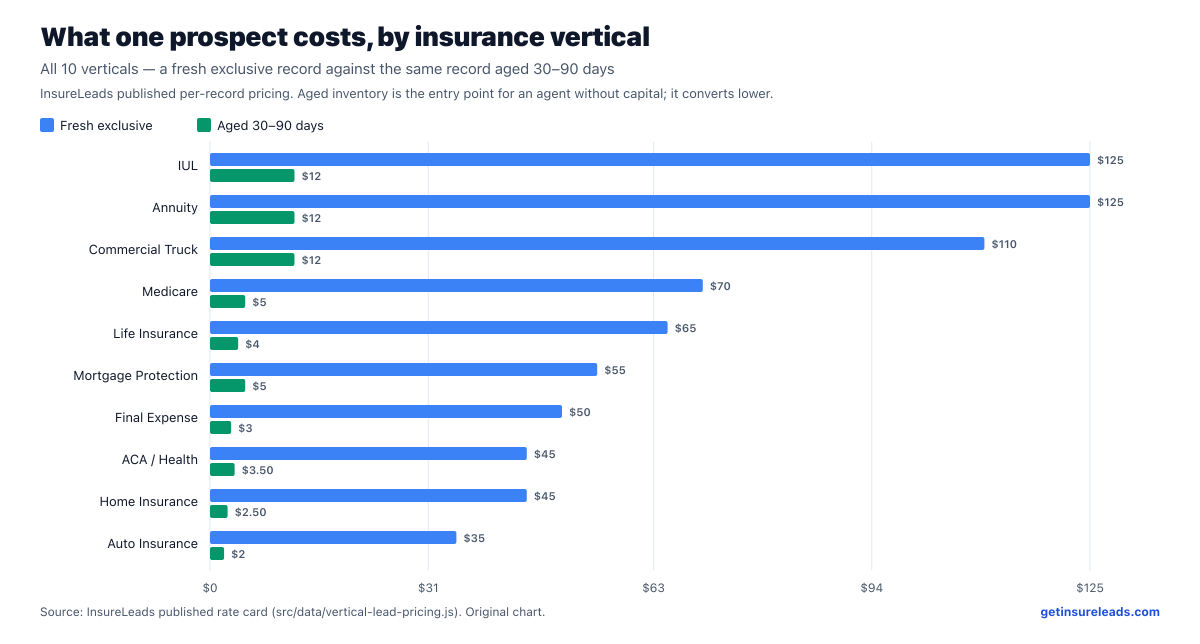
Homeowners inventory on this site runs $45 for exclusive real-time inquiries, $100 for interest-verified live transfers, and from $2.50 for older inquiries priced for a small budget in the 30-to-90-day band. Because most property agents also write the auto policy in the same household, the auto side of the order matters to the arithmetic: exclusive auto runs $35 and 30-to-90-day auto records $2, which is why a bundled order is usually cheaper per household than two single-line orders. You can model the spend before you commit to it, and our homeowners inventory and what it includes lists the fields each record carries.
The rule that saves new property agents the most money has nothing to do with price. Do not buy volume in a state where your only placement option is the residual market. A lead you convert into a quote you cannot bind costs you the lead, the hour and the referral — the Citizens figures above are what that failure looks like at state scale. Buy where your bench is open, then widen the geography as your appointments and surplus lines access widen.
Both auto and home sell à-la-carte or as a bundled order rather than through a prepaid single-line campaign, for the same reason in both cases: one policy's first-year commission is too thin to carry a large upfront commitment. That is a constraint on how we sell, and it is why nothing here points a first-year agent at a big prepaid spend.
| Format | Close rate (site data) | Leads per policy at that rate | When it makes sense |
|---|---|---|---|
| New home buyer | 20–35% | 3 to 5 | You can work to a mortgage closing date |
| Interest-verified live transfer | 18–28% | 4 to 6 | Bench open in that state and a rater ready |
| Exclusive web lead | 7–14% | 8 to 15 | 6+ property appointments, disciplined intake script |
| Shared web lead | 3–7% | 15 to 34 | High-volume quoting against several agents |
| Aged record, 30–90 days | 2–5% | 20 to 50 | Dial capacity, timed to a renewal or non-renewal notice |
How does a property agent get appointed, and what happens when nobody will write the risk?
The routes are the same three as anywhere in P&C — captive, direct appointment as an independent, or a cluster and aggregator arrangement that places you under someone else's contracts — but the property side adds a twist: carriers freeze new appointments in stressed states, so the appointment you want may simply not be available where you live this year. Ask which states an appointment is actually open in before you count it. The sequence and paperwork are laid out in the appointment process step by step.
When the admitted market declines a risk, the fallback is either surplus lines or the state's residual mechanism. Surplus lines authority is a separate credential in most states and is the single most useful thing a property agent can add after the base license, because it converts declined risks into placeable ones. State residual markets exist as the last resort — Florida's Citizens is the one whose numbers we verified for this page, and other states run their own equivalents with their own eligibility rules. Treat residual placement as a service you provide, not a sale you celebrate; the premium is high, the commission is often restricted, and the client will shop the moment a private carrier reopens.
One disclosure, since almost every other page on this subject is monetised: we take no referral, sponsorship or affiliate money from any carrier, cluster, aggregator or IMO. There is no arrangement behind any name on this page and no ranking implied by the order they appear in.
Which states should a new property agent actually start in?
The states with the most homeowners shopping are frequently the states where you can place the least — that is the whole point of a hard market, and it is the trap in choosing a territory by lead volume. Rate volatility, non-renewal waves and coastal or wildfire exposure generate the shopping; narrowed appetite is what generated the volatility.
Start where you hold residency and where your bench is genuinely open, get your intake and estimator discipline working there, then add catastrophe-exposed states once you have surplus lines access and specialty appointments to support them. If you want the faster, cheaper, higher-frequency half of the same credential to learn on first, that is the auto half of the same license — smaller commission per policy, but a quote-to-bind cycle measured in minutes.
Frequently asked questions
Is a property and casualty agent the same thing as a homeowners agent?
A homeowners agent is a property and casualty agent working one product inside that license. The same credential also authorizes auto, dwelling fire, landlord DP-3, and commercial lines such as BOP and general liability. Most independent P&C agents write at least homeowners and auto, because the bundle is what makes a household stay.
Do I need a separate license for property and for casualty?
It depends on the state. California issues a Property Broker-Agent license and a Casualty Broker-Agent license separately, though an applicant seeking more than one of those types completes the state's 12 Hours of Study on Ethics and the California Insurance Code only once. Other jurisdictions issue a single combined property and casualty license — check your own state rather than assuming.
How many home carriers do I need before I start buying leads?
Our vertical data puts the minimum competitive bench at six to eight standard-market appointments, with twelve or more materially improving how often you have an appetite match. In catastrophe-exposed states, add specialty or regional carriers, because a standard-only bench will decline a large share of the risks you quote.
Why did my homeowners quote get declined after I sent it to the client?
Almost always an underwriting gate rather than price — roof age, catastrophe exposure, prior claims on the CLUE report, or a replacement cost figure that does not support the requested limit. The fix is intake: ask about roof age, claims and occupancy before you build the quote, not after.
Should I start with auto or with home?
Auto teaches you faster because the quote-to-bind cycle is minutes and the inventory is cheaper, so you get more repetitions per dollar. Home pays more per policy and anchors the bundle. Most new P&C agents run auto first for volume and add property once they have a bench that can actually place risks.
How long until a new property agent makes a first sale?
Our compensation analysis reports median time-to-first-sale of 21–45 days for new agents working aged records only, and 12–21 days for agents working purchased exclusive web leads. Those medians come from interviews with life and health producers rather than P&C agents, so read them as a shape rather than a benchmark for homeowners.
What happens when no private carrier will write the house?
You either place it in the surplus lines market — a separate authority in most states, and the most useful credential to add after your base license — or in the state's residual mechanism. Florida's Citizens reported 294,894 policies in force as of April 30, 2026, including 60,860 personal residential wind-only policies, which is what a state-scale placement failure looks like.
What does homeowners lead inventory cost on this site?
Exclusive real-time homeowners inquiries run $45, interest-verified live transfers $100, and 30-to-90-day aged records start at $2.50. Home and auto sell à-la-carte or as a bundled order rather than through a prepaid single-line campaign.
Sources
- https://www.insurance.ca.gov/0200-industry/0050-renew-license/0200-requirements/property/quals.cfm — California Property Broker-Agent qualifications: minimum age 18; the 12 Hours of Study on Ethics and the California Insurance Code required once across multiple license types; 24 hours of instruction per two-year license period including at least 3 hours of ethics.
- https://www.insurance.ca.gov/0200-industry/0050-renew-license/0200-requirements/casualty/quals.cfm — That California issues a Casualty Broker-Agent license separately from the Property Broker-Agent license, with the same age, ethics-course and continuing-education requirements.
- https://content.naic.org/cipr-topics/producer-licensing — NAIC on nonresident licensing: a producer licensed in one state generally had to meet the separate nonresident licensing requirements in other states, the problem NARAB II was created to streamline.
- https://content.naic.org/article/naic-releases-homeowners-insurance-report-2022 — NAIC homeowners report: the nationwide average premium for dwelling fire and homeowners owner-occupied policies increased by 10.5% between 2021 and 2022; HO-3 up 11.26% year over year; HO-4 up 0.6%.
- https://www.citizensfla.com/-/20260430-policies-in-force — Citizens Property Insurance Corporation as of April 30, 2026: 294,894 policies in force, total exposure $88,506,830,769, premium with surcharges $804,002,403, including 228,964 personal residential multiperil, 60,860 personal residential wind-only, and 5,070 commercial policies.