
How to Become an Auto Insurance Agent
The short answer
Becoming an auto insurance agent means passing a property and casualty exam — a different license from the life and health path most insurance careers start on. Before your first sale you need carrier appointments and a comparative rater. Auto also pays the smallest commission per policy of any line on this site.
Which license does an auto insurance agent actually need?
An auto insurance agent holds a property and casualty line of authority. Private passenger auto sits across both halves of that credential: liability is casualty, physical damage is property. This is the fork in the road that catches most people researching an insurance career, because the majority of published "how to become an insurance agent" material is written for the life and health path — final expense, Medicare, annuities. Nothing transfers between the two except your tolerance for sitting a state exam.
How the credential is issued varies by jurisdiction, and some states split it in two. California issues a Property Broker-Agent license and a Casualty Broker-Agent license separately. For each, the California Department of Insurance sets a minimum age of 18 and requires the state's 12 Hours of Study on Ethics and the California Insurance Code — an applicant seeking more than one of those license types completes that 12-hour course only once. After licensing, property and/or casualty agents must complete 24 hours of instruction during each two-year license period, including at least 3 hours of ethics training.
The gate is real but not exotic. The NAIC records that more than 2 million individuals and more than 236,000 business entities are licensed to provide insurance services in the United States. Hour requirements, fees and fingerprint rules differ by state, and we verified California's figures directly rather than borrowing them; check what your own state requires before the exam instead of assuming California's numbers apply. If you are still weighing P&C against the life and health route, the license-choice decision itself is covered separately.
| Product | Inside a P&C license? | What else it takes |
|---|---|---|
| Private passenger auto liability and physical damage | Yes | Carrier appointments plus a comparative rater |
| Homeowners and dwelling fire | Yes | A separate carrier bench with its own appetite rules |
| Commercial auto, BOP, general liability | Yes | Commercial appointments, which are gated on experience |
| Final expense whole life | No | Life line of authority, separate exam |
| Medicare Advantage and Part D | No | Health line of authority plus annual carrier certification |
| Fixed and indexed annuities | No | Life line of authority plus suitability training |
| Surplus lines and E&S placements | No | A separate authority in most states |
- Pick your resident state — that is the license that governs everything else you do.
- Complete whatever prelicensing education that state requires for property and casualty.
- Sit the state's property and casualty exam.
- Clear fingerprinting and background review where your state requires it.
- Apply through your state's producer licensing portal and receive the license.
- Only then chase carrier appointments — no carrier will appoint an unlicensed producer.
What does the first 90 days as an auto agent actually consist of?
Almost none of it is selling. The first 90 days are spent assembling a quoting stack, and an agent who buys prospects before that stack exists burns the inventory. Auto buyers compare three to five prices inside a short window, so an agent who cannot produce several of those prices while the prospect is still on the phone loses on mechanics rather than on skill.
The stack has three parts. A comparative rater — EZLynx, Applied Rater, TurboRater and similar platforms — is what turns one data entry into several carrier quotes. A carrier bench wide enough to have an answer for the risk in front of you: our own vertical data puts the working minimum at 15 to 30 standard and preferred appointments, with strong independent agencies carrying more, and agencies running three or four appointments losing on rate far more often than they lose on presentation. And a place to keep the pipeline — a single-seat CRM that costs nothing to run is enough for a solo producer's first year, because at this stage the constraint is callback discipline, not software.
Set your callback standard at five minutes and structure your day around it rather than around lead volume. Auto is the one personal line where the rating engine is fast enough that same-call binding is normal, which means the agent who answers first while the prospect's browser tabs are still open usually writes the policy.
The honest part: in your first 90 days you will lose most quotes to carrier appetite, not to price. That is normal in P&C and it is the reason the bench comes before the budget.
Why does auto pay less per policy than any other line on this site?
Because auto commission is a percentage of an annual premium, and that premium is small relative to the products a life-side agent sells. The structural difference matters more than any single number: a P&C policy pays you a slice of premium every renewal term, forever, while a life policy pays you most of year one's premium once and then a thin residual. Our own compensation analysis puts final expense first-year commission at 90–120% of annual premium with 3–5% residual in years 2–10, and ACA health at $15–$25 per member per month for as long as the member stays enrolled. Auto has no published band in that dataset, which is a gap we would rather flag than fill with a guess.
What does bound the ceiling is premium size, and there the primary data is unambiguous. In the NAIC's 2023 Auto Insurance Database Average Premium Supplement, average expenditures per insured vehicle increased to $1,281.60, a 19.21% increase since 2019; combined average premiums rose 14.41% nationally in 2023, with comprehensive premiums up 21.31% against exposure growth of just 0.38%. Read that two ways. Your revenue per household is a fraction of roughly that figure, which is thin. But premiums rising far faster than the number of insured vehicles is exactly what drives shopping frequency, which is why auto lead flow is the steadiest in personal lines.
For career-stage expectations, our own analysis of what agents earn by career stage puts producers in their first year at $24,000 at the 25th percentile, $38,000 median, $56,000 at the 75th and $78,000 at the 90th. One caveat we will not paper over: the interview panel behind that analysis covered Medicare, final expense, IUL and ACA producers, not P&C. Treat the first-year column as a career-stage picture, not an auto forecast.
| Line | How year one pays | What renews | Source |
|---|---|---|---|
| Auto | A percentage of a premium that renews every 6 or 12 months | The same percentage each renewal term, indefinitely | No verified band published here yet |
| Final expense whole life | 90–120% of annual premium | 3–5% in years 2–10 | Site compensation analysis |
| ACA / health, under 65 | $15–$25 per member per month | Same PMPM while the member stays enrolled | Site compensation analysis |
Where does a new auto agent get people to quote?
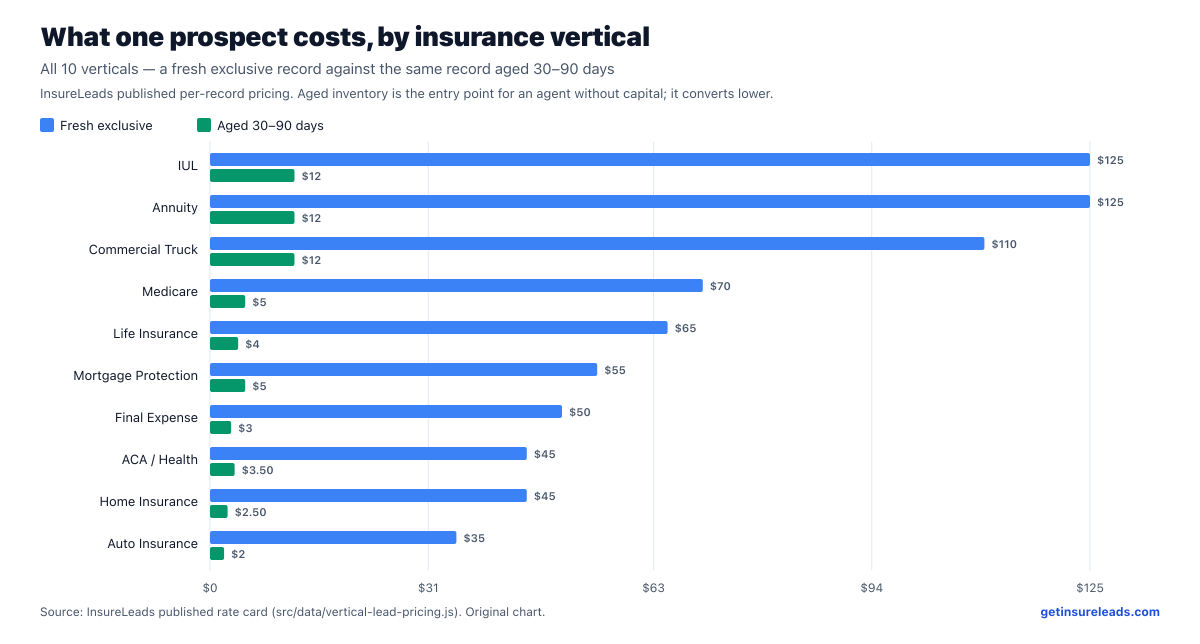
Auto carries the cheapest entry inventory of any vertical we sell, which is the one genuine advantage a capital-poor new agent has in this line. Exclusive real-time auto inquiries run $35, contact-verified records $50, interest-verified live transfers $90, and records that have already been through one shopping cycle start at $2 for the 30-to-90-day band.
The useful arithmetic is in lead counts, not dollars. Our published planning band puts exclusive auto web leads at a 5–12% close rate, which is nine to twenty leads per policy. Aged records close at 2–5%, or twenty to fifty per policy — cheap per record, expensive in dial time, and the reason aged-only programs are the slowest path to a first sale. Live transfers close at 15–25%, four to seven per policy, but only if your rater is already open when the call lands; a transfer you cannot quote on the call is the most expensive mistake available to a new agent.
Auto and home sell à-la-carte or as a bundled order rather than through a prepaid single-line campaign, and the reason is the margin math above: first-year commission on one auto policy is too thin to carry a large prepaid commitment. That is a constraint on us as a vendor as much as on you as a buyer, and it is why nothing on this page routes you toward a big upfront spend.
| Format | Close rate (site data) | Leads per policy at that rate | When it makes sense |
|---|---|---|---|
| Interest-verified live transfer | 15–25% | 4 to 7 | Rater already open, agent trained to quote live |
| Exclusive web lead | 5–12% | 9 to 20 | 15+ appointments and a five-minute callback habit |
| Non-standard / SR-22 | 15–30% | 4 to 7 | Non-standard appointments in place |
| Shared web lead | 3–7% | 15 to 34 | High-volume quoting, competing with several agents |
| Aged record, 30–90 days | 2–5% | 20 to 50 | Dial capacity, timed to the next renewal window |
What is the non-standard auto market, and should a new agent start there?
Non-standard auto serves drivers with coverage lapses, serious violations or a court-ordered filing, and it is the one segment of personal lines where the buyer has no legal alternative to buying. California's driver handbook sets the state's minimum liability limits at "$30,000 for a single death or injury. $60,000 for death or injury to more than one person. $15,000 for property damage," and states that a driver may recover the driving privilege during the final three years of a suspension by providing a California Insurance Proof Certificate (SR 22/SR 1P) "and maintain it during the three-year period."
That three-year maintenance requirement is the whole commercial logic of the segment. The prospect cannot drive legally without the filing, cannot let it lapse without the suspension resuming, and therefore answers the phone. Our published planning band puts non-standard and SR-22 close rates at 15–30%, roughly triple the standard exclusive web lead.
The cost is service load. Non-standard business runs on monthly pay plans, cancels more often, and generates more chargebacks and more inbound calls per policy than standard auto. It also requires its own appointments — Dairyland, Bristol West, National General and Progressive's non-standard arm are the usual names — so quoting these risks against a preferred-only bench wastes the lead entirely.
Those California limits are California's. Every state sets its own minimums and its own filing form, and quoting another state's numbers from memory is how new agents create errors-and-omissions exposure in month two.
How does an auto agent get appointed with carriers?
Three routes exist, and they are not equally open to a new licensee. A captive career contract with a single-brand carrier trades your independence for training and a book you usually do not own. Direct appointments as an independent give you the widest bench but most carriers will not appoint a producer with no premium history. A cluster, aggregator or agency network places you under someone else's contracts in exchange for a commission split, which is how a large share of new independents actually get on paper.
Worth knowing before you read life-side career material: P&C distribution does not run on the IMO and FMO ladder that final expense and Medicare use. If you have been reading about upline hierarchies and contract levels, that is how the life-side distribution ladder is structured, and the closest P&C analogue is the cluster. The mechanics of getting appointed, in the order they actually happen, are covered in the appointment process step by step.
Two honest notes. Carriers tighten appointments when their loss ratios move, so appointment availability in your state this quarter is a fact you have to check rather than plan around. And we take no referral, sponsorship or affiliate money from any carrier, cluster or IMO — nothing on this page is placed, and nothing here ranks one of them above another.
- Who owns the book if you leave, and what does the non-compete say?
- What is the commission split, and does it change at volume?
- Is there a minimum premium commitment, and what happens if you miss it?
- Which carriers do you actually get access to, and which are already saturated in your territory?
- Do the prospects you pay for stay yours, or do they route through the cluster's system?
- What does exiting cost, in money and in months?
What should an auto agent add second?
Home, and for a reason auto agents discover in month three: a mono-line auto household shops on price at every renewal, while a household with two policies at the same agency has switching costs. The same license already authorizes it, so the second line costs you a carrier bench rather than another exam.
Property is a slower, more appetite-constrained sale than auto — roof age, wind exposure and replacement cost decide placements before price does. If you are planning to bundle, read the property side of the same credential before you order homeowners inventory, because the states with the most home shopping are frequently the states where you can place the least.
Frequently asked questions
Do I need a property and casualty license to sell auto insurance?
Yes. Auto insurance sits inside the property and casualty line of authority — liability is casualty, physical damage is property. A life or health license does not authorize it, and there is no partial credential for auto alone in most states, though some issue a narrower personal lines license.
Can I sell auto insurance with a life insurance license?
No. They are separate lines of authority with separate exams. An agent who wants both sells under both licenses, which is common but means two exams and two sets of continuing education. California, for example, requires 24 hours of instruction per two-year license period including at least 3 hours of ethics for property and casualty agents.
How many carriers do I need before I start quoting auto?
Our vertical data puts the working minimum at 15 to 30 standard and preferred appointments, with strong independent agencies carrying considerably more. Agencies with three or four appointments lose on rate rather than on presentation, which is why the carrier bench comes before any lead budget.
How long until a new auto agent makes a first sale?
Our compensation analysis reports median time-to-first-sale of 12–21 days for new agents working purchased exclusive web leads and 21–45 days for agents working aged records only. Those medians come from interviews with Medicare, final expense, IUL and ACA producers rather than P&C agents, so treat them as a shape rather than a promise.
Is auto a good first line for a brand-new agent?
It gives you the most at-bats per dollar and the fastest feedback loop, because auto quotes and binds in minutes. It also pays the least per policy of any line we sell, so early cash flow is thin and the economics only work if you treat renewals and bundling as part of the plan rather than as a bonus.
Do I need a comparative rater before I buy auto leads?
Yes, and it should be configured before your first order. Auto buyers compare several prices in a short window, so an agent who cannot produce multiple carrier quotes during the first call is paying for inventory they cannot convert. This is the single most common way new P&C agents waste a lead budget.
What does auto lead inventory cost on this site?
Exclusive real-time auto inquiries run $35, contact-verified records $50, interest-verified live transfers $90, and 30-to-90-day aged records start at $2. Auto and home sell à-la-carte or as a bundled order rather than through a prepaid single-line campaign.
Sources
- https://www.insurance.ca.gov/0200-industry/0050-renew-license/0200-requirements/casualty/quals.cfm — California Casualty Broker-Agent qualifications: minimum age 18; the 12 Hours of Study on Ethics and the California Insurance Code required only once; 24 hours of instruction per two-year license period including at least 3 hours of ethics.
- https://www.insurance.ca.gov/0200-industry/0050-renew-license/0200-requirements/property/quals.cfm — California Property Broker-Agent qualifications: minimum age 18; the 12-hour ethics and Insurance Code course applies once across multiple license types; 24 hours CE per two-year license period including 3 hours of ethics.
- https://content.naic.org/cipr-topics/producer-licensing — NAIC: more than 2 million individuals and more than 236,000 business entities licensed to provide insurance services in the United States.
- https://content.naic.org/article/naic-releases-2023-auto-insurance-database-average-premium-supplement — NAIC 2023 Auto Insurance Database Average Premium Supplement: average expenditures increased to $1,281.60 in 2023, a 19.21% increase since 2019; combined average premiums rose 14.41% nationally; comprehensive premiums up 21.31%; exposure growth 0.38%.
- https://www.dmv.ca.gov/portal/handbook/california-driver-handbook/financial-responsibility-insurance-requirements-and-collisions/ — California minimum liability limits of $30,000 / $60,000 / $15,000, and that a driver may recover the driving privilege during the final three years of a suspension by providing a California Insurance Proof Certificate (SR 22/SR 1P) and maintaining it during the three-year period.