
How to Become a Medicare Sales Agent
The short answer
A Medicare sales agent needs a resident life and health licence, then an annual certification cycle: a plan-year training module, per-carrier product certification, and the 85 percent test score CMS requires yearly. First-year Medicare Advantage compensation is capped by CMS at $694 nationally for 2026, with renewals capped at half.
What does a Medicare sales agent do that other insurance agents don't?
A Medicare sales agent works inside a federal rulebook that reaches all the way down to the paperwork on a kitchen table. Three things separate this vertical from every other line an independent agent can sell, and each one is a regulation rather than a market condition.
First, the certification resets every year. CMS requires organisations to train and test all agents and brokers selling Medicare products annually, and agents must "achieve an 85 percent or higher on all forms of testing" (42 CFR 422.2274(b)(2)). Second, your pay has a federal ceiling: CMS publishes fair-market-value maxima for initial and renewal compensation each contract year, so an enrollment is worth what CMS says it is worth and no negotiation changes it. Third, the marketing rules bind the calendar and the conversation — a Scope of Appointment must be secured and documented before you meet a potential enrollee (422.2274(b)(3)), and for a personal marketing appointment it must be agreed and recorded at least 48 hours in advance (422.2264(c)).
The practical consequence is that a Medicare practice is a compliance operation with a sales function attached, not the reverse. Agents who come from life or property and casualty consistently underestimate this, and it is the single most common reason a first Medicare season produces enrollments the carrier will not accept.
- Annual training and testing, with an 85 percent minimum score, every plan year (42 CFR 422.2274(b)(2)).
- A federally capped commission — the ceiling moves once a year, when CMS publishes it, not when you negotiate.
- A Scope of Appointment documented before the meeting, and recorded at least 48 hours ahead for personal marketing appointments.
- Selling seasons defined in regulation rather than by demand, which decides when your income arrives.
What certifications does a Medicare agent have to keep current?
The state licence is the smallest part of the stack and the only part you do once. Everything above it renews annually, and the order matters: carriers will not release product certifications to you until the general Medicare training is complete, and they will not release contracts until the certifications are.
CMS sets the requirement, not the vendor. The regulation obliges plans to train and test agents annually at an 85 percent threshold; AHIP's Medicare training is the third-party module most carriers accept to satisfy it, which is why the industry treats "AHIP" and "annual certification" as synonyms even though the rule names no vendor. Our explainer on what the annual AHIP module covers and how the exam works goes through it in detail. It is a paid product sold by a third party: we do not sell it, resell it, or take any affiliate fee on it, and we do not publish a fee figure we have not verified for the current plan year.
Plan-specific certification sits on top of the general module, once per carrier, every year. An agent contracted with six carriers completes six product certifications annually in addition to the general training — a workload that is invisible in every recruiting pitch and consumes real weeks of the pre-season. Our interview cohort put time spent on licensing, E&O and AHIP or carrier certifications on the pain list for 51 percent of respondents.
| Requirement | Cadence | Who sets it | Source |
|---|---|---|---|
| Resident life and health licence | Once, then continuing education per state | Your state insurance department | State statute; NAIC PR-20 summarises hours by jurisdiction |
| Annual Medicare training and testing, 85% minimum score | Every plan year | CMS, enforced through the plan | 42 CFR 422.2274(b)(2) |
| General certification module (AHIP or a carrier-accepted equivalent) | Every plan year | Carrier's choice of module to satisfy the CMS rule | Third-party paid product; CMS names no vendor |
| Plan-specific product certification | Every plan year, per carrier | Each carrier | Carrier certification requirements |
| Scope of Appointment, documented before the meeting | Every appointment | CMS | 42 CFR 422.2274(b)(3); 42 CFR 422.2264(c) for the 48-hour advance rule |
How much does a Medicare enrollment pay, and who decides?
CMS decides. Each year CMS publishes the fair market value amounts an organisation may pay an independent agent for an initial enrollment, and limits renewal compensation to a maximum of 50 percent of that value. The CY 2026 amounts, from the CMS memorandum on Contract Year 2026 agent and broker compensation rates dated June 18, 2025, are $694 initial and $347 renewal nationally, with higher amounts in a handful of jurisdictions and lower amounts in Puerto Rico and the U.S. Virgin Islands. Standalone prescription drug plans pay $114 initial and $57 renewal. Referral fees are capped separately at $100 for an MA or MA-PD referral and $25 for a PDP referral.
Read that table as a ceiling on your upside and a floor under your risk. Because street commission is fixed, the only variables you control are how many enrollments you write, how long they persist, and what each one cost you to acquire. Overrides at the FMO level add to the figure — our analysis puts a typical override in the range of $100 to $150 per policy — but they do not change the shape of the problem, and Medicare Supplement runs on a different basis entirely: 18 to 24 percent of annual premium, which on a roughly $1,800 premium at 22 percent works out near $396 first-year.
Persistency is not a soft virtue in this vertical; it is written into the compensation regulation. Where rapid disenrollment compensation recovery applies, "the entire compensation must be recovered", and for other recoveries plans must claw back a pro-rated amount equal to the number of months the member was not enrolled. An enrollment that leaves in month three is not a small win — it is a debit.
| Plan type / jurisdiction | Initial year | Renewal years |
|---|---|---|
| MA and Section 1876 Cost Plans — National | $694 | $347 |
| MA — Connecticut, Pennsylvania, District of Columbia | $781 | $391 |
| MA — California, New Jersey | $864 | $432 |
| MA — Puerto Rico, U.S. Virgin Islands | $474 | $237 |
| Prescription drug plans (PDP) | $114 | $57 |
| Referral fees | $100 (MA / MA-PD), $25 (PDP) | — |
How does the enrollment calendar decide when you get paid?
Medicare selling seasons are defined in regulation, not by demand. The annual coordinated election period for the following calendar year runs October 15 through December 7 (42 CFR 422.62(a)(2)(iii)). Separately, a beneficiary already enrolled in an MA plan may make one election during the first three months of the year to switch plans or return to Original Medicare (422.62(a)(3)(i)). Special election periods run year-round for qualifying events, and people turn 65 every day of the calendar.
What that does to a new agent's cash flow is the part nobody warns you about. Our own seasonality analysis puts roughly 55 to 65 percent of annual agent-written volume inside those eight AEP weeks, with lead prices running 30 to 50 percent above baseline while the window is open and most vendors capping or reallocating their AEP inventory by early September. The January-to-March period carries roughly 25 to 35 percent of AEP volume at or slightly below baseline pricing.
Then the timing inverts. AEP applications are elections for the following calendar year — the work happens in October, November and December, and the coverage begins January 1. A first AEP is therefore a spending season that becomes an earning season later, which is precisely the wrong shape for someone who just paid for prelicensing, certification and a first lead order. Agents who quit in their first year frequently quit in December.
- October 15 – December 7: the annual coordinated election period, for coverage starting the following January 1 (422.62(a)(2)(iii)).
- January – March: MA enrollees get one election to change plans or return to Original Medicare (422.62(a)(3)(i)); our analysis puts volume at 25–35% of AEP.
- April – September: special election periods and turning-65 prospects carry the pipeline; certification for the coming plan year is completed here.
- Early September: practical cut-off when most vendors, including us, cap or reallocate AEP inventory — pre-booking happens in summer, not autumn.
When is the best time to get licensed as a Medicare agent?
Work backwards from October 15. To sell during an AEP you need the state licence, the general annual certification, the carrier product certifications, and signed contracts — in that order, each one gated on the last. Certification for the coming plan year opens months before AEP; confirm the exact release date with your upline rather than assuming last year's, because the whole downstream chain moves with it.
Starting in January is the other defensible entry point, and it is underrated. You land inside the three-month election window with roughly a quarter to a third of AEP's volume, at baseline lead pricing rather than peak, against a much thinner field of agents — most of whom are exhausted. The tempo is survivable for someone learning a script, which an AEP is not.
The months to be honest about are May through August. Volume comes from special election periods and turning-65 prospects, both of which reward patience over intensity. This is the stretch where aged Medicare records earn their place: cheap enough to sustain dialing volume through a quiet quarter, and useful precisely because a beneficiary whose situation changed after they filled in a form is exactly who a special election period exists for. Pair them with somewhere to log every disposition — a free CRM seat is enough for one agent in one vertical, and Scope of Appointment discipline demands a record anyway.
What does a new Medicare agent's prospecting actually cost?
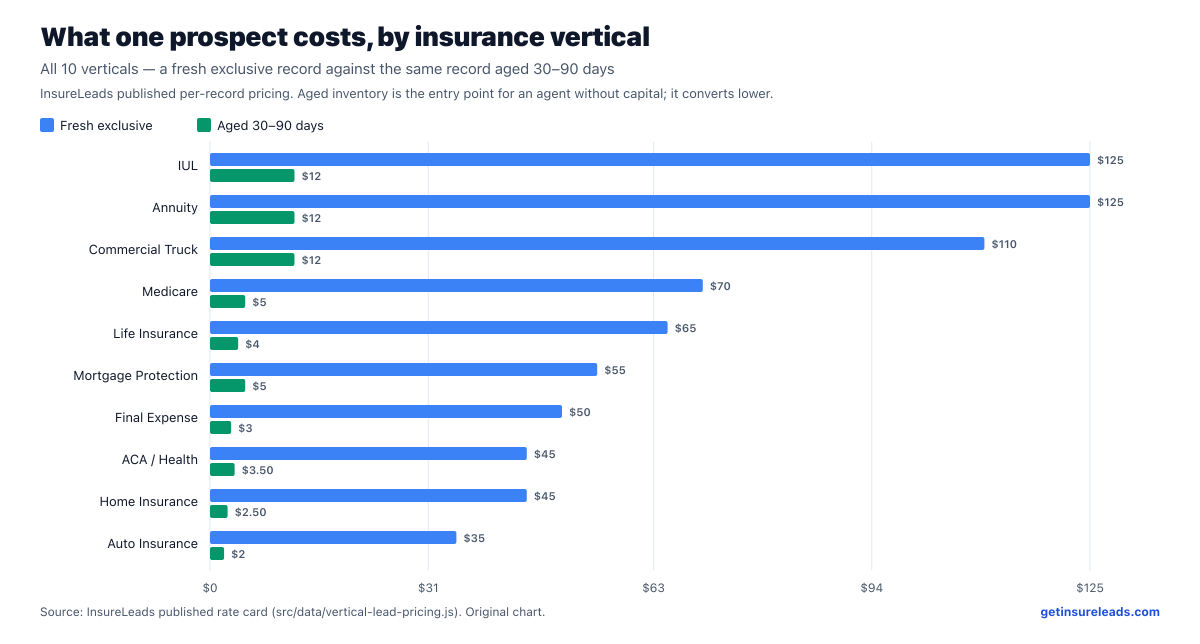
Medicare carries the second-highest per-record prices on our card and the most seasonal ones — our Medicare line is explicitly flagged seasonal for AEP and OEP, which means the figures below move with the enrollment calendar rather than sitting still all year. Exclusive real-time records run $70, contact-verified records $95, interest-verified live transfers $125, and aged records 30 to 90 days old $5.
Put our close-rate ranges against those prices and the maths is unsentimental. Exclusive web records convert at 8 to 15 percent in our data, which means seven to thirteen of them per enrollment; turning-65 records at 12 to 20 percent; live transfers at 15 to 25 percent; aged records at 2 to 5 percent. Now hold that against a first-year enrollment worth $694 nationally under the CMS cap, with renewals capped at half of it — and against the fact that most prospects you reach outside an election period cannot legally change plans yet. Our interview cohort put rising cost per lead outpacing commissions, specifically in MA after the CMS compensation rules, on the pain list for 64 percent of respondents. That is the vertical's central economic fact, and no lead vendor honestly gets to soften it.
What survives that arithmetic is persistency and product mix rather than volume. Medicare Supplement pays on premium instead of the CMS schedule, PDP adds $114 initial per the CMS memo, and renewals compound in a way a first-year agent never sees on a spreadsheet. The Medicare lead formats we sell and their seasonal pricing are published per record, and our income-by-experience and income-by-lead-source tables show what the second and fifth years look like for agents who stayed.
| Format | Price | Close rate (our analysis) | What it demands of you |
|---|---|---|---|
| Interest-verified live transfer | $125 | 15–25% | Live phone coverage and a compliant opener, including Scope of Appointment discipline |
| Exclusive real-time web record | $70 | 8–15% | Speed to first contact and a CRM; seven to thirteen records per enrollment |
| Contact-verified record | $95 | — | Fewer wasted dials; the wrong-number, wrong-state and no-interest waste is removed first |
| Aged record, 30–90 days | $5 | 2–5% | Volume and patience; most prospects are already enrolled, so this is special-election-period work |
| Aged record, 91–180 days | $3 | 2–5% | Sustained dialing through the quiet May-to-August stretch |
How does a new Medicare agent get contracted?
Contracting runs through an intermediary for almost every independent Medicare agent, and the sequence is fixed: complete the annual general certification, complete each carrier's product certification, then get released to write. An upline that promises contracts before certifications is describing a shortcut that does not exist.
The override is where the intermediary is paid, and in Medicare it sits on top of a commission you cannot negotiate. Our analysis puts a typical FMO override at $100 to $150 per policy — which is worth knowing not because you can capture it, but because it explains why recruiting pressure in this vertical is so intense and why 31 percent of our interview cohort named FMO and IMO override opacity as a pain point. Our explainer on how the IMO, FMO and MGA layers are structured lays out the tiers without ranking anyone; the mechanics of getting appointed are covered in our walkthrough of the carrier appointment process.
Two contract terms deserve more scrutiny in Medicare than anywhere else. The release policy, because Medicare appointments are annual and a locked contract can cost you a whole selling season. And the treatment of clawbacks, since compensation recovery on early disenrollment is a regulatory requirement rather than a carrier preference — the money moves back whether or not your upline warned you. We take no referral, sponsorship, or affiliate payment from any FMO, IMO, or carrier, and we do not recruit agents; that is why this page names no upline as a recommendation.
Which Medicare rules actually get agents sanctioned?
The Scope of Appointment is the rule new agents break first. CMS requires agents to "secure and document a Scope of Appointment prior to meeting with potential enrollees" (42 CFR 422.2274(b)(3)), and for a personal marketing appointment the scope must be agreed and recorded with the beneficiary at least 48 hours in advance, subject to stated exceptions (422.2264(c)). An enrollment produced from a conversation with no valid scope behind it is a compliance event, not a sale.
The second rule reaches your lead vendor, which is why it belongs on a page published by one. When plans do business with a third-party marketing organisation, CMS requires their contracts to ensure the TPMO "discloses to the MA organization any subcontracted relationships used for marketing, lead generation, and enrollment" (422.2274(g)(2)(i)). Where your prospects came from is a documented part of the plan's oversight chain — so the ability to produce a source, a timestamp, a landing page and a consent record for a given lead is a compliance requirement, not a nicety. We maintain those records on every lead we sell and capture TCPA consent through TrustedForm or Jornaya on the landing page.
The third is compensation recovery, covered above and worth repeating in a compliance frame: rapid disenrollment triggers full recovery of the compensation paid, and other recoveries are pro-rated by the months the member was not enrolled. Violations of the marketing rules can carry civil money penalties, and the amounts are adjusted periodically — we do not print a figure here because we could not verify the current one from a primary source, and a stale penalty amount would be worse than none.
- Document the Scope of Appointment before the meeting, and record it at least 48 hours ahead for a personal marketing appointment.
- Keep the audit trail for every lead: source, timestamp, landing page, consent record. Your carrier's TPMO oversight obligations run through it.
- Treat permission to contact and TCPA consent as separate things, because they are.
- Expect compensation to be recovered when a member disenrolls early — full recovery on rapid disenrollment, pro-rated otherwise.
Frequently asked questions
Do I have to complete AHIP to sell Medicare?
CMS requires agents and brokers selling MA and Part D products to be trained and tested annually and to achieve 85 percent or higher on all forms of testing (42 CFR 422.2274(b)(2)). The regulation names no vendor. AHIP's Medicare training is the module most carriers accept to satisfy that requirement, so in practice most agents complete it — but the obligation is CMS's, imposed through the plan, and each carrier decides which module it accepts.
Is the Medicare Advantage commission negotiable?
No. CMS publishes fair market value maxima each contract year and limits renewal compensation to 50 percent of that value. For CY 2026 the amounts are $694 initial and $347 renewal nationally, $781/$391 in Connecticut, Pennsylvania and DC, $864/$432 in California and New Jersey, and $474/$237 in Puerto Rico and the U.S. Virgin Islands. Overrides sit above street level and are set by your upline, not by you.
How much does the annual Medicare certification cost?
It is a paid third-party product whose fee is set for each plan year, and some carriers reimburse or discount it for contracted agents. We do not publish a figure we have not verified from a primary source for the current year, and we earn nothing from any certification vendor — check the current price with the module provider or your upline.
When exactly is Medicare's Annual Enrollment Period?
October 15 through December 7, for coverage beginning the following January 1 (42 CFR 422.62(a)(2)(iii)). Separately, a beneficiary already enrolled in an MA plan may make one election during the first three months of the calendar year to change plans or return to Original Medicare (422.62(a)(3)(i)).
Can I start selling Medicare in January instead of waiting for AEP?
Yes, and for a new agent it is often the better entry. The first three months carry the MA election window plus year-round special election periods and turning-65 prospects. Our seasonality analysis puts January-to-March volume at roughly 25 to 35 percent of AEP volume, at or slightly below baseline lead pricing rather than the 30 to 50 percent premium AEP commands.
Do I lose the commission if the member leaves the plan?
Partly or entirely, depending on when. Under CMS compensation rules, where rapid disenrollment recovery applies the entire compensation must be recovered; for other recoveries plans must claw back a pro-rated amount equal to the number of months the member was not enrolled. Persistency is a compensation mechanic in Medicare, not a soft metric.
Does a Medicare agent need a health licence, or is life enough?
You need accident and health authority in your resident state. A life-only line of authority does not cover Medicare Advantage, Part D or Medicare Supplement business. Prelicensing hours for the life and health line group vary widely by jurisdiction — the NAIC's PR-20 chart shows figures from no statutory provision in Texas to 50 hours in Colorado.
Sources
- https://ritterim.com/documents/cms-memos/memo-agent-broker-compensation-and-training-and-testing-requirements-cy2026.pdf — Verbatim CMS memorandum (Medicare Drug & Health Plan Contract Administration Group, Kathryn A. Coleman, June 18, 2025) giving CY 2026 FMV amounts: MA national $694 initial / $347 renewal; CT, PA, DC $781/$391; CA, NJ $864/$432; Puerto Rico and USVI $474/$237; PDP $114/$57; referral fees $100 MA/MA-PD and $25 PDP; CMS rounded amounts up to the nearest dollar; renewal limited to 50% of FMV; annual training and testing at 85%. Fetched and text-extracted 2026-08-10.
- https://blog.actionbenefits.com/hubfs/2026.06.19_Memo_Agent%20Broker%20Compensation%20and%20Training%20and%20Testing%20Requirements%20CY2026.pdf — Second independently hosted copy of the same CMS CY 2026 compensation memorandum, fetched 2026-08-10 to corroborate the figures above (cms.gov itself returns 403 to automated fetches).
- https://www.cms.gov/medicare/health-drug-plans/managed-care-marketing/medicare-marketing-guidelines/agent-broker-compensation — Canonical CMS landing page for the agent/broker compensation memoranda. Attempted 2026-08-10: returned HTTP 403 to automated fetch, so the memo text was obtained from the two mirrored copies above and matches src/data/research-compensation-survey.js, which was parsed from CMS's own CY2026 ABC extract.
- https://www.govinfo.gov/content/pkg/CFR-2024-title42-vol3/pdf/CFR-2024-title42-vol3-sec422-62.pdf — 42 CFR 422.62 as printed in the 2024 CFR annual edition: "Beginning in 2011, the annual coordinated election period for the following calendar year is October 15 through December 7" (a)(2)(iii); and the MA open enrollment period allowing one election "during the first 3 months of the year" (a)(3)(i). Fetched and text-extracted 2026-08-10.
- https://www.govinfo.gov/content/pkg/CFR-2024-title42-vol3/pdf/CFR-2024-title42-vol3-sec422-2274.pdf — 42 CFR 422.2274 as printed in the 2024 CFR annual edition: agents must "Be trained and tested annually ... and achieve an 85 percent or higher on all forms of testing" (b)(2); "Secure and document a Scope of Appointment prior to meeting with potential enrollees" (b)(3); renewal compensation up to 50 percent of FMV (d)(3); rapid-disenrollment recovery of "the entire compensation" with other recoveries pro-rated by months not enrolled; referral fee limits ($100 MA-PD, $25 PDP); and TPMO oversight requiring disclosure of "any subcontracted relationships used for marketing, lead generation, and enrollment" (g)(2)(i). Fetched and text-extracted 2026-08-10.
- https://www.govinfo.gov/content/pkg/CFR-2024-title42-vol3/pdf/CFR-2024-title42-vol3-sec422-2264.pdf — 42 CFR 422.2264(c): "At least 48 hours prior to the scheduled personal marketing, the MA plan (or agent or broker, as applicable) must agree upon and record the Scope of Appointment with the beneficiary(ies), except for [stated exceptions]". Fetched and text-extracted 2026-08-10.
- https://content.naic.org/sites/default/files/model-law-chart-pr-20-producer-education-and-examination-requirements.pdf — NAIC PR-20 (Spring 2024) prelicensing cells cited in the licence FAQ: Texas "No provision", Colorado "50 hours life, A/H". Fetched and text-extracted 2026-08-10.
- https://www.ahipmedicaretraining.com/ — Attempted 2026-08-10 to verify the module's fee, passing score and attempt limit. The public landing page states none of them (it references plan year 2027 and CMS compliance only), so no AHIP-specific figure is printed on this page.