
How to Sell IUL: The Illustration Limits, the Break-Even, and the Honest Case for Waiting
The short answer
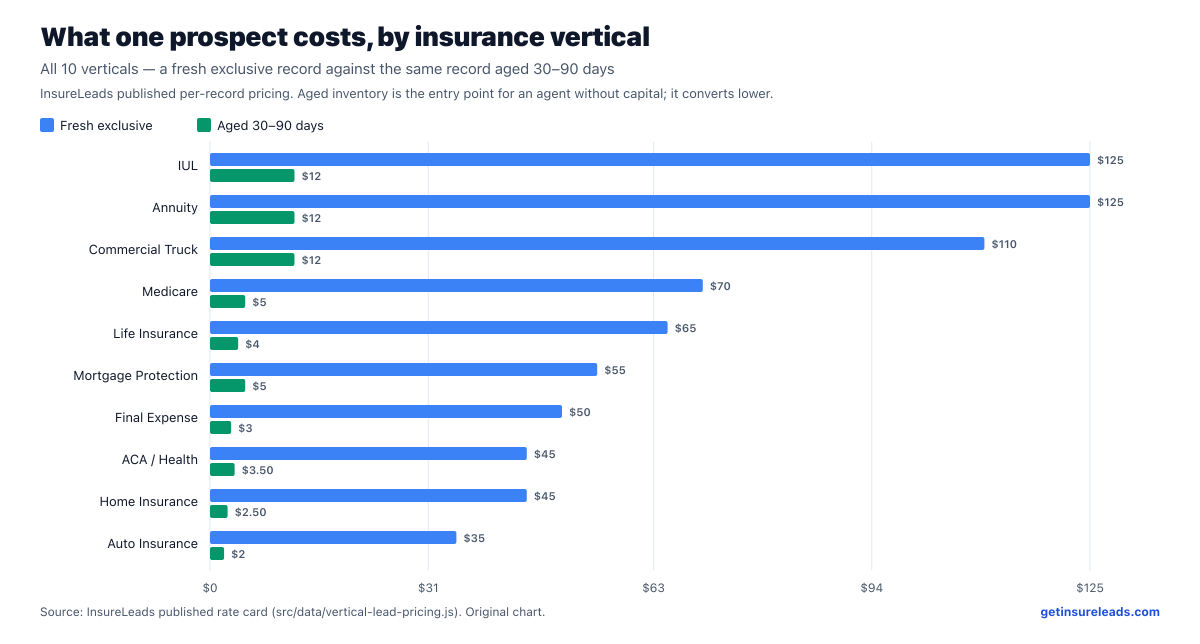
Selling IUL means presenting a regulated projection. Revised AG 49-A caps the illustrated indexed rate on the benchmark account at 145% of the insurer's net investment earnings rate, limits illustrated loan arbitrage to 50 basis points, and from 1 April 2026 bans most historical-return displays. No agent wins on the number. IUL also carries this site's highest cost per lead.
What an IUL sale actually consists of
An indexed universal life sale is the explanation of a projection. The mechanic runs in four steps: premium pays the cost of insurance and policy expenses, the excess funds account value, that account value credits interest tied to an index subject to a cap, a floor and a participation rate, and policy loans draw against the accumulated value later. None of that is visible to a client except through an illustration. The illustration is therefore the product, which is why the guideline governing illustrations is the binding constraint on your pitch rather than a compliance footnote.
Compare that to the line most agents start on. A final expense sale closes on two numbers a 68-year-old already understands: the monthly premium and the face amount. An IUL sale closes on a multi-decade ledger of non-guaranteed values that you are specifically restricted in how you may present. The skill transfer between those two conversations is close to zero, which is worth knowing before you spend a month's lead budget finding out.
Demand is not the problem. LIMRA's first-quarter 2026 release, dated 12 June 2026, reported that "indexed universal life (IUL) new annualized with excess premium reached $1.1 billion in the first quarter of 2026," "up 9% from the prior year," that "IUL accounted for 25% of total new annualized with excess premium in the first quarter," and — the line that matters most to an agent — that "policy count was flat year over year." Read those two facts together: premium up 9% on flat policy count means the growth is coming from larger cases written to the same number of buyers, not from a widening pool of prospects. The full-year picture published 19 March 2026 said the same thing more loudly, with "IUL new premium totaled a record-high $4.5 billion, 17% higher than 2024 results" and "25% of the total U.S. life insurance market in 2025" against industry-wide new annualized premium that "exceeded $17.5 billion in 2025, up 10% year over year."
The practical implication is uncomfortable for a newcomer. A vertical growing on case size rather than case count is a vertical where the incremental dollar is being won by producers who can design larger, more complex funding — not by whoever dials hardest.
What revised AG 49-A lets you illustrate, and what it now forbids
The NAIC has narrowed indexed-life illustrations three times. Its own summary: "In 2015, to bring uniformity to the illustrations of policies tied to an external index or indices, the NAIC adopted Actuarial Guideline XLIX," then "for policies sold in 2020 and later, AG 49 requirements were superseded by Actuarial Guideline XLIX-A … Sold on or after December 14, 2020," and "revisions to AG 49-A became effective in 2023 to tighten illustration limits and in 2026 to enhance consumer-protection disclosures." That is the summary. The guideline text is where an agent finds out what it means.
The revised guideline document itself records its adoption chain — "Adopted by Life Actuarial (A) Task Force 11/13/2025," "Adopted by Life Insurance and Annuities (A) Committee 11/13/2025," "Adopted by Executive (EX) Committee and Plenary 12/11/2025" — and states three purposes: it "provides guidance in determining the maximum crediting rate for the illustrated scale and the earned interest rate for the disciplined current scale," it "limits the policy loan leverage shown in an illustration," and it "requires additional consumer information (side-by-side illustration and additional disclosures) that will aid in consumer understanding." Scope is defined narrowly in Section 2: the guideline applies where "the policy is subject to Model #582" and "the policy offers Indexed Credits."
Three provisions decide what you can put in front of a client. First, the ceiling on the illustrated rate. For the Benchmark Index Account — defined in Section 3.D as an account crediting on "the percent change in S&P 500 Index value only, over a one-year period," with an annual cap, a floor that "shall be 0%," a participation rate that "shall be 100%," annual crediting, and "no enhancements or similar features that provide additional Indexed Credits … including but not limited to experience refunds, multipliers, or bonuses" — Section 4.B limits the illustrated Annual Rate of Indexed Credits to the lower of a 25-year lookback mean and "145% of the Annual Net Investment Earnings Rate." Section 3.D also provides that "a policy shall have no more than one Benchmark Index Account," which is what stops a carrier from shopping for a flattering reference point.
Second, the loan. Section 6 states that "if the illustration includes a loan, the illustrated Policy Loan Interest Credited Rate shall not exceed the illustrated Policy Loan Interest Rate by more than 50 basis points," and gives the worked example: "if the illustrated Policy Loan Interest Rate is 4.00%, the Policy Loan Interest Credited Rate shall not exceed 4.50%." Fifty basis points is the entire illustrable arbitrage. Any presentation built on the idea that borrowing is structurally free money is describing something the guideline will not let you draw.
Third, and this is the change most inherited scripts have not absorbed, the Alternate Scale is not optional. Section 3.A defines it as a scale where the indexed credit rate "does not exceed the lesser of the maximum Annual Rate of Indexed Credits for the illustrated scale less 100 basis points and the credited rate for the Fixed Account," and where a loan may show no arbitrage at all — "the illustrated Policy Loan Interest Credited Rate shall not exceed the illustrated Policy Loan Interest Rate." Section 7 requires that "a ledger using the Alternate Scale shall be shown alongside the ledger using the illustrated scale with equal prominence." You do not get to present the optimistic ledger by itself, so you should stop trying to sell as though you could.
From 1 April 2026 the disclosure rules move again, and they move against the most common IUL sales visual. Section 7.C provides that for policies sold on or after that date, neither the basic nor the supplemental illustration may include "historical returns, including historical geometric average returns," beyond the tables the guideline itself requires, and may include "neither tables nor disclosures that either explicitly or implicitly compare historical returns and maximum illustrated rates, such as a side-by-side presentation." The required historical table moves from a 20-year to a "most recent 25-year period," and where an index has fewer than ten years of history, "no table for that Index or Index Account shall be shown" — which quietly removes the back-test from every newly launched proprietary index. Section 7.D adds required wording "substantially similar to" this: "Historical index changes shown in this illustration are not indicative of future returns." Our walkthrough of the illustration guideline for working agents takes the rule mechanics further; this page is about what to do inside the conversation.
The strategic conclusion is the same in every version of the guideline: you cannot out-illustrate a competitor on an equivalent design. If another agent's projection looks better than yours on a comparable product, the difference is design choice, funding level, a non-benchmark account with a different hedge budget, or non-compliance — not product superiority. Agents who do not internalise that spend careers losing cases to numbers they should have interrogated instead of matched.
| Constraint | AG 49-A section | What it means at the kitchen table |
|---|---|---|
| Illustrated indexed credit rate on the benchmark account capped at the lesser of a 25-year lookback mean and "145% of the Annual Net Investment Earnings Rate" | 4.B | There is a hard ceiling on the headline number. Two comparable designs converge |
| Benchmark Index Account fixed as S&P 500 only, 0% floor, 100% participation, annual cap, no "experience refunds, multipliers, or bonuses" | 3.D | The reference point is standardised, and "a policy shall have no more than one Benchmark Index Account" |
| Non-benchmark index accounts carry a third cap for policies sold on or after 1 May 2023, tied to the ratio of their hedge budget to the benchmark's | 4.C.iii | This is what the 2023 revision actually did — it closed the multiplier and uncapped-account route to a better-looking ledger |
| Illustrated loan credited rate may exceed the loan interest rate "by more than 50 basis points" — no more | 6 | Illustrated borrowing arbitrage is capped at half a point. Not a strategy |
| Alternate Scale (illustrated scale less 100 bp, or the fixed rate, with zero loan arbitrage) "shown alongside … with equal prominence" | 3.A, 7 | The conservative ledger is mandatory and equally prominent. Lead with it |
| From 1 April 2026: no historical returns beyond the required tables; no "side-by-side presentation" comparing historical returns to maximum illustrated rates | 7.C | The back-test-versus-projection slide is out. Rebuild any deck that leans on it |
| From 1 April 2026: required 25-year historical table; no table at all where an index has under ten years of history | 7.B.iii | Newly launched proprietary indexes lose their history display entirely |
| From 1 April 2026: required statement "Historical index changes shown in this illustration are not indicative of future returns." | 7.D | Say it out loud before the client reads it, or you look caught |
IUL is not a security. Variable UL is, and the line is enforced elsewhere
New agents conflate these two products constantly, usually because a prospect does. IUL is a fixed life insurance product written on a state life line of authority plus carrier appointments. Variable universal life is a registered securities product, and the boundary is drawn by a different regulator with different consequences for crossing it.
FINRA's own description of the Series 6 registration lists the products it qualifies a candidate to solicit as "mutual funds (closed-end funds on the initial offering only), variable annuities, variable life insurance, unit investment trusts (UITs) and municipal fund securities." Getting there requires you to "pass both the Series 6 exam and the SIE exam to obtain the Investment Company and Variable Contracts Products registration," and — the part that makes this a career decision rather than a purchase — "candidates must be associated with and sponsored by a FINRA member firm or other applicable self-regulatory organization (SRO) member firm to be eligible to take FINRA representative-level qualification exams." You cannot self-serve your way onto the variable side. A firm has to sponsor and supervise you.
On the SEC side, variable life is treated as an investment product sold on a prospectus: its investor education material describes a policy whose "cash value that varies according to the amount of premiums you pay, the policy's fees and expenses, and the performance of a menu of investment options—typically mutual funds," and directs buyers to the prospectus, which "is available free of charge." The prospectus is the tell. Fixed IUL has an illustration governed by AG 49-A; variable UL has a registered prospectus. If the document in your hand is a prospectus, you are outside your licence.
State insurance regulators police the illustration side of the same boundary rather than the securities side. New York's guidance for variable universal life is explicit that VUL still sits under the state illustration regulation — "all applicable sections of Regulation 74 at 11 NYCRR Subpart 53 should be complied with for a variable universal life policy that has been designated to be illustrated in compliance with Regulation 74" — and that an insurer "must always provide either: preliminary information and a policy summary … or an illustration that complies … with the illustration requirements in Regulation 74." Two regulators, two documents, one product. The practical rule for a life-only agent: when a prospect who "read about indexed life online" starts naming subaccounts and fund choices, they are describing VUL. Stop, name the difference, and refer rather than improvise.
The standard of care on an IUL recommendation is thinner than agents assume
Most agents have absorbed the annuity best-interest rules and assume they cover life insurance. They do not. The NAIC's Suitability in Annuity Transactions Model Regulation (#275) "sets forth standards and procedures for recommending annuity products to consumers," and its February 2020 revisions established that "all recommendations by agents and insurers must be in the best interest of the consumer" and that they "may not place their financial interest ahead of the consumers' interest in making a recommendation," with a duty to act with "reasonable diligence, care and skill." As of 1 February 2025, NAIC records 48 states as having adopted those revisions. Every word of it is about annuities.
There is no equivalent nationwide best-interest standard for a life insurance recommendation, and that is a fact worth stating plainly rather than papering over. What governs an IUL sale in most states is the illustration regulation — the disclosure and signature discipline of NAIC Model #582 and its state analogues — not a fiduciary-style duty of care. That is a lower bar, and it is the reason the strongest protection available to you is documentation you generate voluntarily.
New York is the significant exception and the best available template for what a defensible file looks like. Insurance Regulation 187 (11 NYCRR 224) took effect for annuity transactions on 1 August 2019 and for life insurance transactions on 1 February 2020, extending a best-interest standard to permanent life recommendations, with different suitability criteria for term products. New York's own guidance frames the test as process rather than outcome: the Department examines "the steps taken and analysis performed" from "the initial gathering of suitability information" onward. On training, the state is deliberately non-prescriptive — the regulation "does not require the completion of a specific training course, nor is the training a requirement to maintain the insurance license," but insurers must ensure "every producer is adequately trained to make the recommendation," and "it is the responsibility of the producer to know these training requirements." Translation: your carrier sets the bar, and not knowing it is your problem, not theirs.
Even outside New York, the state illustration rules impose a hard artefact requirement that new agents skip. New York's illustration guidance records that a copy of the illustration "signed in accordance with this Subpart, shall be submitted to the insurer at the time of policy application. A copy also shall be provided to the applicant," alongside prohibitions on using or describing "non-guaranteed elements in a manner that is misleading" and on stating or implying "that the payment or amount of non-guaranteed elements is guaranteed." That signed, delivered illustration is the only contemporaneous record of what you actually showed. Treat it as the file, not as paperwork.
The 7-pay test and the loan treatment, from the statute
The reason most IUL clients are buying is the loan. The reason a loan can go wrong is a statutory line the agent draws by choosing a funding level. Under 26 U.S.C. § 7702A(a), a modified endowment contract is a contract meeting section 7702's requirements that "is entered into on or after June 21, 1988, and fails to meet the 7-pay test" (or is received in exchange for one). The test in § 7702A(b) is failed when the accumulated amount paid under the contract at any time during the first seven contract years exceeds the sum of the net level premiums that would be needed for paid-up future benefits after seven level annual payments. Section 7702A(c)(3) adds the trap that catches funding increases later: on a material change in benefits or terms, "such contract shall be treated as a new contract entered into on the day on which such material change takes effect" — which restarts the seven-year clock.
What MEC status costs is exactly the feature the client came for. Section 72(e)(10) applies the distribution rules to modified endowment contracts such that loans and pledges count as amounts received, per § 72(e)(4)(A): "if, during any taxable year, an individual receives (directly or indirectly) any amount as a loan under any contract to which this subsection applies, or assigns or pledges (or agrees to assign or pledge) any portion of the value of any such contract, such amount or portion shall be treated as received under the contract as an amount not received as an annuity." A MEC's loan is a taxable event; a non-MEC's generally is not. Run the test on every design, state the result in writing, and tell the client which future funding decisions would push the contract across the line — because § 7702A(c)(3) means they can do it to themselves years after you stop being involved.
Five things belong in writing on every case, in this order. The habit to build is subtraction: every additional claim you make about future performance is a liability you have taken on, and none of it improves your close rate as much as a client who genuinely understands what they bought. Before any of it, settle the prior question of whether this client needs permanent coverage at all. The term-versus-permanent decision you should resolve before designing anything is where a surprising share of honest IUL conversations end — and the agent willing to end there is the one who gets the referral.
- The guaranteed column, shown and discussed before any non-guaranteed figure appears.
- The Alternate Scale ledger, which the guideline requires beside the illustrated scale "with equal prominence" — so lead with it rather than being asked about it.
- The floor, the cap and the participation rate as three separate levers, never collapsed into a single "return", plus the fact that illustrated loan arbitrage is capped at 50 basis points.
- The § 7702A 7-pay test result for the design you are proposing, whether it produces a modified endowment contract, and what a later funding increase would do under the material-change rule.
- What happens if the client stops paying in year three, stated plainly rather than implied.
A worked break-even at this site's IUL lead prices
IUL and annuity sit at the top of our rate card, and IUL is where new agents most often get hurt by it, because the accumulation buyer looks more approachable than the retiree with a rollover. An exclusive IUL web lead is $125. The same format in final expense is $50 and in ACA health $45. On the aged file the gap widens rather than narrows: IUL records 30–90 days old are $12 against $3 for final expense.
Here is the arithmetic done all the way through, with every assumption named so you can substitute your own. Close rate: 4%, the midpoint of the 3–6% band our compensation analysis publishes for exclusive-web IUL. First-year commission: $4,750, that analysis's own worked figure of a $5,000 target premium at 95% of target, inside a stated 60–115% band. At a 4% close rate you need 25 exclusive leads for one placed case, so the lead cost behind that case is 25 × $125, and the case pays $4,750 if it stays on the books.
Now break it. Chargeback terms are set by the carrier's commission agreement, not by any regulation, and no regulator publishes them — so the two common forms have to be modelled as scenarios rather than quoted as rates. Form one reverses the unearned portion of an advance. Form two reverses the whole first-year commission on a first-year lapse. Take a policy that lapses in month nine against a twelve-month advance: under form one, three of twelve months are unearned, so 25% of $4,750, or $1,187.50, comes back and you net $3,562.50 before lead cost. Under form two you net nothing, and the 25 leads behind that case are unrecovered spend that the next case has to carry as well as its own.
That second scenario is the whole argument of this page in one number. One first-year lapse means one paid case now has to fund 50 leads' worth of spend rather than 25 — which doubles the close rate you need to stay cash-positive on lead spend from 4% to 8%. Eight percent is above the entire 3–6% planning band and sits at the very bottom of the 8–15% figure our own money page publishes. A single early lapse does not dent the model; it moves your required performance outside the range you planned against.
We owe you one more disclosure, because it is uncomfortable for us: our two datasets disagree on the IUL close rate. The IUL lead page publishes 8–15% for exclusive web leads, while the compensation analysis puts the same format at 3–6%. We have not reconciled them. Plan against the lower band — if the business works at 3%, the optimistic figure is upside rather than a requirement. And note what timing does independently of any of this: the IUL cycle runs three to eight weeks through fact-find, illustration revisions, paramedical exam, financial underwriting, delivery and first-premium collection, so a new agent funds two or three months of leads at the highest per-lead price we publish before the first commission arrives.
| Scenario | Leads consumed | Commission retained | Required close rate to stay cash-positive on lead spend |
|---|---|---|---|
| Case persists past the first policy year | 25 × $125 | $4,750 | 4% |
| Month-9 lapse, unearned portion of a 12-month advance reversed (3/12 = 25%) | 25 × $125 | $3,562.50 | ≈5.3% |
| Month-9 lapse, full first-year commission reversed | 25 × $125, unrecovered | $0 | 8% — above the 3–6% planning band |
| Two placed cases, one of which lapses in month nine with full reversal | 50 × $125 | $4,750 | 8% |
The honest case that IUL is a poor first vertical
Four things make this vertical hostile to a first-year agent, and none of them yields to effort.
Chargeback exposure, which the arithmetic above prices. Producers in our interview cohort named carrier chargebacks on IUL and life business — driven by persistency and replacement — as a top-three operational pain point, cited by 58% of respondents. Be precise about what that figure is: it counts how many producers named the problem, not a chargeback rate. No first-party persistency data exists on this site and no regulator publishes an IUL chargeback or lapse rate, so the honest position is that the frequency is unmeasured and the consequence is quantified.
Runway. First-year agents cluster in a $24,000–$56,000 interquartile income range in our compensation analysis, with a $38,000 median. Pair that with the highest per-lead price we publish and a three-to-eight-week cycle and the binding constraint is not skill, it is cash. The analysis reaches the same verdict from the other direction, listing exclusive IUL leads among what a new agent should avoid buying outright.
Explanation risk on a delay. This product punishes a shallow pitch months after the pitch. A client who never understood the loan mechanic funds happily for two years and then lapses when a statement confuses them, and the loss lands on you long after the sale felt like a win. Worse, in most states no best-interest standard applies to a life recommendation — so the record of what you explained is whatever you chose to create.
Regulatory drift. The illustration guideline changed for policies sold from 14 December 2020, tightened again for policies sold on or after 1 May 2023, and changed the disclosure rules again for policies sold on or after 1 April 2026. A vertical whose central sales artefact is re-regulated roughly every three years is a poor place to learn the trade, because the script you inherit is probably describing a superseded rule and the person who gave it to you may not know.
The conclusion is sequencing, not abandonment. Sell a line with a same-week decision, build a book, then write IUL into relationships you already have. The same verdict arrives from the other end of the retirement market: our annuity career guide reaches it through licensing gates and transfer paperwork rather than chargebacks. And because a three-to-eight-week cycle with six to eight touches per prospect is a follow-up problem before it is a selling problem, stand up a free single-user CRM before your first IUL lead rather than after your tenth goes cold.
Getting your first IUL cases without the exclusive price tag
Your existing book is the best IUL source you will ever have and it costs nothing. A term client whose income has doubled since you wrote them, a final expense client's adult child, a business owner already maxing qualified contributions — in each case you hold the trust and a rough financial picture, which is precisely what a consultative sale needs and precisely what a cold lead lacks.
When you do buy, buy the deliberation cycle rather than the moment of intent. Because IUL research runs for weeks, an aged record is often still evaluating: 30–90 day records at $12 and 181–365 day records at $4 support an education-first sequence that a same-day web lead does not require. Say the honest thing out loud — aged records are not exclusive and someone has probably called already, which is exactly why the education angle beats the quote angle. The aged-lead pricing ladder shows how the bands step down.
What not to do in month one: buy interest-verified live transfers at $275. That format only pays when you can run a fact-find and produce a compliant design inside the same conversation — and since 1 April 2026 a compliant design means an Alternate Scale ledger of equal prominence and no back-test slide to fall back on. Without illustration capacity at your desk, a transfer is a very expensive introduction you cannot act on.
- Touch one: the mechanic in plain language, no illustration attached.
- Touch two: the guaranteed column and the Alternate Scale ledger, sent before any optimistic version.
- Touch three: the policy-loan walkthrough in writing, including the 50-basis-point limit on illustrable arbitrage and what over-loaning does.
- Touch four: the 7-pay test result for the design, and what a later funding increase would trigger under the material-change rule.
- Touch five onward: answer questions, do not add promises. Every new claim is a future liability.
Licensing, appointments, and the organisation recruiting you
IUL is a fixed life product. You write it on a state life line of authority plus carrier appointments, and the prelicensing and continuing-education hours behind that authority vary widely by jurisdiction — the state-by-state producer requirements guide carries the hours and statutory citations for all 51 jurisdictions. Nothing about IUL adds a licence beyond that. What it adds is carrier-level product training, which is where the training obligation actually lives, and which New York's guidance describes accurately for every state: the insurer sets the standard, and "it is the responsibility of the producer to know these training requirements."
On carriers: productive IUL writers typically hold several appointments rather than one, because cap structures, non-benchmark account designs and loan provisions differ enough that matching design to client fit genuinely requires choice. Note that the guideline's Section 4.C is what makes those differences real rather than cosmetic — a non-benchmark account with a larger hedge budget can support a higher illustrated rate within the cap structure, and after 1 May 2023 that headroom is itself capped. Each appointment brings its own product-training requirement, so add them deliberately rather than collecting them.
If your route to those appointments runs through an IMO or FMO, understand the hierarchy before you sign. We take no referral, sponsorship or override money from any IMO, FMO or carrier, which is the only reason this page can say bluntly that the organisation recruiting you most enthusiastically is the one with the most to gain from your production — and that an organisation urging a brand-new licensee toward IUL first is optimising for its own revenue per recruit, not for your survival.
Frequently asked questions
Do I need a securities license to sell IUL?
No. Indexed universal life is a fixed life insurance product written on a state life line of authority with carrier appointments. Variable universal life is different: FINRA lists "variable life insurance" among the products its Series 6 registration qualifies a candidate to solicit, and that registration requires you to "pass both the Series 6 exam and the SIE exam" and to be "associated with and sponsored by a FINRA member firm or other applicable self-regulatory organization (SRO) member firm." A practical tell: fixed IUL comes with an AG 49-A illustration, variable UL comes with a registered prospectus. If you are holding a prospectus, you are outside a life-only licence.
What changed in AG 49-A for policies sold on or after 1 April 2026?
Section 7 of the revised guideline, adopted by NAIC Executive (EX) Committee and Plenary on 11 December 2025, changes the disclosure package. The required historical table moves from a 20-year to a "most recent 25-year period"; where an index has under ten years of history, "no table for that Index or Index Account shall be shown"; illustrations may no longer include "historical returns, including historical geometric average returns" beyond the required tables; and they may include "neither tables nor disclosures that either explicitly or implicitly compare historical returns and maximum illustrated rates, such as a side-by-side presentation." Section 7.D requires wording substantially similar to "Historical index changes shown in this illustration are not indicative of future returns." If your presentation opens on a back-test, rebuild it.
What is the maximum rate I can illustrate on an IUL?
For the Benchmark Index Account, Section 4.B of AG 49-A limits the illustrated Annual Rate of Indexed Credits to the lower of the arithmetic mean of the geometric average annual credited rates from a 25-year lookback and "145% of the Annual Net Investment Earnings Rate." Non-benchmark index accounts carry an additional cap under Section 4.C.iii for policies sold on or after 1 May 2023, tied to the ratio of the account's hedge budget to the benchmark's. Separately, Section 6 caps illustrated loan arbitrage: the illustrated Policy Loan Interest Credited Rate "shall not exceed the illustrated Policy Loan Interest Rate by more than 50 basis points."
Does a best-interest standard apply when I recommend an IUL?
In most states, no — and that is worth knowing rather than assuming. The NAIC's best-interest revisions sit in the Suitability in Annuity Transactions Model Regulation (#275), adopted by 48 states as of 1 February 2025, and they govern annuities. New York is the significant exception: Insurance Regulation 187 (11 NYCRR 224) extended a best-interest standard to life insurance transactions effective 1 February 2020, and New York evaluates "the steps taken and analysis performed" rather than the outcome. Everywhere else, the binding rules on an IUL sale are illustration rules, so the strongest protection you have is documentation you create voluntarily.
What close rate should a new agent plan for on IUL leads?
Plan against 3–6% on exclusive web leads. Our two datasets disagree — the IUL lead page publishes 8–15% for that format while our compensation analysis puts it at 3–6% — and we have not reconciled them, so budget on the conservative figure. Aged records run roughly 3–8%, and interest-verified live transfers 20–30%, but the transfer figure assumes you can fact-find and produce a compliant design inside a single conversation.
How many IUL leads does it take to fund one case, and what does a chargeback do to that?
At a 4% close rate — the midpoint of our 3–6% planning band — you need 25 exclusive leads per placed case, at 25 × the published exclusive price. Against a $4,750 first-year commission (our analysis's worked figure: $5,000 target premium at 95%), that clears comfortably if the case persists. If it lapses in month nine and the carrier reverses only the unearned portion of a 12-month advance, you keep $3,562.50. If the carrier reverses the whole first-year commission, you keep nothing and the next case must fund 50 leads' worth of spend — which lifts the close rate you need from 4% to 8%, above the entire planning band. Chargeback terms come from the carrier's commission agreement; no regulator publishes them.
What is a MEC and why does it matter to the sale?
A modified endowment contract is a contract that "fails to meet the 7-pay test" under 26 U.S.C. § 7702A(a). It matters because MEC status forfeits the loan treatment that is usually the entire reason the client is buying: § 72(e)(10) applies the distribution rules so that loans and pledges count as amounts received, and § 72(e)(4)(A) treats a loan or pledge as "received under the contract as an amount not received as an annuity." Run the test on every design, put the result in writing, and explain § 7702A(c)(3) — a material change means "such contract shall be treated as a new contract entered into on the day on which such material change takes effect," restarting the seven-year clock, which a client can trigger years after you last spoke to them.
Is IUL demand actually growing, or is it an agent-side fashion?
Growing, but read the composition. LIMRA's first-quarter 2026 release of 12 June 2026 reported IUL "new annualized with excess premium reached $1.1 billion in the first quarter of 2026," "up 9% from the prior year," at "25% of total new annualized with excess premium," while "policy count was flat year over year." The full-year 2025 release of 19 March 2026 reported "a record-high $4.5 billion, 17% higher than 2024 results" and "25% of the total U.S. life insurance market." Premium rising on flat policy count means the growth is in case size, not in the number of buyers — which favours experienced designers over new entrants.
Sources
- https://content.naic.org/sites/default/files/inline-files/AG%2049A(posted).pdf — Revised Actuarial Guideline XLIX-A, draft 11/13/2025, "Adopted by Life Actuarial (A) Task Force 11/13/2025," "Adopted by Life Insurance and Annuities (A) Committee 11/13/2025," "Adopted by Executive (EX) Committee and Plenary 12/11/2025." Source for every section-level quotation on the page: Section 1 effective date ("policies sold on or after December 14, 2020"); Section 2 scope (subject to Model #582 and offers Indexed Credits); Section 3.A Alternate Scale (illustrated scale "less 100 basis points" or the Fixed Account rate, zero loan arbitrage); Section 3.D Benchmark Index Account definition (S&P 500 only, 0% floor, 100% participation, annual cap, no "experience refunds, multipliers, or bonuses," "no more than one Benchmark Index Account"); Section 4.A 25-year lookback; Section 4.B cap at the lesser of the lookback mean and "145% of the Annual Net Investment Earnings Rate"; Section 4.C.iii third cap for non-benchmark accounts "for policies sold on or after May 1, 2023"; Section 6 loan arbitrage limited to "more than 50 basis points" with the 4.00%/4.50% example; Section 7.A/7.B Alternate Scale ledger "shown alongside … with equal prominence" and the 20-year-to-25-year historical table change at 1 April 2026; Section 7.B.iii.1 no table where an index has under ten years of history; Section 7.C prohibition on other "historical returns, including historical geometric average returns" and on "tables nor disclosures that either explicitly or implicitly compare historical returns and maximum illustrated rates, such as a side-by-side presentation"; Section 7.D required statement "Historical index changes shown in this illustration are not indicative of future returns." Also the Background statement of the guideline's three purposes.
- https://content.naic.org/insurance-topics/life-insurance-illustrations — NAIC's own summary of the guideline history: 2015 adoption of AG 49 "to bring uniformity to the illustrations of policies tied to an external index or indices"; "for policies sold in 2020 and later, AG 49 requirements were superseded by Actuarial Guideline XLIX-A … Sold on or after December 14, 2020"; "Revisions to AG 49-A became effective in 2023 to tighten illustration limits and in 2026 to enhance consumer-protection disclosures." Also confirms illustrations sit under the Life Insurance Illustrations Model Regulation (#582), whose purpose is to "provide rules for life insurance policy illustrations that will protect consumers and foster consumer education."
- https://www.finra.org/registration-exams-ce/qualification-exams/series6 — The IUL-versus-VUL boundary: Series 6 qualifies a candidate to solicit "mutual funds (closed-end funds on the initial offering only), variable annuities, variable life insurance, unit investment trusts (UITs) and municipal fund securities"; candidates must "pass both the Series 6 exam and the SIE exam to obtain the Investment Company and Variable Contracts Products registration"; and "candidates must be associated with and sponsored by a FINRA member firm or other applicable self-regulatory organization (SRO) member firm to be eligible to take FINRA representative-level qualification exams."
- https://www.investor.gov/introduction-investing/investing-basics/glossary/variable-life-insurance — SEC investor-education description of variable life insurance as a contract with "a cash value that varies according to the amount of premiums you pay, the policy's fees and expenses, and the performance of a menu of investment options—typically mutual funds" — the investment-product characterisation used to separate VUL from fixed IUL on this page.
- https://www.investor.gov/introduction-investing/general-resources/news-alerts/alerts-bulletins/investor-bulletins-22 — SEC Office of Investor Education and Advocacy Investor Bulletin on variable life insurance, dated 30 October 2018, which directs buyers to the policy prospectus and states that "the prospectus is available free of charge" — the basis for the page's "if the document in your hand is a prospectus, you are outside your licence" test. NOTE: this bulletin does NOT state the securities-law classification, so that point is sourced through FINRA instead.
- https://content.naic.org/insurance-topics/annuity-suitability-and-best-interest-standard — Model #275 "sets forth standards and procedures for recommending annuity products to consumers"; the February 2020 revisions require that "all recommendations by agents and insurers must be in the best interest of the consumer," that they "may not place their financial interest ahead of the consumers' interest in making a recommendation," and that they act with "reasonable diligence, care and skill"; 48 states had adopted the revisions as of 1 February 2025. Supports the page's point that the NAIC best-interest standard covers annuities, not life insurance.
- https://www.dfs.ny.gov/apps_and_licensing/life_insurers/reg187_first_amendment_faq — New York Insurance Regulation 187 (11 NYCRR 224) effective 1 August 2019 for annuity transactions and 1 February 2020 for life insurance transactions; that it applies to permanent life recommendations with different suitability criteria for term; and that the Department examines "the steps taken and analysis performed" from "the initial gathering of suitability information" rather than a single outcome.
- https://www.dfs.ny.gov/apps_and_licensing/agents_and_brokers/Suitability/Best-Interests-Training — Regulation 187 "does not require the completion of a specific training course, nor is the training a requirement to maintain the insurance license," but insurers must ensure "every producer is adequately trained to make the recommendation," and "it is the responsibility of the producer to know these training requirements." Also confirms the 1 August 2019 / 1 February 2020 effective dates.
- https://www.dfs.ny.gov/apps_and_licensing/life_insurers/guidance_life_insurance_policy_illustrations — State-level illustration discipline quoted on the page: a copy of the illustration "signed in accordance with this Subpart, shall be submitted to the insurer at the time of policy application. A copy also shall be provided to the applicant"; prohibitions on using or describing "non-guaranteed elements in a manner that is misleading" and on stating or implying "that the payment or amount of non-guaranteed elements is guaranteed"; and that compliance with Regulation 74 (11 NYCRR 53) is the insurer's responsibility.
- https://www.dfs.ny.gov/apps_and_licensing/life_insurers/vul_illust_and_info_guidance — Variable universal life remains subject to the state illustration regulation: "all applicable sections of Regulation 74 at 11 NYCRR Subpart 53 should be complied with for a variable universal life policy that has been designated to be illustrated in compliance with Regulation 74," and an insurer "must always provide either: preliminary information and a policy summary … or an illustration that complies … with the illustration requirements in Regulation 74." Supports the two-regulator, two-document framing of the IUL/VUL boundary.
- https://www.law.cornell.edu/uscode/text/26/7702A — 26 U.S.C. § 7702A as reproduced by Cornell LII: subsection (a) modified endowment contract definition, including a contract that "is entered into on or after June 21, 1988, and fails to meet the 7-pay test"; subsection (b) the 7-pay test (accumulated amount paid in the first 7 contract years exceeding the sum of net level premiums for paid-up future benefits after seven level annual payments); subsection (c)(3) material change — "such contract shall be treated as a new contract entered into on the day on which such material change takes effect."
- https://www.law.cornell.edu/uscode/text/26/72 — 26 U.S.C. § 72 as reproduced by Cornell LII: subsection (e)(10) applying the distribution rules to modified endowment contracts so that loans and pledges count as amounts received, and subsection (e)(4)(A) — "if, during any taxable year, an individual receives (directly or indirectly) any amount as a loan under any contract to which this subsection applies, or assigns or pledges (or agrees to assign or pledge) any portion of the value of any such contract, such amount or portion shall be treated as received under the contract as an amount not received as an annuity." Basis for the page's statement that a MEC loan is a taxable event.
- https://www.limra.com/en/newsroom/news-releases/2026/limra-u.s.-individual-life-insurance-sales-show-strong-first-quarter-growth/ — Most recent IUL new-premium figure, released 12 June 2026: IUL "new annualized with excess premium reached $1.1 billion in the first quarter of 2026," "up 9% from the prior year," "IUL accounted for 25% of total new annualized with excess premium in the first quarter," "policy count was flat year over year," against a total individual life market of "$4.5 billion in the first quarter of 2026." The flat policy count is the page's evidence that growth is in case size, not buyer count.
- https://www.limra.com/en/newsroom/news-releases/2026/limra-u.s.-individual-life-insurance-new-premium-tops-$17.5-billion-to-set-new-sales-record-in-2025/ — Full-year 2025 figures, released 19 March 2026: "IUL new premium totaled a record-high $4.5 billion, 17% higher than 2024 results"; "IUL new premium represented 25% of the total U.S. life insurance market in 2025"; "policy sales increased 8% over 2024 levels"; "industry-wide new annualized premium exceeded $17.5 billion in 2025, up 10% year over year."