
Annuity License Requirements — and Why Annuities Make a Better Second Line Than a First
The short answer
Fixed, indexed and income annuities sell under a state life line of authority plus a carrier appointment and annuity-specific training. Variable annuities are securities: the SEC regulates them and FINRA registration through a sponsoring member firm is required. Most new agents should earn the fixed side first.
Which licence actually lets you sell annuities?
An annuity licence is not usually a separate credential. In most states the authority to solicit fixed, indexed and income annuities travels with the life line of authority on a resident producer licence, and the gating items sit on top of it: a carrier appointment, product-specific training from that carrier, and — in a growing number of states — a standalone annuity training course you must finish before you solicit at all. Prelicensing and continuing-education hours vary widely by jurisdiction, and our state-by-state breakdown of producer hours and statutory cites carries those figures.
What splits the field is not the licence name. It is the product's legal character. The SEC's investor education site is unambiguous on the variable side: "A variable annuity is a type of annuity contract between you and an insurance company that is a security and therefore regulated by the SEC." FINRA adds that variable annuity sales "are regulated both by FINRA and the Securities and Exchange Commission (SEC)."
The indexed family splits down the middle, and the SEC says so plainly: "Not all indexed annuities are regulated by the SEC. For example, the SEC does not regulate fixed indexed annuities, which guarantee your interest rate will never be less than zero. The SEC regulates only indexed annuities that are securities." A fixed indexed annuity therefore lives on the insurance side of the line. A registered index-linked annuity does not. Two products that sound like siblings sit under two different regulators, and that is the single most consequential fact on this page.
| Product | Legal character | What you need to solicit it |
|---|---|---|
| MYGA (multi-year guaranteed annuity) | Fixed insurance contract | State life line of authority, carrier appointment, carrier product training |
| SPIA / income annuity | Fixed insurance contract | Same as above |
| Fixed indexed annuity (FIA) | Not SEC-regulated — "the SEC does not regulate fixed indexed annuities" | Same as above, plus a state annuity training course where required |
| Registered index-linked annuity (RILA) | A security registered with the SEC | Securities registration in addition to the insurance licence |
| Variable annuity | "a security and therefore regulated by the SEC"; sales regulated by FINRA and the SEC | FINRA registration through a sponsoring member firm, plus the insurance licence |
Why the variable side is a different career, not a bigger licence
Agents routinely describe the securities requirement as "one more exam." It is not. FINRA's Series 6 registration qualifies a candidate for the "solicitation, purchase and/or sale of" mutual funds, variable annuities, variable life insurance, unit investment trusts and municipal fund securities. The exam itself is modest — 50 questions, one hour and thirty minutes, passing score 70. The prerequisites are the obstacle: a candidate must pass the Securities Industry Essentials exam and must be "associated with and sponsored by a FINRA member firm or other applicable self-regulatory organization (SRO) member firm."
Read that sponsorship clause as a career fact rather than paperwork. An insurance licence you can obtain alone, pay for yourself and carry independently. A securities registration you cannot hold without a firm willing to hold it for you, supervise you and answer for you. A newly licensed independent agent who wants to sell variable annuities is really deciding whether to affiliate with a broker-dealer — a different business relationship, a different compliance regime and a different compensation structure from the IMO route most annuity producers take.
The practical consequence for someone planning a first year: your addressable annuity market is the fixed and fixed indexed shelf. MYGAs, SPIAs and FIAs. That is not a consolation prize, as the sales figures below show, but it does mean you should stop reading marketing material about buffered and registered products until the affiliation question is settled.
The training layer that sits above the licence
Annuity solicitation carries a supervision regime that ordinary life sales do not. The NAIC's Suitability in Annuity Transactions Model Regulation (#275) "sets forth standards and procedures for recommending annuity products to consumers to ensure their insurance and financial objectives are appropriately addressed." Its 2020 revisions went further: "all recommendations by agents and insurers must be in the best interest of the consumer and that agents and carriers may not place their financial interest ahead of the consumers' interest in making a recommendation," with producers and carriers required to act with "reasonable diligence, care and skill." The NAIC's own topic page recorded that "To date, 40 states have adopted the model revisions" as of its June 2023 update — treat that as a floor, and confirm your own state's status with its department of insurance.
Several states bolt an annuity-specific hour requirement onto the licence itself. The NAIC's producer education chart (PR-20, Spring 2024 edition) records California as adding "a separate annuity track: 8 hours of training before soliciting annuities, then 4 hours before each renewal," and Rhode Island as having no general prelicensing provision but requiring that "producers must complete an 8-hour training course before selling, soliciting or negotiating annuity policies." Virginia's biennial 16 hours explicitly covers "health, life and annuities." The pattern matters more than any single state: annuity authority is administered as its own track in a meaningful minority of jurisdictions.
- Resident producer licence carrying the life line of authority.
- The state's annuity training course, where the state requires one before solicitation.
- A carrier appointment — the carrier, not the state, decides whether to contract you.
- That carrier's product-specific training, which repeats every time you add a carrier.
- A documented best-interest file for each recommendation, kept where an examiner could find it.
What the best-interest standard changes in your actual sales process
The best-interest revisions did not change what you may sell. They changed what you must be able to prove afterwards. Every recommendation needs a documented basis showing the product serves the consumer's financial interest, alongside disclosure of your compensation and the product's limitations. A recommendation that would have been defensible in 2018 on the strength of a good conversation is now defensible only on the strength of a file.
That reframes the job. Annuity selling is a documentation discipline attached to a sales conversation, and the documentation is heaviest exactly where the money is: replacements and 1035 exchanges, where you have to show the new contract's surrender schedule, lost riders and net benefit against the old one. New producers underestimate this and then spend their first commission cheque on rework. A single-user record system is enough to start — the point is that suitability files, illustration versions and call notes live in one retrievable place, which is the argument for setting up a free single-user CRM before your first case rather than after your first audit request.
It also explains a frustration new agents blame on bad luck. Annuity carriers vet producers harder than simplified-issue final expense carriers do, because the carrier inherits your suitability file. Expect background review, E&O evidence and completed training before a first application can be submitted at all.
Is the annuity market actually there?
Yes, and it has been for four consecutive years. LIMRA's final 2025 tally, released 23 March 2026, reported that "Total U.S. annuity sales increased 7% to $464.1 billion in the 2025." Fixed indexed annuities — the largest slice an insurance-only licensee can write — came in at "$127.9 billion, 1% higher than 2024 results." Registered index-linked annuities "increased 20% year over year to $79.5 billion."
Set those two growth rates beside the licence fork from the top of this page and a strategic picture appears. The biggest insurance-side product line is enormous and flat. The fastest-growing line in the market grew 20% and sits behind a securities registration you cannot obtain without a sponsoring firm. That is the real reason the licence question deserves more attention than agents give it: it determines which half of a $464 billion market you can participate in, and the half you can reach without a broker-dealer is the slower-growing one.
None of this argues against entering. It argues for entering with the sequence deliberate rather than accidental.
| Segment | 2025 sales | Change | Who can write it |
|---|---|---|---|
| Total U.S. retail annuities | $464.1 billion | up 7% | — |
| Fixed indexed annuity (FIA) | $127.9 billion | up 1% | Insurance licence + appointment |
| Registered index-linked annuity (RILA) | $79.5 billion | up 20% | Securities registration required |
Why annuities work as a second line and fail as a first one
Every structural feature of this vertical rewards an agent who already has something. The sales cycle runs two to six weeks, and almost none of that is under your control — rollover and 1035 transfer processing, carrier suitability review and free-look periods, rather than medical underwriting most fixed and indexed products do not require. The close-rate bands we publish for annuity leads are the lowest of any line on this site: roughly 6–12% on exclusive web leads, 15–25% on interest-verified transfers, 2–6% on aged records. And the contracting gate described above is the strictest.
A first-year agent needs the opposite of all that. At-bats, fast feedback and a decision inside a week, so a bad script gets corrected in days rather than after a quarter of cash burn. Our compensation analysis, built from public data plus interviews with 40-plus active producers, puts first-year agents in a $24,000–$56,000 interquartile income range with a $38,000 median — a level at which a two-to-six-week payment cycle is not a patience problem, it is a solvency problem.
The producers who do well here arrive with a book. A term, final expense or Medicare book written three to eight years ago contains clients who are now 55 to 75, hold rollover-eligible balances and already trust you. That is the natural on-ramp, and it costs nothing. The same logic runs in reverse for the other premium line on this site: our guide to selling IUL reaches the same "not first" verdict from the accumulation side rather than the distribution side.
Where a newly appointed annuity agent finds prospects
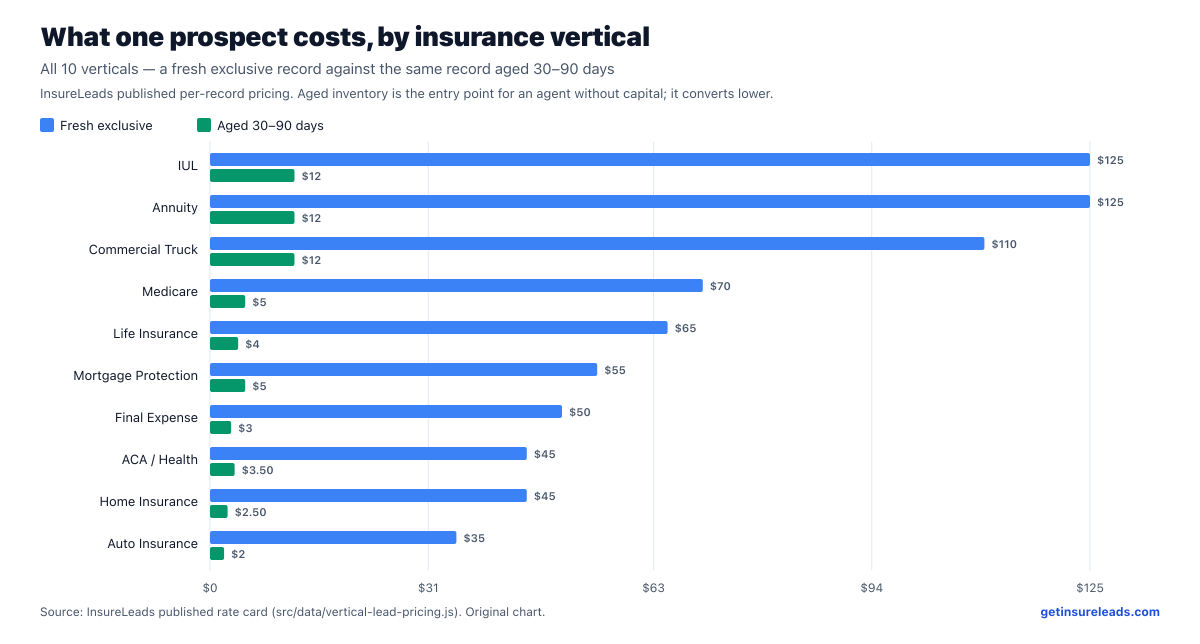
Published annuity lead pricing on this site runs $125 for an exclusive web lead, $175 contact-verified, and $300 for an interest-verified live transfer. Put that against a 6–12% close band and the arithmetic is honest but unforgiving: a statistically meaningful test at exclusive pricing is a four-figure commitment made before you have a working script. Buying it in your first month is how new annuity agents quit in their third.
The aged file is the entry point that respects a beginner's budget. Annuity buyers rate-shop for weeks and rates move while they shop, so a record from 30 to 90 days ago is frequently still deciding — that is a genuine property of this vertical rather than a sales line, and it is why aged annuity records at $12 for the 30–90 day band, or $7 at 91–180 days, are worth working with a rate-update sequence. Say the obvious thing to yourself before you buy: aged records are not exclusive, and you may not be the first call. How the aged file is priced by age band explains the ladder, and the annuity lead page carries the full published rate card for every format.
Three sources cost nothing and outperform anything you can buy in month one:
- Clients already in your book who have crossed 55, changed jobs or retired — every one of those events makes a balance rollover-eligible.
- Orphan and inherited cases from your IMO or a retiring producer, where the relationship exists and the annual review is overdue.
- Rate-update follow-up on aged records you already own — a MYGA shopper who declined 5.1% last quarter is a different prospect this quarter.
Getting appointed on the annuity side
Carrier appointment is a separate gate from licensure, and on the annuity shelf it is the slow one. Most annuity carriers contract independent producers through an IMO or FMO rather than directly, which means your first real negotiation is not with a carrier at all — it is over where you sit in a hierarchy and what override sits above you. That structure, not the product, decides your economics for years. How the IMO, FMO and MGA tiers actually sit between you and a carrier lays out the vocabulary before you sign anything.
We take no referral fee, sponsorship or override from any IMO, FMO or carrier, so nothing on this page is a recommendation of a specific one. That independence is the only reason this section can tell you the uncomfortable part: the entity recruiting you hardest is usually the one with the most to gain from your production, and enthusiasm is not evidence of a good contract level.
Practically, budget longer for annuity contracting than for a simplified-issue line. Expect the carrier to want background review, current E&O, completed general annuity training and completed product training before a first application is accepted — and expect to repeat the product-training step for every carrier you add.
Frequently asked questions
Is there a separate annuity license?
In most states, no. Annuity solicitation authority travels with the life line of authority on a resident producer licence. What sits on top of it is a carrier appointment, that carrier's product-specific training and, in a meaningful minority of states, a standalone annuity training course. The NAIC's PR-20 producer education chart records California, for example, as requiring 8 hours of training before soliciting annuities and 4 hours before each renewal, and Rhode Island as requiring an 8-hour course before selling, soliciting or negotiating annuity policies.
Do I need a securities license to sell annuities?
Not for the fixed shelf. The SEC's investor education site states that "the SEC does not regulate fixed indexed annuities, which guarantee your interest rate will never be less than zero," and that it "regulates only indexed annuities that are securities." Variable annuities are different: "A variable annuity is a type of annuity contract between you and an insurance company that is a security and therefore regulated by the SEC," and FINRA notes those sales "are regulated both by FINRA and the Securities and Exchange Commission (SEC)." Registered index-linked annuities are also securities.
Can I take the Series 6 exam on my own as an independent agent?
No. FINRA requires that a Series 6 candidate pass the Securities Industry Essentials exam and be "associated with and sponsored by a FINRA member firm or other applicable self-regulatory organization (SRO) member firm." The exam itself is 50 questions in one hour thirty minutes with a passing score of 70, and it covers mutual funds, variable annuities, variable life insurance, unit investment trusts and municipal fund securities. The affiliation requirement, not the exam, is what makes the variable side a separate career decision.
What does the annuity best-interest standard actually require of me?
Under the NAIC's Suitability in Annuity Transactions Model Regulation (#275) as revised in 2020, "all recommendations by agents and insurers must be in the best interest of the consumer and that agents and carriers may not place their financial interest ahead of the consumers' interest in making a recommendation," exercised with "reasonable diligence, care and skill." In practice that means a documented basis for each recommendation, disclosure of your compensation and the product's limitations, and a written comparison on any replacement or 1035 exchange. NAIC recorded 40 states as having adopted the revisions as of its June 2023 page update.
Should annuities be my first line as a new agent?
Usually not. The cycle runs two to six weeks driven by transfer processing and carrier review rather than anything you control, the close-rate bands are the lowest of any line we sell, the contracting gate is the strictest, and the leads are the most expensive tier. A first-year producer needs fast feedback on a script, which this vertical cannot provide. Annuities reward an agent who already has a book of 55-to-75-year-old clients holding rollover-eligible balances.
How much do annuity leads cost?
Published pricing on this site is $125 per exclusive web lead, $175 contact-verified, $300 per interest-verified live transfer, and $12 for aged records 30–90 days old, dropping to $7 at 91–180 days and $4 at 181–365 days. Aged records are not exclusive. Annuity sits in the premium tier because a placed case is funded by a single large premium rather than a recurring monthly one.
How long does an annuity sale take to fund?
Plan on two to six weeks from first contact to a funded contract. Most fixed and indexed annuities require no medical underwriting, so the timeline is driven by rollover or 1035 transfer processing, carrier suitability review and free-look periods. That is why annuity follow-up is a records problem as much as a selling problem — the case sits in limbo for weeks while paperwork you did not originate moves between institutions.
How big is the annuity market for an independent agent?
LIMRA's final figures for 2025, released 23 March 2026, reported that "Total U.S. annuity sales increased 7% to $464.1 billion in the 2025." Fixed indexed annuities, the largest product an insurance-only licensee can write, accounted for "$127.9 billion, 1% higher than 2024 results," while registered index-linked annuities — a securities product — "increased 20% year over year to $79.5 billion." The insurance-side shelf is the bigger one and the securities-side shelf is the faster-growing one.
Sources
- https://www.investor.gov/introduction-investing/investing-basics/glossary/variable-annuities — Verbatim: "A variable annuity is a type of annuity contract between you and an insurance company that is a security and therefore regulated by the SEC."
- https://www.investor.gov/introduction-investing/investing-basics/glossary/indexed-annuities — Verbatim: "Not all indexed annuities are regulated by the SEC. For example, the SEC does not regulate fixed indexed annuities, which guarantee your interest rate will never be less than zero. The SEC regulates only indexed annuities that are securities."
- https://www.finra.org/rules-guidance/key-topics/variable-annuities — Verbatim: variable annuity sales "are regulated both by FINRA and the Securities and Exchange Commission (SEC)."
- https://www.finra.org/registration-exams-ce/qualification-exams/series6 — Series 6 scope (mutual funds, variable annuities, variable life insurance, UITs, municipal fund securities), 50 questions, 1h30, passing score 70, SIE prerequisite, and the requirement to be "associated with and sponsored by a FINRA member firm or other applicable self-regulatory organization (SRO) member firm."
- https://content.naic.org/cipr-topics/annuity-suitability-best-interest-standard — Model #275 purpose statement, the 2020 best-interest revision language, the "reasonable diligence, care and skill" standard, and "To date, 40 states have adopted the model revisions" as of the page's June 2023 update.
- https://www.limra.com/en/newsroom/news-releases/2026/limra-final-u.s.-retail-annuity-sales-set-new-sales-high-totaling-$464.1-billion-in-2025/ — Final 2025 U.S. retail annuity sales $464.1 billion up 7%; FIA $127.9 billion up 1%; RILA $79.5 billion up 20%. Release dated 23 March 2026.