
Becoming a Final Expense Agent
The short answer
A final expense agent sells small-face simplified-issue whole life to seniors on a state life licence, with no annual federal certification. The skill that pays is health-question triage before quoting. The trap is cash: carriers advance most of the first-year commission, and a lapse inside thirteen months claws the unearned part back.
What does a final expense agent actually need before the first appointment?
Less than any other line on this site. A resident life licence — the life line of authority alone is sufficient for simplified-issue whole life — plus appointments with carriers that write the product. There is no annual federal certification here. Nothing resembling Medicare's AHIP recertification, nothing resembling the CMS Marketplace registration a health agent redoes every year. The Bureau of Labor Statistics states the position plainly for the whole occupation: separate licences are required for life and health versus property and casualty, most states issue only to applicants who complete specified coursework and pass a state exam, and most licensing authorities also require continuing education.
The size of that coursework burden is not uniform, and the spread is wider than recruitment material admits. On the NAIC's own producer-education chart, California requires 32 prelicensing hours for the life and health lines (20 hours of life/health plus 12 hours of ethics and insurance-code study) and 24 CE hours per two-year term including 3 of ethics; New York requires 40 prelicensing hours for life/health but only 15 CE hours per biennium; Texas states no statutory prelicensing hour requirement at all for these lines, while still demanding 24 CE hours with 50% in a classroom setting. Three states, three different answers to "how long until I can sell" — the full 51-jurisdiction table is in our state-by-state prelicensing and CE requirements guide.
That low barrier is exactly why "final expense sales training" is an industry unto itself, and why it is worth being blunt about what is being sold. Most free FE training comes from an IMO that wants your contract, because the training is a customer-acquisition cost for the override on everything you write for the next decade. That does not make the training bad — plenty of it is excellent, delivered by people who genuinely sold the product — but it does mean the curriculum is shaped by what the organisation sells rather than by what you need.
What you need is narrow and testable. Four things, and only one of them is a script:
- Health-question triage — the ability to run eight to ten questions and know which underwriting tier the answers point to before you name a premium. This is the whole job. Everything else is secondary.
- A carrier grid you have actually read: which of your carriers takes oxygen use, insulin, a stroke inside two years, active cancer treatment, dialysis, dementia — and at which tier each of them lands.
- A monthly-premium presentation. Seniors budget by the month, not by the face amount, and a presentation built around face value loses to one built around a monthly figure.
- A follow-up cadence you run without deciding to. Most FE sales in our observation land on the third to fifth touch, which means the agents who quit at touch two never see the sale exist.
Simplified issue versus guaranteed issue: what actually differs?
Both skip the paramedical exam. That is where the similarity ends, and the difference is not marketing — it is written into the policy form. New York's Department of Financial Services describes the category in its consumer guidance on life insurance: senior life plans, "sometimes referred to as graded death benefit plans," provide older applicants minimal whole life coverage without a medical examination, and because they are issued "with little or no underwriting they will provide only for a return of premium or minimum graded benefits if death occurs during a specified period which is generally the first two or three policy years." DFS also states the parameters New York permits for the type: issue ages 50 to 75, and a maximum issue amount of $25,000. Its closing sentence is the one no recruiter reads aloud — these policies "are usually more expensive than a fully underwritten policy if the person qualifies as a standard risk."
Carrier filings put numbers on the same structure. United of Omaha's Living Promise client sheet, published on Mutual of Omaha's producer site, sells two policy forms rather than one product: a Level Benefit plan issued at ages 45–85 with face amounts from $2,000 to $50,000, and a Graded Benefit plan issued only to age 80 with face amounts capped at $20,000. The graded form's own language is explicit: "for death due to natural causes (any cause other than accidental) during the first two years, the beneficiary will receive all premiums paid plus 10 percent," full benefit after two years, and full benefit in all years for accidental bodily injury. Both forms carry a suicide exclusion running two years from the contestability date (one year in North Dakota), which returns premiums rather than the face amount.
For a new agent, the speed of this underwriting is not a convenience — it is the difference between learning and guessing. A vertical with a one-to-two-week lead-to-commission cycle gives you feedback on your own presentation dozens of times before an IUL agent has closed their second case. You find out what you are doing wrong while you can still remember doing it. The cost of that speed is that you carry the underwriting judgement instead of an examiner. Quote the wrong tier and you either lose the sale on price or set up a decline, and a decline in front of a senior who has just told you about their heart condition is not a neutral event.
One scope note. Whether the vertical is worth entering at all — income ceiling, emotional load, whether the senior market suits you — is a separate and much longer argument, and we have already made it at length in our assessment of whether selling final expense is worth entering at all. This page assumes you have decided and covers the mechanics.
| Tier | Health screening | Early-year death benefit | Sourced example of the parameters |
|---|---|---|---|
| Level / preferred simplified issue | Short questionnaire plus prescription and claims database check; no exam | Full face amount from day one | United of Omaha Living Promise Level Benefit: issue ages 45–85, face $2,000–$50,000 ($5,000–$50,000 in Washington) |
| Graded / modified | Same questionnaire; more answers disqualify from level | Limited for natural-cause death in the early years; accidental death pays in full throughout | Living Promise Graded Benefit: issue ages 45–80, face capped at $20,000, natural-cause death in the first two years returns all premiums paid plus 10% |
| Guaranteed issue | No health questions | Return of premium or a minimum graded benefit during a stated period | New York DFS describes the waiting period as "generally the first two or three policy years" and caps the type at $25,000 with issue ages 50–75 |
Triage before quoting, not after
The single most expensive habit a new FE agent forms is quoting a premium in the first three minutes because the prospect asked. You cannot know the premium until you know the tier, and you cannot know the tier until you have asked about tobacco, insulin and duration, oxygen, cardiac and stroke history with dates, cancer status and treatment window, dialysis, amputation, and cognitive diagnosis. Ask first. Then quote once, correctly.
Guaranteed issue is a floor, not a product line. New York's regulator says outright that this coverage is usually more expensive than a fully underwritten policy for someone who would qualify as a standard risk, and the early-year benefit is limited to a return of premium. An agent who reaches for GI because it is easier to sell is charging a healthy senior more for less, and that is the fastest route to a chargeback and a complaint.
Why a single carrier appointment cannot work
Carrier appetite in this product diverges sharply on exactly the conditions your prospects have, and the sourced age and face limits above show why: one carrier's graded form stops issuing at 80 while its level form runs to 85, so an 83-year-old with insulin is not a graded case at that carrier — they are a declination. One carrier's automatic decline is another's level offer at a modest table. Four to five appointments spanning level, standard, graded and guaranteed issue is the practical minimum, and our carrier-by-carrier look at underwriting appetite is where to start building the grid.
The state rules that change the product itself
Final expense is the vertical where the national brochure is least reliable, because the product is regulated at the policy-form level and several states have written rules that apply to nothing else. United of Omaha's own client sheet carries the standard caveat — "provisions, features, and riders may not be available in all states and may vary by state" — and in this line that sentence is load-bearing rather than boilerplate. Four examples, each with its citation, because the pattern matters more than the list.
Minnesota regulates graded death benefits directly. Minn. Stat. § 72A.207 defines a graded death benefit as a provision where the early-year benefit is less than the face amount but increases over time, then sets a floor: "No policy of life insurance paying a graded death benefit may be issued in this state unless the graded death benefit is equal to at least four times the first year premium." Its carve-outs are narrow and specific — return of premium, or premium plus interest, is permitted for rescission or under the exclusions for suicide, aviation, or war risk, and preneed insurance under § 61A.258 sits outside the section entirely. A natural-causes limitation is not on that list. Read § 72A.207 against the graded form quoted above and you can see why the state-specific policy form, not the national one-pager, is the document that governs your presentation.
Ohio shows the opposite effect — a consumer protection that stops short of this face band. Ohio Admin. Code 3901-6-04 is the state's life insurance illustrations rule, and paragraph (C) states its scope: it applies to all group and individual life policies except variable life, annuities, credit life, and "life insurance policies with illustrated death benefits on any individual not exceeding ten thousand dollars." A large share of final expense sits under that ceiling. The illustration machinery a term or IUL buyer gets — the labelled basic illustration, the guaranteed-versus-non-guaranteed columns, the signed acknowledgement, the illustration actuary's annual certification — does not reach a $10,000 burial policy. Whatever disclosure discipline your senior prospect receives at that face amount is the discipline you brought to the appointment.
Texas treats prepaid funeral benefits as a separate licensed business, and this is the trap for an agent who lets a funeral-home relationship drift. Tex. Fin. Code § 154.101 requires a permit — issued by the Texas Department of Banking, not the Department of Insurance — to sell prepaid funeral benefits or even to "solicit an individual's designation of prepaid funeral benefits to be provided out of" a fund, investment, security, or contract, expressly including a policy of insurance sold under a Texas Department of Insurance licence. The consequences are real: under § 154.158 a seller who violates § 154.101 cannot enforce the contract and the purchaser can recover everything paid, and § 154.401 makes a violation a criminal offence punishable by a $100–$500 fine, one to six months in county jail, or both, with each violation prosecuted separately. Selling a life policy is your licence. Selling a funeral is not.
New York, as shown above, sets the issue ages and the maximum face amount for the senior life plan category itself. The general rule a practitioner should carry out of this section: before you write a state, read that state's policy form and its senior-life rules, and treat the carrier's national marketing sheet as an advertisement rather than as the contract.
| Jurisdiction and citation | What the rule says | What it changes at the kitchen table |
|---|---|---|
| Minnesota — Minn. Stat. § 72A.207 | A graded death benefit must equal at least four times the first-year premium; return of premium is permitted only for rescission or the suicide, aviation and war-risk exclusions; preneed under § 61A.258 is exempt | The graded design you present elsewhere may not be the form filed here. Confirm the state form before quoting a graded case |
| Ohio — Ohio Admin. Code 3901-6-04(C) | The life illustration rule does not apply to policies with illustrated death benefits not exceeding $10,000 | No mandated basic illustration, no signed guaranteed-versus-non-guaranteed acknowledgement at typical FE face amounts. Your own disclosure is the only disclosure |
| Texas — Tex. Fin. Code §§ 154.101, 154.158, 154.401 | A Department of Banking permit is required to sell, or solicit the designation of, prepaid funeral benefits — including via an insurance policy; violation voids enforceability and is a criminal offence ($100–$500 and/or 1–6 months) | Discussing coverage is insurance. Arranging the funeral goods and services is a separate permitted business. Do not cross that line for a funeral-home referral |
| New York — DFS consumer guidance on life insurance | Senior life / graded death benefit plans: issue ages 50–75, maximum $25,000 face, return of premium or minimum graded benefit generally in the first two or three years | Caps what you can write for an older or larger-face applicant here, and states on the record that the product costs more than underwritten coverage for a healthy buyer |
Suitability, replacement, and the senior-specific rules that bind the appointment
There is no single national suitability standard for small-face life insurance of the kind that governs annuity recommendations, and we are not going to invent one to make this section tidier. What does bind you is state statute, and California has written the most explicit senior-sales code in the country — which makes it the useful worked example even if you never sell there, because several of its requirements exist in weaker form elsewhere and because carriers build their compliance packets around the strictest state.
Cal. Ins. Code § 789.10 governs the in-home senior appointment, and it applies by its own terms not only to the sale of life insurance but to "the generation of leads for the sale of life insurance" to seniors. A person meeting a senior in the senior's home must deliver a written notice "no less than 24 hours and no more than 14 days prior" to that first in-home meeting. The notice must be a stand-alone document with no attachments, set in 16-point bold type, carrying the agent's full name as licensed, licence number, and the mailing address and telephone number on the licence, plus a prescribed disclosure that the agent is licensed, that the senior may have family members or advisers present, may end the meeting at any time, may contact the Department of Insurance, and a list of everyone who will be attending. On arrival, before any statement other than a greeting, the agent must state that the purpose is to talk about insurance. Everyone present must hand over a card with name, business address, phone and any licence number. And the statute requires the agent to end all discussion and leave immediately when asked.
Two more California provisions shape the paperwork rather than the doorstep. Cal. Ins. Code § 10127.10 requires every individual life policy delivered to a senior citizen — defined in subdivision (g) as an individual 60 years of age or older on the date of purchase — to carry a cancellation notice on the policy jacket or cover page, in 12-point bold with one inch of clear space, using prescribed language, and the return period "shall be not less than 30 days" with a full refund. And Cal. Ins. Code § 10509.4 requires the agent to submit, with every life application, a statement signed by the applicant as to whether replacement is involved and a signed statement as to whether the agent knows it is or may be. Where replacement is involved the agent must present the prescribed "Notice Regarding Replacement" no later than at the time of taking the application, signed by both applicant and agent and left with the applicant, list every policy being replaced by insurer, insured and contract number, and leave the originals of any printed material used.
Practically, this is why replacement is where new FE agents generate complaints. The statute does not ask whether the replacement was a good idea; it asks whether you documented it. A replacement you cannot justify in writing, on a form the applicant signed, is a file with nothing in it when the carrier's conservation unit calls the client.
- Before an in-home senior appointment in California: deliver the § 789.10 notice at least 24 hours and not more than 14 days ahead, as a stand-alone 16-point bold document.
- On arrival: state the purpose is insurance before anything else, and give every attendee's card with licence number.
- On the application: the § 10509.4 replacement questions, signed by the applicant and by you, on every case — including the ones you are certain are not replacements.
- Where replacement is involved: the Notice Regarding Replacement at or before application, a list of every policy replaced by insurer, insured and contract number, and the originals of anything you presented left behind.
- At delivery: confirm the policy carries the § 10127.10 notice and that the client knows the return window is at least 30 days for a full refund.
- Whenever a funeral home, a preneed contract, or funeral goods and services enter the conversation: stop and check whether your state licenses that separately, as Texas does under § 154.101.
Do-not-call and TCPA exposure when your prospects are seniors
Start with the correction, because the internet is still full of pages stating a rule that never took effect. The FCC's 2023 order would have redefined prior express written consent so that a consumer could consent to calls from only one seller at a time and only on subject matter "logically and topically associated" with the interaction that produced the consent. On 24 January 2025 the Eleventh Circuit vacated that part of the order in Insurance Marketing Coalition Ltd. v. FCC, No. 24-10277, holding that the FCC had exceeded its statutory authority because the new restrictions "impermissibly conflict with the ordinary statutory meaning of 'prior express consent.'" The court's mandate issued on 30 April 2025, and on 29 August 2025 the FCC published a final rule (90 FR 42137) that reinstated the prior version of 47 CFR 64.1200(f)(9) and noted that the revised rule had never gone into effect. One-to-one consent is not the law. Do not build your prospecting around it, and do not let a vendor sell you compliance against it.
What is the law is the pre-2023 definition, which is demanding enough. Under 47 CFR 64.1200(f)(9), prior express written consent means a written agreement bearing the signature of the person called that clearly authorises the seller to deliver telemarketing messages using an automatic telephone dialing system or an artificial or prerecorded voice, and that identifies the telephone number to which those messages may be delivered, with a clear and conspicuous disclosure that signing authorises such calls and that the person is not required to sign as a condition of purchasing anything. Three operational details in the same section decide most real cases: 64.1200(c)(1) bars telephone solicitation to a residential subscriber before 8 a.m. or after 9 p.m. local time at the called party's location; 64.1200(c)(2)(i)(D) requires the caller to use a version of the national do-not-call registry obtained no more than 31 days before the call and to keep records documenting that process; and 64.1200(a)(10) lets a called party revoke consent by any reasonable method, treats "stop," "quit," "end," "revoke," "opt out," "cancel" and "unsubscribe" as per se reasonable, forbids designating an exclusive means of revocation, and requires every revocation to be honoured "within a reasonable time not to exceed ten business days from receipt."
Then read the strictest state you dial and work to that standard, because the federal floor is not the binding constraint. Florida's telephone solicitation statute, Fla. Stat. § 501.059, prohibits an unsolicited telephonic sales call involving an automated dialing system or a recorded message without the called party's prior express written consent, and defines that consent to require the called party's signature, the specific telephone number authorised, and a clear and conspicuous disclosure including that they need not sign as a condition of purchase. Subsection (10) gives the called party a private action for actual damages or $500 per violation, whichever is greater, which a court may treble for a wilful or knowing violation. Subsection (8)(d) creates a rebuttable presumption that a call to any Florida area code is a call to a Florida resident — so an out-of-state agent dialing a Florida number carries Florida exposure by default. Since the 2023 amendment, a text-message claim additionally requires the called party to have replied "STOP" and the solicitor to have kept texting more than 15 days later.
For a final expense agent this is not abstract compliance trivia. Your prospect universe is retirees on landlines in Florida, Texas and Ohio — the highest-registration, highest-litigation demographic in telemarketing. The practical rule: never dial a record whose consent artefact you cannot produce, keep the registry scrub inside the 31-day window, and honour a stop request the day you hear it rather than on day ten.
What does a final expense policy actually pay in year one?
The band is wide and it is worth stating precisely rather than in slogans. Our analysis of published carrier schedules and producer interviews puts first-year commission on a simplified-issue whole life policy at 90% to 120% of annual premium, with a renewal trail of roughly 3% to 5% in years two through ten. On a $600-a-year policy — an ordinary FE case, not a flattering example — that is a first-year commission of roughly $540 to $720.
Two structural facts sit underneath that number and both cut against a new agent. First, contract level: the percentage you are quoted is not a market rate, it is a position in a hierarchy, and where an IMO seats you determines whether you are near the top of that band or the bottom. Second, advances. Our analysis records 75% as the typical advance option at a 100% contract level, which is why the product feels like it pays fast — the money arrives at issue rather than as premium is collected. It is a loan against persistency. If the policy lapses inside the first thirteen months, the unearned portion is charged back, and it is recovered from your next commission statement rather than billed to you.
Neither of those is a reason to avoid the vertical. They are reasons to negotiate the contract and to sell to budget rather than to the largest face amount the prospect will nod at. The rate mechanics — contract levels, street versus top, how advances are structured — belong to our breakdown of how contract levels and commission schedules are set, and the full first-year income tables belong to our compensation analysis. This page will not restate either.
For outside calibration: the Bureau of Labor Statistics puts the median annual wage for insurance sales agents at $60,370 in May 2024, with the lowest 10% under $36,390 and the highest 10% above $135,660, and the median inside insurance agencies and brokerages specifically at $59,580. The occupation held 568,800 jobs in 2024 and is projected to grow 4% through 2034, with about 47,000 openings a year, many of them replacing people who left. That is the whole occupation across every line and every experience level — useful as a reality check against recruitment income claims, useless as a first-year forecast, and worth noting that it excludes self-employed workers, which is what most independent FE agents are.
One final expense case, costed end to end — including a month-four lapse
Numbers make the advance mechanic obvious in a way prose does not. What follows uses only figures already sourced on this page: the tier structure and face limits come from the Living Promise policy forms, the commission band and the 75%-advance-at-100%-contract-level convention come from our own compensation analysis, and the lead cost is the live rate card. Two assumptions are stated rather than sourced, and stated deliberately: the $600 annual premium is our analysis's ordinary-case figure, not a quote from a rate table, and the 10% close rate is the mid-point of the 8–15% planning band we publish for exclusive records. A real premium for a real applicant comes off the carrier's quoter, not off this page.
The case. A 68-year-old non-tobacco applicant, insulin for six years, hypertension controlled, no cardiac event. Triage puts her outside the level questions at your first carrier and inside a graded offer — she is 68, so the graded form's age-80 ceiling is not a problem, and a $10,000 face sits under its $20,000 cap. You quote once, graded, at $50 a month. She understands that if she dies of natural causes in the first two years her daughter receives the premiums paid plus 10% rather than $10,000, and that an accident pays in full from day one. You write it. It issues in four days.
Now the money. Annual premium $600. At a schedule paying 110% of first-year annual premium — inside our analysed 90–120% band — the first-year commission is $660. At the typical 75% advance the carrier pays you $495 on issue and the remaining $165 earns through as premium is collected across year one. That $495 is the number that makes new agents think final expense pays quickly.
She lapses in month four. Four monthly premiums have been collected, $200 of annual premium. Commission actually earned is 110% of that: $220. You were advanced $495. The unearned $275 is charged back — debited from your next commission statement, which in practice means the advance on your next issued case clears the debt before any of it reaches you. So the real sequence is: $495 in, $275 out, $220 earned on the case, and one subsequent sale worked mostly for the ledger.
Set that against acquisition. At a 10% close rate you consumed ten exclusive records at $50 each to write her, and the $220 you kept does not cover that. This case lost money, and nothing in it was unusual — no bad carrier pick, no compliance failure, no misquote. It lost money because the household could not carry $50 a month, which is a question you could have asked in the appointment and did not. That is why "sell to the budget, not to the face amount" is the single highest-value habit in this vertical, and why persistency, not volume, is what makes an FE book pay.
| Stage | What happens | Cash effect on the agent |
|---|---|---|
| Triage | Insulin six years, age 68 — outside level questions, inside the graded form's ages 45–80 and $20,000 face cap | No cash. Determines everything downstream |
| Presentation | One quote, graded, $50/month for $10,000 face. Early-year limitation disclosed: natural-cause death in the first two years returns premiums paid plus 10% | No cash |
| Acquisition | Ten exclusive records consumed at a 10% close rate, at $50 each | Spend already incurred before the case existed |
| Issue, week 1 | First-year commission $660 at 110% of the $600 annual premium; carrier advances 75% | +$495 advanced; $165 left to earn through |
| Months 1–4 | Four monthly premiums collected — $200 of annual premium. Earned commission is 110% of $200 | $220 actually earned |
| Month 4 lapse | Policy lapses inside the 13-month window; unearned advance recovered | −$275 debited from the next commission statement |
| Net on the case | $220 earned against ten records of acquisition cost, plus a debit balance the next sale has to clear first | Negative. And the next issued case funds the ledger before it funds you |
Door-knock or phone: which one should a new final expense agent choose?
This was a genuine debate a decade ago and it is largely settled now. All major FE carriers support telephonic application with voice or electronic signature, and by our observation the great majority of final expense sales are now conducted by phone or video. The productivity gap is the reason: measured per agent-hour, telephonic selling produces several times the applications of field work, because the driving is gone.
Field work has not disappeared and should not be dismissed. In rural markets, in communities where a knock is a normal way to conduct business, and with prospects who will not transact over a phone, the door still works — and it works better than the phone for the specific agent who is naturally good in a living room and stiff on a headset. Our income-by-source analysis puts door-to-door and in-person agents at a $64,000 median with a $36,000 first-year median, against $82,000 and $44,000 for agents working purchased records. A lower median is not zero, and the variance inside that group is wide.
Note that the field model carries its own regulatory load, not less of one. The California in-home notice regime in § 789.10 exists specifically because someone knocked on a senior's door — 24 hours to 14 days of advance written notice, 16-point bold, before the first meeting. An agent who chose the door to avoid compliance chose wrong.
The honest framing is cost structure, not superiority. The phone costs money — you buy the conversations. The door costs time — you generate them yourself, one drive at a time. If you have capital and no calendar, buy conversations. If you have a calendar and no capital, the door is a real business and always has been. What does not work is choosing the door because you are avoiding the phone; that decision surfaces four months later as an empty pipeline. If you go telephonic, the presentation itself is a learnable sequence and we have broken it down call by call in our guide to the telephonic presentation.
| Telephonic / video | Door-knock / field | |
|---|---|---|
| What it costs | Cash — you buy the conversations | Time and fuel — you generate them |
| Applications per agent-hour | Materially higher by our observation | Lower; travel dominates the day |
| Median income, our income-by-source analysis | $82,000 career median, $44,000 first-year median on purchased records | $64,000 career median, $36,000 first-year median |
| Regulatory load | TCPA, DNC scrub inside 31 days, revocation honoured within 10 business days | The same consent rules for any dialing, plus in-home senior notice regimes such as Cal. Ins. Code § 789.10 |
| Where it wins | Volume, multi-state work, any dense market | Rural markets, referral-dense communities, agents who present better in person |
| The failure mode | Slow speed-to-contact turns paid conversations into wasted money | A day of driving that produces two conversations |
How does a new final expense agent get the first prospects?
Assume the warm market gives you three or four cases and then stops. What comes next is either self-generated — door-knocking, direct mail if you can fund it, your own advertising if you have the skill — or purchased. Most new agents purchase, and the sequencing of that purchase decides whether they are still in the business in month six.
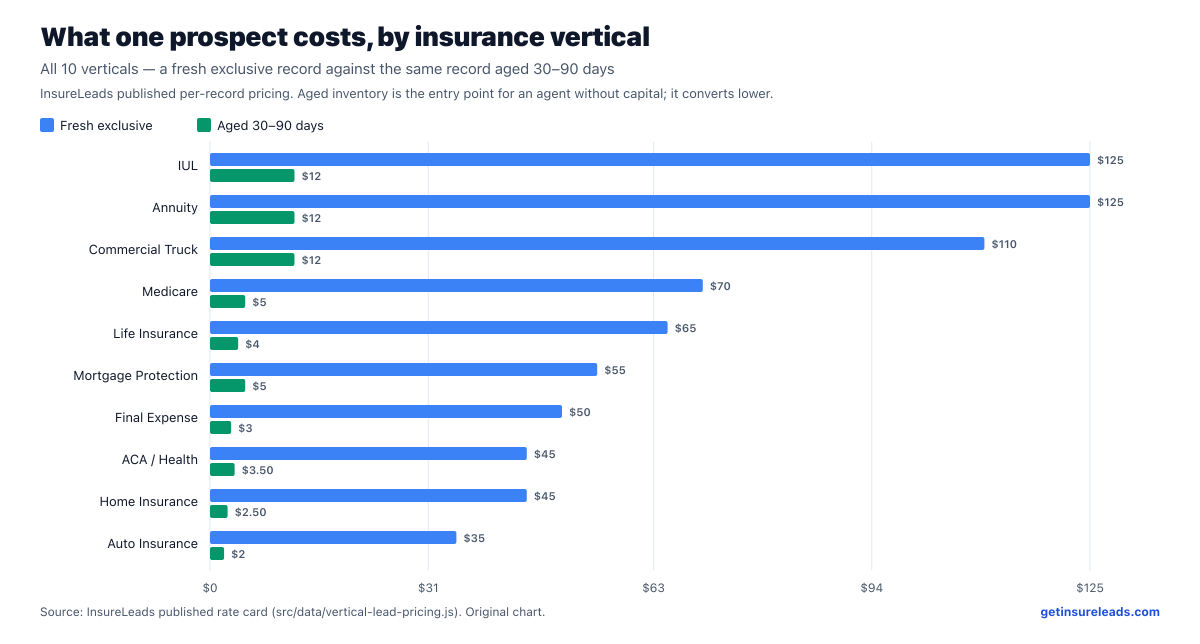
Buy the cheap file first. Records 30 to 90 days old cost $3 and convert, by our observation, at 2–5%. Exclusive real-time records cost $50 and convert at 8–15% for an agent with fast follow-up and a working carrier grid. Read those two lines side by side and the temptation is to skip straight to the expensive file. Do not. While your triage is still slow and your objection handling is improvising, the expensive record is a wasted record, and you can buy an order of magnitude more conversations per dollar on the aged file. Log a few hundred dials on cheap volume, then move up. Our aged-record vintages and what each band costs show what each age band buys.
The time-to-first-sale evidence backs the sequence rather than contradicting it. Our benchmarks put a new agent working exclusive real-time records at a median of 12 to 21 days to first sale, and a new agent working aged records only at 21 to 45 days with higher attrition. Slower — but the agent who arrives at real-time records with three hundred conversations behind them converts at the top of the 8–15% band instead of the bottom, and that difference is worth more than three weeks.
Keep the operational floor cheap while you are learning, and note that one of your compliance obligations is a data obligation: you cannot honour a revocation within ten business days, or prove you scrubbed against a registry version less than 31 days old, out of a notebook. You need somewhere to store dispositions and consent artefacts, a dialer or click-to-call, and text follow-up. A free single-user CRM covers all three at this stage. Spending on tooling beyond that before you have a stable close rate is spending on the wrong thing — the constraint in month one is your presentation.
| Source | Planning-band close rate | Median time to first sale | Fit in year one |
|---|---|---|---|
| Aged records, 30–90 days | 2–5% | 21–45 days | Start here. Buys conversation reps cheaply |
| Exclusive real-time records | 8–15% | 12–21 days | Step up once triage and objections are solid |
| Live transfers | 15–28% | 4–8 days with trained scripts | Only with live phone coverage; punishing without a script |
| Preset appointments | 25–40% | — | Highest close rate, highest cost, 20–30% reschedule or no-show |
| Self-generated — door, mail, own ads | Highly variable | Slowest | Real business, but funds and skill dependent |
Where do new final expense agents lose money?
Not on the economics. The product's cost-per-acquisition against its first-year commission is among the friendlier ratios available to a new agent — our own benchmarks put FE exclusive-web CPA at $140–$225 against a $540–$720 first-year commission — which is precisely why so many enter here. New agents lose money on execution, and the failure modes are consistent enough to list.
- Quoting before triage. Naming a premium before you know the tier produces either a lost sale on price or a decline in front of a prospect who has just confided their health history.
- Carrying too few carriers. Age ceilings differ by policy form within a single carrier — the graded form that stops at 80 while the level form runs to 85 — so two appointments means declining most of the applicants you paid to reach.
- Selling to face amount rather than to monthly budget. The policy that lapses in month four was sold at a premium the household could not carry, and the unearned advance comes back out of your next statement.
- Slow speed to contact on a purchased record. A record you answer in five minutes and a record you answer in thirty are two different products at the same price.
- Replacing existing coverage without the documented paperwork. Cal. Ins. Code § 10509.4 requires signed replacement statements on every life application and a prescribed replacement notice, policy list and left-behind originals where replacement is involved. Undocumented is indefensible.
- Presenting a national brochure in a state that filed a different form. Minn. Stat. § 72A.207 sets a four-times-first-year-premium floor on graded benefits; New York caps the senior-life category at $25,000 and issue age 75. Check the state form.
- Letting a funeral-home relationship pull you into preneed. In Texas, soliciting the designation of prepaid funeral benefits needs a Department of Banking permit under § 154.101, and violating it voids the contract and carries a criminal penalty.
- Loose consent discipline. Prior express written consent under 47 CFR 64.1200(f)(9) must be on file before autodialer or prerecorded contact, revocations must be honoured within ten business days, and Florida alone gives a called party $500 per violation, trebled for wilful conduct.
- Quitting at touch two. Most of these sales are not on the first call. An agent who marks a record dead after two attempts is discarding the majority of their own pipeline.
Frequently asked questions
What licence do you need to sell final expense insurance?
A state life licence. Simplified-issue whole life falls under the life line of authority, so a life-only licence is sufficient — no health line, no securities registration, and no federal certification comparable to AHIP or CMS Marketplace registration. Prelicensing hours vary sharply: 32 hours in California, 40 in New York, and no statutory hour requirement in Texas, per the NAIC's producer-education chart.
What is the difference between simplified issue and guaranteed issue?
Simplified issue uses a short health questionnaire plus database checks and, at the level tier, pays the full face amount from day one. Guaranteed issue asks no health questions and limits the early-year benefit — New York's DFS describes senior life plans as paying only return of premium or a minimum graded benefit for death in generally the first two or three policy years, capped at $25,000 and issue ages 50–75. Quote level first.
How does a graded or modified death benefit actually work?
The early-year benefit is less than the face amount and increases with time. United of Omaha's Living Promise graded form states it plainly: natural-cause death in the first two years returns all premiums paid plus 10%, full benefit after two years, and full benefit in all years for accidental bodily injury. Structures differ by state — Minnesota requires a graded death benefit to equal at least four times the first-year premium.
How much does a final expense policy pay the agent?
Our analysis of published carrier schedules and producer interviews puts first-year commission at 90% to 120% of annual premium with a 3% to 5% trail in years two through ten — roughly $540 to $720 on a $600-a-year policy. Where you land in that band depends on your contract level, not on the market.
What is a chargeback and how worried should a new agent be?
Carriers commonly advance a share of first-year commission at issue — our analysis records 75% as typical at a 100% contract level. If the policy lapses inside thirteen months, the unearned portion is recovered from your next commission statement. On a $600-premium case advanced at 75%, a month-four lapse leaves about $220 earned against $495 advanced and a $275 debit the next sale has to clear.
Is the FCC's one-to-one consent rule in force for insurance lead calls?
No. The Eleventh Circuit vacated that part of the FCC's 2023 order on 24 January 2025 in Insurance Marketing Coalition Ltd. v. FCC, the mandate issued 30 April 2025, and the FCC reinstated the prior definition of 47 CFR 64.1200(f)(9) effective 29 August 2025, noting the revised rule never took effect. The pre-2023 prior-express-written-consent standard still governs, and state statutes such as Florida's are stricter.
Do most final expense agents sell by phone or door-to-door?
Overwhelmingly by phone or video now. Every major FE carrier supports telephonic application with voice or electronic signature, and applications per agent-hour are several times higher without the driving. Field selling remains viable in rural and referral-dense markets, but it carries extra rules rather than fewer — California requires written notice 24 hours to 14 days before an in-home senior appointment.
How much should a new final expense agent spend on prospects?
Start on the cheap file. Records 30 to 90 days old cost $3 and convert at 2–5%; exclusive real-time records cost $50 and convert at 8–15%. Log a few hundred conversations on aged volume before moving up — the expensive record is wasted while your triage is still slow.
Sources
- https://www.dfs.ny.gov/consumers/life_insurance — New York DFS consumer guidance defining senior life / graded death benefit plans: no medical examination, return of premium or minimum graded benefit for death generally in the first two or three policy years, permissible issue ages 50–75, maximum issue amount $25,000, and that such policies are usually more expensive than a fully underwritten policy for a standard risk
- https://producer.mutualofomaha.com/enterprise/wcm/connect/producer.mutualofomaha.com-9968/efbe83e0-01d4-4275-b956-7d393e577666/45107_living-promise-client-highlight-sheet.pdf?MOD=AJPERES&CVID=nz81aeV — Carrier primary source for the level/graded split: United of Omaha Living Promise Level Benefit issue ages 45–85 with face $2,000–$50,000 ($5,000–$50,000 in WA); Graded Benefit issue ages 45–80 with face $2,000–$20,000 and natural-cause death in the first two years paying all premiums paid plus 10%, full benefit thereafter and full benefit in all years for accidental death; no medical exam; two-year suicide exclusion from contestability date (one year in ND); state-variation caveat on provisions and riders; the ~$7,500 funeral cost it cites is attributed there to NFDA 2022
- https://www.revisor.mn.gov/statutes/cite/72A.207 — Minn. Stat. § 72A.207: definition of a graded death benefit, the requirement that it equal at least four times the first-year premium, the limited carve-outs for rescission and the suicide/aviation/war-risk exclusions, and the exemption for preneed insurance under § 61A.258
- https://codes.ohio.gov/ohio-administrative-code/rule-3901-6-04 — Ohio Admin. Code 3901-6-04(C): the life insurance illustrations rule does not apply to policies with illustrated death benefits on any individual not exceeding $10,000 — i.e. it does not reach much of the final expense face band; also the basic-illustration, signed-acknowledgement and illustration-actuary requirements it imposes on the policies it does cover
- https://statutes.capitol.texas.gov/Docs/FI/htm/FI.154.htm — Tex. Fin. Code ch. 154: § 154.101 permit requirement (Texas Department of Banking) to sell or solicit the designation of prepaid funeral benefits including via a TDI-licensed insurance policy; § 154.158 unenforceability plus purchaser recovery; § 154.401 criminal penalty of $100–$500 and/or one to six months with each violation a separate offence; § 154.002 definitions of prepaid funeral benefits and insurance-funded contract
- https://leginfo.legislature.ca.gov/faces/codes_displaySection.xhtml?lawCode=INS§ionNum=789.10 — Cal. Ins. Code § 789.10: applies to the sale, offering and lead generation for life insurance to seniors; written notice no less than 24 hours and no more than 14 days before an initial in-home meeting; stand-alone document in 16-point bold with prescribed contents including licence number and the senior's rights; the on-arrival statement of purpose; business cards for all attendees; obligation to leave when asked; ban on ruses
- https://leginfo.legislature.ca.gov/faces/codes_displaySection.xhtml?lawCode=INS§ionNum=10127.10 — Cal. Ins. Code § 10127.10: cancellation notice on the policy jacket or cover page for individual life policies delivered to senior citizens, prescribed 12-point bold language, return period not less than 30 days for a full refund, and subdivision (g) defining senior citizen as 60 years of age or older on the date of purchase
- https://leginfo.legislature.ca.gov/faces/codes_displaySection.xhtml?lawCode=INS§ionNum=10509.4 — Cal. Ins. Code § 10509.4: signed applicant and agent statements on every life application as to whether replacement is involved; where it is, the prescribed Notice Regarding Replacement presented no later than at application and signed by both parties, the list of policies to be replaced by insurer, insured and contract number, and leaving originals of printed material with the applicant
- https://media.ca11.uscourts.gov/opinions/pub/files/202410277.pdf — Insurance Marketing Coalition Ltd. v. FCC, No. 24-10277 (11th Cir. Jan. 24, 2025): the court granted the petition and vacated Part III.D of the FCC's 2023 order — the one-to-one consent and 'logically and topically associated' restrictions — holding the FCC exceeded its statutory authority because the restrictions conflict with the ordinary statutory meaning of 'prior express consent'
- https://www.federalregister.gov/documents/2025/08/29/2025-16641/delete-delete-delete-targeting-and-eliminating-unlawful-text-messages-rules-and-regulations — FCC final rule, 90 FR 42137 (Aug. 29, 2025): the Eleventh Circuit's mandate issued April 30, 2025 vacating the revised first paragraph of 47 CFR 64.1200(f)(9); this action reinstates the prior version; the revised rule had never gone into effect — the primary confirmation that one-to-one consent is not law
- https://www.ecfr.gov/current/title-47/section-64.1200 — 47 CFR 64.1200 as currently in force: (f)(9) definition of prior express written consent (signature, specific number, clear and conspicuous disclosure, no purchase condition); (c)(1) 8 a.m.–9 p.m. local-time restriction; (c)(2)(i)(D) national do-not-call registry version obtained no more than 31 days before the call plus recordkeeping; (a)(10)–(11) revocation by any reasonable method, per se reasonable keywords, no exclusive means, honoured within a reasonable time not to exceed ten business days. Last amended 90 FR 42138, Aug. 29, 2025
- http://www.leg.state.fl.us/statutes/index.cfm?App_mode=Display_Statute&URL=0500-0599/0501/Sections/0501.059.html — Fla. Stat. § 501.059: (1)(g) definition of prior express written consent; (8)(a) ban on unsolicited automated or recorded telephonic sales calls without it; (8)(d) rebuttable presumption that a call to a Florida area code reaches a Florida resident; (10)(a) private action for actual damages or $500 per violation, trebled at the court's discretion for wilful or knowing violations; (10)(c) the 15-day STOP prerequisite for text-message claims
- https://www.bls.gov/ooh/sales/insurance-sales-agents.htm — BLS Occupational Outlook Handbook, Insurance Sales Agents (SOC 41-3021): median annual wage $60,370 in May 2024, lowest 10% under $36,390, highest 10% above $135,660, insurance agencies and brokerages median $59,580; 568,800 jobs in 2024, 4% projected growth 2024–34, about 47,000 annual openings; separate licences for life/health versus property and casualty, state coursework and exam, and CE requirements; the wage series excludes self-employed workers
- https://www.nfda.org/media-center/ — NFDA's current public statistics page — cited for what it does NOT contain: no median or average funeral cost figure appears on it (it carries a projected 2025 cremation rate of 63.4% against a 31.6% burial rate, and 15,401 U.S. funeral homes). This is why no current funeral-cost figure is stated as fact on this page