
How to Become a Life Insurance Agent
The short answer
Becoming a life insurance agent takes one state licence — a resident life line of authority. Florida requires a 30-hour prelicensing course, California 32 hours, Texas none at all. Term pays 50–90% of first-year premium, permanent products several times more. Variable life and variable annuities need FINRA registration on top.
Why do most new agents start with life insurance?
Life insurance carries the fewest gates of any vertical a new agent can enter. One resident line of authority, one state exam, and — unlike Medicare or marketplace health work — no annual federal certification and no enrollment window. A Medicare agent has to pass fresh training and testing every plan year and can only enroll beneficiaries during defined election periods. A life agent licensed in March writes business in March.
That openness cuts both ways. Nothing keeps anyone else out either, so life is where the largest number of first-year agents compete, and it carries the longest wait between effort and money. Our compensation analysis puts the life sales cycle at two to six weeks from first contact to a placed policy, with underwriting as the main variable: term written through instant-decision tele-underwriting can issue in 24 to 72 hours, while a fully underwritten permanent case will not.
This guide runs the questions that actually decide whether the first year works, in life-specific terms — which licence, what the licence does not cover, what the products pay, which regulation will cost you the licence if you get it wrong, and what prospects cost. Where the answer is genuinely state-by-state across all 51 jurisdictions, our state-by-state licensing and continuing-education reference carries the statutory citations; this page works three states in detail instead, because the detail is where new agents get surprised.
- No federal certification to renew annually — the recurring obligation is state continuing education, not a plan-year exam.
- No enrollment window — life business is written all twelve months, so income is not concentrated into eight weeks.
- One licence covers a wide product ladder, from small whole-life face amounts to target-premium indexed universal life.
- The trade-off: underwriting sits between the sale and the commission, and a share of applications never place.
What can't you sell with a life licence?
Two categories sit outside it, and new agents discover them in the middle of a case rather than before one. The first is securities. Variable universal life and variable annuities are not sold on a state insurance licence alone: FINRA's Series 6 registration is what covers "mutual funds (closed-end funds on the initial offering only), variable annuities, variable life insurance, unit investment trusts (UITs) and municipal fund securities," and the Series 7 covers the "solicitation, purchase and/or sale of all securities products." A state can bundle the insurance side of variable products into the life licence and still leave the securities side untouched — Florida's class is literally named "Life (Including Annuities & Variable Contracts)," and California prints variable contract authority on the Life-only licence when the agent holds it.
The gate that matters practically is not the exam, it is the sponsorship. The Securities Industry Essentials exam is open to anyone 18 or older and "association with a firm is not required to take the SIE," with results valid for four years. The representative-level exams are different: FINRA states that "the individual must be associated with a member firm to take a qualification exam," and that "passing the SIE alone does not qualify an individual for registration with a FINRA member firm or to engage in securities business." So a newly licensed independent agent cannot simply buy their way to a Series 6. They need a broker-dealer to take them on first — which is a recruiting conversation, not a study plan, and it is the real reason most first-year life agents never write a variable case.
The second category is health-adjacent product a life licence looks like it should reach and does not. California is the cleanest example because the Department of Insurance states it outright: an agent who holds only a Life licence is not authorised to sell long-term care insurance, and is not authorised to sell 24-hour care coverage either. The Accident and Health or Sickness licence carries those, and brings its own training load — eight hours of long-term care training in each of the first four 12-month periods after issue, then eight hours per two-year term. Annuities run the other way in California: the Life licensee may sell them, the Accident and Health licensee may not, and either way an initial eight-hour annuity training course must be completed before soliciting an annuity, with four hours each renewal after that.
- Series 6 or Series 7 registration, the SIE as a corequisite, and association with a FINRA member firm — for variable life and variable annuities.
- Series 63, the NASAA-written Uniform Securities State Law Examination administered by FINRA (60 scored questions, 75 minutes, 43 correct to pass) — for state securities registration.
- The Accident and Health or Sickness line — for long-term care in California, and for Medicare, marketplace health and disability business generally.
- State annuity product training before soliciting an annuity — eight hours initially in California, four hours each renewal thereafter.
- A carrier appointment — in Florida the licence itself is invalid without one, whatever your exam result says.
Which products need which credential, and what does each pay?
Put the credential question and the money question in the same table and the sequencing for a first year answers itself. Everything a new agent can actually sell profitably in months one to twelve needs nothing beyond the resident life licence. Everything that needs a second credential also needs either a broker-dealer relationship you do not have or a training course you have not taken, and pays on a schedule we cannot verify — which is a reason to leave it alone for now, not a reason to guess at the number.
The commission column comes from our own compensation analysis: published carrier schedules, our buyer-side operational data from Q1 2025 through Q1 2026, and structured interviews with 40-plus active producers conducted January to March 2026. It is an analysis, not a controlled survey with a disclosed sampling frame, and the ranges are wide because contract level moves them more than product does. The case-cycle column comes from the same analysis plus the underwriting route the product normally takes.
Two rows carry a deliberate blank. We hold no verified first-year schedule for fixed or fixed-indexed annuities, and none for variable products, where compensation is paid through a broker-dealer's grid rather than the carrier's insurance schedule. Publishing a plausible-looking number there would be worse than the blank, because a new agent would budget against it.
| Product | Credential beyond a resident life licence | First-year commission shape | Typical case cycle |
|---|---|---|---|
| Level term, 20–30 years, ages 35–55 | None | 50–90% of annual premium; 1–3% renewal years 2–10 | 24–72 hours if tele-underwritten; 3–8 weeks fully underwritten |
| Simplified-issue whole life, $10k–$25k face (final expense) | None | 90–120% of annual premium; 3–5% renewal years 2–10 | 1–2 weeks |
| Mid-market whole life or fixed universal life | None | $1,500–$4,000 in the first year; 2–5% renewal years 2–10 | 3–8 weeks; full underwriting common |
| Indexed universal life, target premium, ages 40–55 | None — a fixed-index product is not a registered security | 60–115% of target premium; 2–5% excess/trail | 3–8 weeks, plus illustration review before delivery |
| Fixed and fixed-indexed annuities | State annuity product training (California: 8 hours before soliciting, 4 hours each renewal) | Not published here — no verified schedule exists in our data | Weeks; suitability review adds time |
| Variable universal life and variable annuities | Variable contract authority on the state licence, plus the SIE, Series 6 or 7, Series 63 — and association with a FINRA member firm, without which you cannot sit the exam | Paid through the broker-dealer's grid, not the carrier's insurance schedule; no verified figure held | Longest of any product on this table |
| Long-term care (California worked example) | The Accident and Health or Sickness licence — a Life-only licensee is not authorised; 8 hours LTC training in each of the first four 12-month periods | Not applicable to a life-only practice | Not applicable to a life-only practice |
Term or permanent — where is the money in a first year?
Life commission is a percentage of first-year premium, and the percentage moves far less than the premium does. Our analysis puts 20- and 30-year term at 50 to 90 percent of annual premium and target-premium indexed universal life at 60 to 115 percent of target premium. The spread that decides your year is not the percentage. It is the premium those percentages attach to. A $600-a-year term policy at 80 percent produces roughly $480 of first-year commission. A $5,000 target-premium IUL case at 95 percent produces roughly $4,750 — ten term policies in one application.
The market agrees with that arithmetic, which is the uncomfortable part. LIMRA's 19 March 2026 release on 2025 U.S. individual life insurance sales reported total new annualized premium of $17.5 billion, up 10 percent year over year, with policy count up 7 percent. Whole life took 37 percent of that premium at $6.4 billion, indexed universal life 25 percent at $4.5 billion and variable universal life 15 percent at $2.6 billion — while term life, which dominates consumer search volume and lead volume, took just 17 percent at $3.1 billion. Sean Grindall, LIMRA's senior vice president and chief member relations officer, called it "an exceptional year for individual life insurance with indexed and variable universal life products posting double-digit premium growth." Fixed universal life was the only line to fall, down 4 percent to $984 million.
Agents who read that and move straight to permanent business usually miss the second half of it. Our interview cohort put carrier chargebacks on IUL and life persistency at the top of the pain list for 58 percent of respondents, and the exposure concentrates in the first 13 months — exactly when a new agent has no book to absorb it. The honest sequencing is term and simplified-issue whole life for cash flow, permanent business as it appears rather than as a target, and no reliance on advanced-case commission that has not yet survived a policy anniversary. Our guide to how term and permanent compare from the writing agent's side works through the product mechanics; the contract level printed on your appointment paperwork decides what share of the schedule you personally see.
The replacement rules that put a new licence at risk
This is the section most career guides skip, and it is the one with the licence attached to it. When a new policy causes an existing policy to lapse, be surrendered, be reduced, or be borrowed against to fund the new premium, the transaction is a replacement, and a separate body of regulation governs what you disclose and when. The NAIC's Life Insurance and Annuities Replacement Model Regulation defines replacement as a transaction where it "is known or should be known to the proposing producer" that an existing policy will be lapsed, surrendered, converted to reduced paid-up insurance, amended so as to reduce benefits, reissued with a reduction in cash value, or used in a financed purchase.
Under the model's Section 3, a producer taking any application must submit a statement signed by both the applicant and the producer as to whether the applicant has existing coverage. If the answer is no, the producer's replacement duties are complete. If it is yes, the producer must "present and read to the applicant, not later than at the time of taking the application," the notice regarding replacements, get it signed by both parties attesting it was read aloud or that the applicant declined to have it read, leave a copy with the applicant, list every policy proposed to be replaced by insurer and policy number, leave a copy of all sales material at application, and submit copies of everything to the insurer. Section 8 makes any failure to comply a violation of the state's twisting provisions, and names as examples the intentional incorrect recording of an answer and "advising an applicant to respond negatively to any question regarding replacement in order to prevent notice to the existing insurer."
"Most states have adopted this" is the vague claim everyone makes, so here is the actual count from the NAIC's own state-adoption chart for the model: 31 of the NAIC's 56 member jurisdictions are listed under Model Adoption as having enacted the current version in substantially similar form (Alaska with portions only). Fifteen — including California, Florida, Texas, Pennsylvania and Illinois — appear only under Previous Version, meaning an older edition is in force. New York, Oklahoma and Puerto Rico appear only under Related Activity. Seven jurisdictions show no current activity at all: North Dakota, Wyoming, the District of Columbia, American Samoa, Guam, the Northern Marianas and the Virgin Islands. So the answer to "what do I have to do" is genuinely your state's rule, not the model, and in a quarter of the country the rule is materially different from the model text.
New York is the case study in how much further a state can go. Regulation 60 (11 NYCRR 51) requires the agent to obtain a signed "Definition of Replacement" form with every application, replacement or not — not only when the applicant answers yes. Where a replacement is involved, the agent must notify both the existing and the replacing insurer, request the data needed to complete a Disclosure Statement, and, before policy delivery, submit a signed Disclosure Statement specifying "the primary reasons for recommending the new life insurance policy or annuity contract and why the existing life insurance policy or annuity contract cannot meet the applicant's objectives." The existing insurer has 20 days to furnish the information. The replacement policy carries a 60-day unconditional right of return, double the model's 30 days. And section 51.7(c) is the sentence to read twice: where policyholders replace coverage after saying they did not intend to, "patterns of such action by policyholders or contractholders having the same insurance agent or broker shall be deemed prima facie evidence of the agent's or broker's knowledge that replacement was intended," and prima facie evidence of intent to violate the regulation. Penalties named in the same section include monetary restitution, restoration of policies, and suspension or revocation of an agent's licence.
The practical reading for a first-year agent: the replacement paperwork is not the carrier being difficult, and "the client said there was nothing in force" is not a defence that survives a pattern. It is also where chargebacks come from, since a replaced policy that lapses inside the first year takes your advance with it.
What do the first 90 days actually consume?
The first 90 days of a life career are not spent selling. They are spent removing the things that stop you from selling: the prelicensing hours your state requires, the exam, the fingerprinting your jurisdiction requires (Texas routes applicants through IdentoGO before the application; Florida requires it as a separate step with fees paid directly to the vendor), appointment paperwork with two or three carriers, and the mechanics of getting a prospect's answers written down somewhere you can find them again.
Time to a first sale depends almost entirely on what you dial. Our interview medians put a new agent on purchased exclusive web leads at 12 to 21 days to a first sale, a new agent on aged records only at 21 to 45 days, and a new agent working referrals and warm market at 30 to 90 days. Then life adds its own lag on top: the sale is not the commission. Our worked model for the life vertical assumes roughly one in five applications does not place, and a fully underwritten case can sit for weeks. Plan for a first commission several weeks after a first application, not several days.
One piece of infrastructure is worth setting up before the first dial rather than after the twentieth: somewhere to record who you called, what they said, and when to call again — and, given the replacement rules above, what they told you about coverage already in force. A dialer without a record produces the same conversation twice and the follow-up never. Our free single-user CRM is free permanently on one seat and one vertical, which is the shape of a first-year life practice anyway.
- Licence work first — prelicensing hours where your state states them, then the exam. In Texas's published path there are no required hours, only the exam and the background check.
- Carrier contracting second, and in parallel where possible: in Florida the licence is not even valid until an appointment exists, so this is not an optional later step.
- A written follow-up system third, before volume arrives. Life buyers take two to six weeks; nothing survives that window in your head.
- Prospect volume last, and small. A first buy exists to calibrate your script and your contact rate, not to produce a quota.
What can a first-year life agent afford to buy?
Purchased prospects are the most common entry path in this vertical, and the cheapest formats are the ones a new agent is least equipped to convert. Our own close-rate ranges for life put interest-verified live transfers at 15 to 25 percent, exclusive real-time web leads at 7 to 14 percent, and aged records at 2 to 5 percent. Those numbers describe skill as much as inventory: a transfer places a stranger on your phone mid-intent, which rewards a script you do not have yet, while aged records reward volume and patience, which you do.
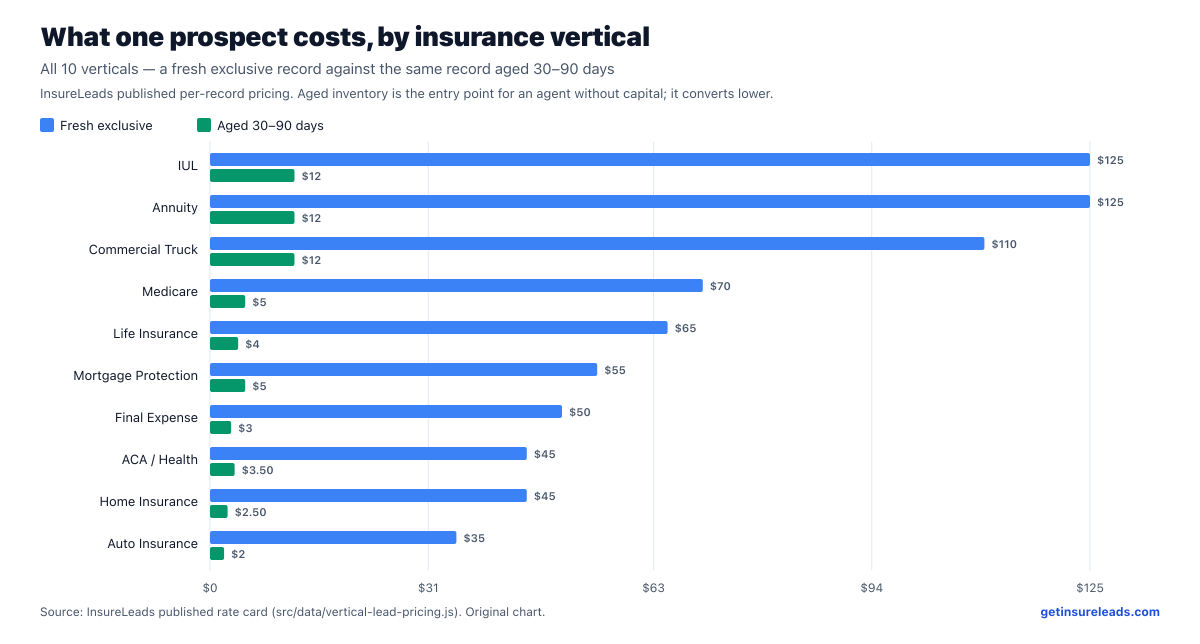
That is the argument for starting on aged data rather than the argument against it. Aged records are priced low enough that 200 dials cost less than three fresh exclusive leads, and 200 dials is roughly what it takes to stop sounding new. They are also not exclusive unless they genuinely have never been resold, and at a 2 to 5 percent close rate they are practice inventory, not a business plan. Fresh exclusive life records and interest-verified transfers earn their price once your contact-to-appointment ratio is stable.
Budget on placed policies, not on leads or even applications. With a 7 to 14 percent close rate on exclusive web leads and roughly one application in five failing to place, the cost per placed policy is meaningfully higher than the cost per lead — which is the number most new agents plan around and the reason most of them run out of money in month four. Our cost-per-lead calculator lets you put your own close rate against the current card before you commit.
| Format | Price | Close rate (our analysis) | Who it actually suits |
|---|---|---|---|
| Interest-verified live transfer | $160 | 15–25% | Agents with phone coverage and a script that already survives objections |
| Exclusive real-time web lead | $65 | 7–14% | Consultative needs-analysis selling with a follow-up cadence, not one-call closing |
| Contact-verified lead | $90 | — | Agents who cannot dial fast and want the wrong-number and wrong-state waste removed first |
| Aged record, 30–90 days | $4 | 2–5% | New agents building dialing reps; life buyers are often still shopping at 60–90 days |
| Aged record, 91–180 days | $2.50 | 2–5% | High-volume nurture dialing where the cost of a bad conversation is near zero |
Where does mortgage protection fit in a life career?
Mortgage protection is not a separate licence or a separate career. It is a life product sold against a specific event: someone has just taken on a mortgage and has a number in their head that they want covered. The policy underneath is ordinary — level term sized to the balance, or simplified-issue whole life where health rules term out — so the life line of authority covers the whole conversation, in every one of the three states worked above.
What differs is the prospect's clock. A mortgage-protection record is triggered by a recorded property transaction, so its value decays with the newness of that event in a way a general life inquiry does not: the homeowner who closed six weeks ago is still organising their paperwork, and the one who closed a year ago has either bought coverage or stopped thinking about it. Recency, not volume, is the variable that decides whether the format works for you.
Priced per record, mortgage protection sits on its own line of the card — exclusive at $55, interest-verified transfers at $150, aged 30-to-90-day records at $5. Treat it as a second script inside the same licence rather than a second business, and expect the objection pattern to be different: mortgage-protection prospects argue about whether they need coverage at all, while general life prospects argue about how much. Watch the replacement question here in particular — a buyer who already carries a term policy from a previous house is a replacement case whether or not they describe it that way.
Where does a first-year life agent's income actually come from?
First-year income in this business is wide and low. Our compensation analysis puts agents with under one year licensed at a 25th percentile of $24,000, a median of $38,000, a 75th percentile of $56,000 and a 90th percentile of $78,000. The distribution is right-skewed by a small number of outliers, which is why averages quoted in recruiting material tend to describe people who are not you yet. Lead source shows up in that number more than product choice does: among agents whose primary source is purchased leads, our first-year median lands at $44,000; among agents running their own paid advertising, $31,000, with the widest variance of any source in the set.
How much of the schedule you see is set by your contract, and for a new independent agent the contract almost always arrives through an intermediary rather than direct from the carrier. That intermediary sets your commission level, which is why two agents selling the identical policy at the identical premium can be paid very differently. The mechanics of that layer — the tiers, the overrides, the vocabulary — are covered in our explainer on how the IMO and FMO layer sits between you and the carrier. Three contract terms matter more in year one than the headline level: whether commissions are advanced or as-earned and at what percentage, the release policy that decides whether you can move an appointment to a different upline later, and chargeback treatment on early lapses.
We take no referral fee, sponsorship, or affiliate payment from any IMO, FMO, or carrier, and we do not place agents. That is deliberate: every other party explaining contracting to a new agent is usually being paid for the recruit. It also means this page will not tell you which upline to sign with — only which questions to ask before you do.
Two structural facts are worth internalising before you plan a budget. Chargebacks are real and land in the same 13-month window as your first permanent-life commissions. And renewal income, which is what eventually makes this career work — 45 to 55 percent of total compensation for agents past ten years in our analysis — pays you nothing at all in year one. Our full agent compensation analysis carries the income tables by experience, by lead source, and by vertical, with its methodology and its limits stated on the page.
- Ask for the release policy in writing before you sign anything, not after your first chargeback.
- Ask whether commissions are advanced or as-earned, and at what percentage of the expected first-year commission.
- Ask what happens to your appointments and your book if you leave — and get the answer in the contract, not in an email.
- Ask what the upline actually provides beyond the contract: training, case design, or nothing but a paper trail.
Frequently asked questions
How long does it take to get a life insurance licence?
It depends on your state's prelicensing requirement, which varies by weeks. Florida's class 2-14 licence requires a 30-hour life, annuity and variable contracts course. California's Life licence requires 20 product hours plus 12 code-and-ethics hours, 32 in total. Texas publishes no prelicensing course requirement at all — its own path runs exam, fingerprinting, application, fee. Exam scheduling, fingerprinting and application processing sit on top of the coursework in every state.
Do I need an accident and health licence to sell life insurance?
Not in general, but the answer is state-specific. Florida and California issue the life line separately, so a life-only licensee can write life and annuities without it. Texas does not split them — its general lines licence covers life, accident and health together. Watch the product carve-outs: California states that an agent holding only a Life licence is not authorised to sell long-term care insurance or 24-hour care coverage.
Can I sell variable universal life or variable annuities with just a life licence?
No. Those are securities. FINRA's Series 6 registration covers variable annuities and variable life insurance, and Series 7 covers all securities products, with the SIE as a corequisite and Series 63 for state securities registration. The practical obstacle is not the exam but the sponsorship: FINRA states that an individual must be associated with a member firm to take a qualification exam, so you need a broker-dealer to take you on before you can even sit the Series 6.
What pays more in the first year, term or IUL?
IUL, by a wide margin per case. Our analysis puts term at 50–90% of annual premium (a $600/yr policy at 80% is roughly $480) and target-premium IUL at 60–115% of target (a $5,000 target at 95% is roughly $4,750). The market agrees: LIMRA reported that in 2025 indexed universal life took 25% of $17.5 billion in new annualized premium against term's 17%. The same analysis found 58% of interviewed producers naming carrier chargebacks on IUL and life persistency as a top pain point, concentrated in months 1–13.
What do I have to disclose when I replace someone's existing policy?
Follow your state's rule, not the NAIC model, because only 31 of the NAIC's 56 member jurisdictions have adopted the current model in substantially similar form. Under the model, if the applicant has existing coverage you must present and read the replacement notice no later than at the time of application, list every policy to be replaced by insurer and number, get the notice signed by both parties, leave all sales material with the applicant, and submit copies to the insurer. New York's Regulation 60 goes further: a signed Definition of Replacement form on every application, a Disclosure Statement stating why the existing policy cannot meet the client's objectives, and a 60-day right of return.
Can a replacement mistake cost me my licence?
Yes. The NAIC model treats non-compliance as a violation of the state's twisting provisions, and names as examples incorrectly recording an answer and advising an applicant to answer the replacement question negatively to prevent notice to the existing insurer. New York's Regulation 60 lists suspension or revocation of an agent's licence among the penalties, and treats a pattern of clients replacing coverage after stating they did not intend to as prima facie evidence of the agent's intent to violate the rule.
How many leads does a new life agent need to place one policy?
Plan on placed policies rather than leads. Our close-rate range for exclusive real-time life web leads is 7–14%, and our worked life model assumes roughly one application in five does not place. That combination puts the true cost per placed policy well above the cost per lead, which is the number most first-year budgets are built on.
Does InsureLeads recommend a particular IMO or upline?
No. We take no referral fee, sponsorship, or affiliate payment from any IMO, FMO, or carrier, and we do not recruit or place agents. We publish how the distribution layer works and which contract terms to interrogate; we do not rank uplines, because we have no basis for a ranking that anyone should trust.
Sources
- https://www.limra.com/en/newsroom/news-releases/2026/limra-u.s.-individual-life-insurance-new-premium-tops-$17.5-billion-to-set-new-sales-record-in-2025/ — 2025 U.S. individual life new annualized premium of $17.5 billion, up 10% with policy count up 7%; whole life $6.4bn / 37% share, IUL $4.5bn / 25%, VUL $2.6bn / 15%, term $3.1bn / 17%, fixed UL $984m and down 4%; release dated 19 March 2026; direct quote from Sean Grindall, LIMRA SVP and chief member relations officer. Fetched 2026-08-11.
- https://www.finra.org/registration-exams-ce/qualification-exams/series6 — Series 6 covers 'mutual funds (closed-end funds on the initial offering only), variable annuities, variable life insurance, unit investment trusts (UITs) and municipal fund securities'; SIE is a corequisite. Fetched 2026-08-11.
- https://www.finra.org/registration-exams-ce/qualification-exams/series7 — Series 7 qualifies a candidate for 'solicitation, purchase and/or sale of all securities products'; SIE is a corequisite. Fetched 2026-08-11.
- https://www.finra.org/registration-exams-ce/qualification-exams/series63 — Series 63 is the NASAA-developed Uniform Securities State Law Examination administered by FINRA: 60 scored questions, 75 minutes, 43 correct answers to pass. Fetched 2026-08-11.
- https://www.finra.org/registration-exams-ce/qualification-exams/securities-industry-essentials-exam — 'Association with a firm is not required to take the SIE, and results are valid for four years'; 'passing the SIE alone does not qualify an individual for registration with a FINRA member firm'; 'the individual must be associated with a member firm to take a qualification exam.' Fetched 2026-08-11.
- https://content.naic.org/sites/default/files/model-law-613.pdf — NAIC Life Insurance and Annuities Replacement Model Regulation: Section 2J definition of 'replacement' (lapsed/surrendered/reduced/reissued/financed purchase, 'known or should be known to the proposing producer'); Section 3A–3E producer duties (signed existing-coverage statement, notice presented and read aloud no later than at application, list of policies by insurer and number, sales material left with applicant, copies submitted to insurer); Section 5 replacing-insurer duties including five-year indexed retention and the owner's 30-day unconditional right of return; Section 8 violations and penalties including the twisting examples. PDF fetched and text-extracted 2026-08-11 (2015 printing of the 2000 model).
- https://content.naic.org/sites/default/files/model-law-state-page-613.pdf — State-adoption counts for the replacement model, tallied from the chart: 31 of 56 NAIC member jurisdictions under Model Adoption (Alaska portions only); 15 under Previous Version only, including California, Florida, Texas, Pennsylvania and Illinois; New York, Oklahoma and Puerto Rico under Related Activity only (NY = Regulation 60); seven with no current activity (North Dakota, Wyoming, DC, American Samoa, Guam, Northern Marianas, Virgin Islands). Fetched 2026-08-11.
- https://www.dfs.ny.gov/industry_guidance/regulations/final_insurance/rf60_amend3_text — New York Regulation 60 (11 NYCRR 51) as amended: section 51.5 agent and broker duties (signed 'Definition of Replacement' with every application; notification of both insurers; Disclosure Statement before delivery specifying the primary reasons for the new policy and why the existing one cannot meet the applicant's objectives); section 51.6(c)(2) 20-day existing-insurer response; section 51.6(d) 60-day unconditional right of return; section 51.7(a) prohibited acts; section 51.7(b) penalties including suspension or revocation of an agent's licence; section 51.7(c) pattern as prima facie evidence of intent to violate. Fetched 2026-08-11.
- https://myfloridacfo.com/docs-sf/insurance-agents-and-agency-services-libraries/agents-docs/licensure/agents-adjusters/2-14-resident-life-agent-license.pdf — Florida class 2-14 Resident Life (Including Annuities & Variable Contracts): scope of transactions; 30-hour life, variable contracts prelicensing course within four years of application; fingerprinting as a separate step with vendor-paid fees; 24 hours CE biennially (Fla. Stat. 626.2815); appointment required for validity (626.112(4)); licence expires if unappointed 48 months (626.431(3)). Fetched 2026-08-11.
- https://myfloridacfo.com/docs-sf/insurance-agents-and-agency-services-libraries/agents-docs/licensure/agents-adjusters/2-15-resident-health-life-agent-license.pdf — Florida class 2-15 Resident Health & Life: 60-hour combined life-and-health prelicensing course, or the 30-hour life/annuity/variable contracts course plus a 40-hour health course; same 24-hour biennial CE and appointment rules as 2-14. Fetched 2026-08-11.
- https://myfloridacfo.com/division/agents/licensing/agents-and-adjusters/qualifications — Florida DFS licence-class index confirming the life line is issued as separate classes — 2-14 Life (Including Annuities & Variable Contracts), 2-15 Health & Life, 2-40 Health — rather than as one combined licence. Fetched 2026-08-11.
- https://www.insurance.ca.gov/0200-industry/0090-faq/lo-ahfaq.cfm — California: AB 720 (2007) split the Life Agent licence into a Life licence and an Accident and Health or Sickness licence; Life prelicensing = 20 product hours + 12 code-and-ethics hours = 32 (Ins. Code 1749(c),(e)); both lines = 40 product + 12 ethics = 52 hours; $188 filing fee covering both if applied for together; 24 hours CE per term including 3 ethics hours (1749.33); 'an agent that only holds a Life license is not authorized to sell long-term care insurance'; the same for 24-Hour Care Coverage; Life licensee may sell annuities after an initial 8-hour annuity training course with 4 hours each renewal (1749.8); LTC training of 8 hours in each of the first four 12-month periods (10234.93); variable contract authority is printed on the Life-only licence. Fetched 2026-08-11.
- https://www.tdi.texas.gov/tips/be-an-agent.html — Texas: the general lines – life, accident, and health licence 'lets you sell life and health insurance, including annuities, with just one license'; exam code InsTX-LAH05; TDI's published path lists no prelicensing course (exam, IdentoGO fingerprinting, application within a year, fee); February 2021 pass rates of 60% for life, accident, and health, 53% property and casualty, 47% adjuster-all lines; temporary licence good for 180 days and non-renewable; page last updated 12 February 2026. Fetched 2026-08-11.