
The New Insurance Agent's First 90 Days: A Phase-by-Phase Operating Plan
The short answer
A licensed agent's first 90 days start in a queue, not a sale. Carriers file appointments on state deadlines — 15 days in Michigan, New York and Washington, 30 in Ohio, North Dakota and Virginia. Our compensation analysis puts median time-to-first-sale at 12–21 days on exclusive web leads once dialing starts.
What actually happens in a new insurance agent's first 90 days?
The first 90 days after a license number is issued do not begin with selling. They begin with a queue. Carriers and uplines process contracting packets on their own clock, state law gives the insurer a filing window measured in days rather than hours, and a newly licensed producer spends the opening stretch waiting on writing numbers while the fixed costs of starting — errors-and-omissions coverage, a phone stack, a first lead budget — have already begun.
The honest shape of the quarter is three uneven phases. A paperwork phase where nothing is sellable. A conversation phase where a first submitted application becomes possible. A settlement phase where the first commission statement finally reports what the previous 60 days produced. The table maps what is happening inside each phase against the cash position at that same moment, because cash lags activity by weeks at every stage and that lag is the part most first-quarter plans omit.
Two structural facts govern the whole quarter. The carrier controls phase one, and your dialing volume controls phase two. Nothing you do in week two shortens a statutory filing window, and nothing a carrier does in week six substitutes for the calls you did not make.
| Phase | What is actually happening | Realistic cash position |
|---|---|---|
| Days 1–15 — paperwork | License number and NPN active. Contracting packets submitted to an upline or direct to carriers. Background and industry-database checks underway. E&O certificate bound. AML training certificate attached where a life carrier requires one. No writing numbers yet. | Outflow only. No submitted business exists, so no commission can exist. |
| Days 16–30 — first appointments file | Carriers file appointments one at a time, not as a batch, and the statutory window runs from contract execution or first application — 15 days in Michigan, New York, Washington and Alabama, 30 in Ohio, North Dakota and Virginia. The first writing number often arrives from the carrier with the lightest contracting process rather than the one you most wanted. | Still outflow. A first application may be submitted late in this window, which starts an underwriting clock, not a payment clock. |
| Days 31–60 — first submitted application | Dialing discipline becomes the only variable that moves. Underwriting takes over the outcome. Our analysis puts median time-to-first-sale at 12–21 days for a new agent working exclusive web leads, once they actually start working them. | First advance or as-earned commission becomes possible only after the carrier issues the policy and the initial premium is collected. |
| Days 61–90 — first money, first chargeback risk | First commission statements arrive. So do the first lapses and returned premium drafts. You learn a close rate from a sample far too small to trust, and the temptation is to over-correct on it. | First money in. Net position across the quarter is frequently still negative, and that is a normal reading rather than a failure signal. |
Why the first 30 days belong to the carrier, not to you
A producer appointment is not something you file. The NAIC State Licensing Handbook defines it plainly: "An appointment is a registration with the state insurance department that a producer is acting on behalf of an insurer." The insurer submits it. The uniform appointment process adopted by the NAIC's Producer Licensing Working Group in 2002 states that "States shall require insurers to follow a prescribed timeline to file appointments" and that states "shall allow insurers to select the effective date of the initial appointment." Both levers sit with the carrier.
That is why calling the insurance department in week two accomplishes nothing. The department is waiting on the same carrier you are, and the transaction itself is almost always electronic and routed through NIPR — the National Insurance Producer Registry — which processes appointments and terminations against your National Producer Number. Alabama's own rule says so in one line: "All appointments are handled on-1ine through NIPR." The productive escalation path is the contracting desk at your upline, and the only genuine accelerant is a packet that was complete and correct the first time.
It also corrects a misreading that panics new agents. You are licensed. The handbook's recommended practice to regulators is explicit — "Do not require an appointment as a condition of licensure. Model #218 and the ULS provide that a producer can hold a license without holding an active appointment." A licensed, unappointed producer is a normal and lawful state of affairs. What you lack is authority to write for one specific insurer, not a license.
One operational consequence worth respecting before you sign anything: the uniform process holds that states "shall require only one appointment or termination form or transaction per producer per company." Two uplines submitting you to the same carrier is not twice the speed — it is a conflict someone has to unwind, and it can cost you weeks and a hierarchy placement you did not intend. Note also that the same NAIC framework requires an insurer to report a termination within 30 days of its occurrence, so a botched double-submission leaves a dated record, not a quiet correction. The mechanics of choosing that upline and getting released are covered in our walkthrough of how producers get appointed and contracted with carriers.
How long does a carrier have to file your appointment? Nine jurisdictions compared
Almost every article on this subject says appointment timing "varies by state" and stops there. It varies in two dimensions, and the second one is the one that actually bites: the number of days, and which event starts counting. Two states can both say 30 days and mean completely different calendars, because one starts the clock at the earlier of contract execution or first application and the other starts it at the later of the two.
The table below is built from each jurisdiction's own statute or administrative rule, read directly. No single insurance department publishes this comparison, and the divergence in the third column is the practitioner-relevant finding: North Dakota's clock runs from the later of contract execution or first application, while Ohio's runs from whichever came first — the same 30-day number producing a materially different deadline for the same producer and the same carrier.
Read the last two rows carefully if you sell in California or Florida. Neither statute gives the insurer a grace period at all. California requires the notice of appointment to be on file before the licensee acts as the insurer's agent, and Florida makes appointment a precondition of acting, not a follow-up filing.
| Jurisdiction | Filing deadline | What starts the clock | Citation |
|---|---|---|---|
| Alabama | 15 days | Agency contract execution or first insurance application, whichever occurs first | Ala. Admin. Code r. 482-1-147-.10(3) |
| Michigan | 15 days | "from the date the agency contract is executed or the first insurance application is submitted" — no tie-breaker stated in the statute | MCL 500.1208a(3) |
| New York | 15 days | Same two trigger events, also with no tie-breaker stated | N.Y. Ins. Law § 2112(b) |
| Washington | 15 days | Contract execution or first application, "whichever is earlier" | RCW 48.17.160(2) |
| Ohio | 30 days | Contract execution or first application, "whichever is earlier" | Ohio Rev. Code § 3905.20(B)(1) |
| North Dakota | 30 days | "the later of the date the agency contract is executed or the first insurance application is submitted" — the opposite trigger to Ohio's | N.D.C.C. § 26.1-26-13.1(2) |
| Virginia | 30 calendar days | Execution of the first application or policy submitted by a licensed but not-yet-appointed agent; within that window the insurer must either appoint or reject the application | Va. Code § 38.2-1833(A)(1) |
| California | No day count in statute | The appointment must already be filed — a licensee "shall not act as an agent of an insurer unless the insurer has filed with the commissioner a notice of appointment." Authority is effective as of the date the notice is signed | Cal. Ins. Code § 1704(a) |
| Florida | No day count in statute | Appointment is filed with the fee and taxes at the same time, and is "subject to the prior issuance" of the license; no person may act as an agent unless currently licensed and appointed | Fla. Stat. §§ 626.451(1), 626.112(1)(a) |
Can you produce business before the appointment is filed?
This is the question new agents ask in week three, and the honest answer has three layers: what the statute permits, what the statute prohibits, and what your carrier will actually tolerate. The third layer governs in practice regardless of the first two.
One state answers it affirmatively in plain text. Virginia provides that "every licensed agent may sell policies and solicit applications for insurance … on behalf of an insurer (i) also licensed in the Commonwealth for those classes of insurance and (ii) by which the licensed agent has not yet been validly appointed," subject to the insurer either rejecting the application or notifying the Commission of the appointment within 30 calendar days. Virginia also requires the insurer to give the agent written verification inside that same window, and makes it a violation to keep selling after being told the appointment is invalid.
Most states go the other way. North Dakota, Ohio, Michigan and Washington all open their appointment sections with the same prohibition — an insurance producer "shall not act as an agent of an insurer unless" appointed by that insurer — and Michigan adds a separate sentence barring an unappointed producer from binding coverage at all. North Dakota goes further and reassigns the agency relationship itself: a producer who is not appointed by the insurer and who helps place a risk "is regarded as representing the insured … and not the insurer," which is an E&O exposure sitting where you did not put it. California requires the notice on file before you act, and Florida makes knowingly transacting insurance without a license a third-degree felony.
Now the layer that decides your week: no carrier is obligated to accept business written before its writing number issued, and most contracting agreements say so. A submitted application that arrives before the appointment posts can be rejected, held, or paid at a different level, and no statute compels the insurer to honor it. Treat the statutory window as the carrier's deadline to file, not as your permission to sell. If you are unsure which rule your own state applies, the requirement sits with the state that issued your license, and the state-by-state licensure picture is laid out in our guide to insurance licensing requirements by state.
Why a life contracting packet asks for an AML certificate
Nearly every life and annuity contracting packet asks a brand-new agent for an anti-money-laundering training certificate, and nobody explains why. The requirement is federal, it sits in the Bank Secrecy Act regulations administered by FinCEN, and it is imposed on the insurance company — which is precisely why it lands on you as a packet attachment rather than as a licensing condition.
31 CFR 1025.210 requires each insurance company to maintain a written AML program covering its "covered products," and the minimum contents of that program expressly include "integrating the company's insurance agents and insurance brokers into its anti-money laundering program." The same rule requires the carrier to "provide for on-going training of appropriate persons" and to conduct independent testing that determines "compliance of the company's insurance agents and insurance brokers with their obligations under the program." The carrier cannot satisfy its own rule without documenting that you were trained.
Two details save new agents real time. First, scope: a "covered product" is defined at 31 CFR 1025.100(b) as a permanent life insurance policy other than group, an annuity contract other than group, or "any other insurance product with features of cash value or investment." Term life with no cash value and pure group business sit outside that definition — which is why a term-only or Medicare-only contracting packet may never mention AML while a whole-life or IUL packet always does. Second, portability: the rule lets a carrier satisfy the training requirement "by directly training such persons or verifying that persons have received training by another insurance company or by a competent third party." That is the legal basis for the industry-standard third-party AML course being accepted by multiple carriers, so a certificate cleared once in week one usually satisfies every life carrier you contract with that year. Clear it before you submit packets, not after a carrier bounces one.
What should a new agent do while carrier appointments are still filing?
This dead time is the most wasted stretch of an insurance career and the least written-about. It is also finite and, thanks to the filing windows in the table above, roughly predictable — which makes it the only period in the first 90 days you can fully control. The agents who come out of it well treat weeks one through four as a build sprint with a fixed deliverable list.
Our compensation analysis found that 51% of interviewed producers named time consumed by licensing, E&O and carrier certifications as a top operational pain point, and 46% named dialer and CRM fragmentation with poor data hygiene. Both are pre-revenue problems, which means both are solvable in exactly this window, before a single lead is at stake.
- Pick one vertical and one prospect profile. Not three. A first-quarter agent selling final expense, Medicare Supplement and IUL simultaneously has three shallow scripts and no reference case for any of them.
- Bind E&O before you submit contracting, not after. Many carrier and upline packets ask for the certificate as an attachment, and a missing certificate is the single most common reason a packet sits.
- Clear an AML training certificate in week one if you are contracting for permanent life or annuities. Under 31 CFR 1025.210(b)(3) a carrier may accept training verified from a competent third party, so one course generally clears several packets.
- Stand up a CRM before the first lead exists. Importing 200 records into a spreadsheet in week five and migrating them in week twelve loses the disposition history that would have told you what your close rate actually was. A brand-new agent with no book is the exact user the free-forever single-user CRM plan was built for — one vertical, one pipeline, no card.
- Assemble the phone stack and test it end to end: business number, call-recording and consent posture, dialer, calendar links, a place notes land. Our rundown of the working tool stack a solo producer actually needs covers the pieces and the order to add them in.
- Learn one carrier's underwriting cold — the field questions, the build chart, the medication knockouts, the replacement rules — instead of skimming five. Product depth on one contract closes more first-quarter business than shallow familiarity with a shelf.
- Clear every certification your vertical requires ahead of its season rather than inside it. A certification finished in August is a non-event; the same certification attempted in mid-October competes with your selling hours.
- Write down your daily activity number now, while nothing is at stake and the number is not yet embarrassing. Dials, conversations, presentations. A number set in week three survives a bad week five; a number invented during a bad week five never holds.
- Rehearse the first ten minutes of the call out loud, on a recording, until the opening is boring to you. Prospects in weeks five and six are not free practice — they are the sample your first close rate gets computed from.
How long until the first sale, and what the median actually depends on
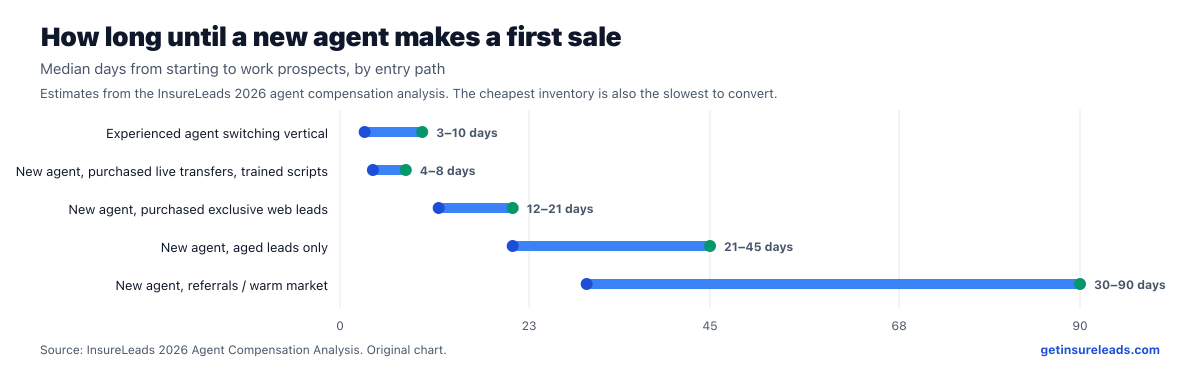
Time-to-first-sale is the number every new agent wants and the one most sources refuse to state. Our own analysis, built from public sources, operational data across our buyer base, and structured interviews with 40+ active producers conducted January–March 2026, puts medians in the ranges below. Read the clock carefully: it starts the day you begin working prospects, not the day your license was issued. A quarter with three weeks of contracting in front of it does not get those three weeks back.
The pattern in the data is uncomfortable and consistent — the cheaper the entry path, the longer and harder the road to a first sale. Aged records are the least expensive inventory a pre-revenue agent can practice on, and they carry the slowest median and the highest attrition. That is not an argument against them. It is an argument for knowing which trade you are making before you make it, and for treating aged records as practice volume rather than a conversion channel. How a first-quarter agent should actually source prospects, and what each format costs, belongs to our companion chapter on how a newly licensed agent gets in front of prospects.
The day-level failure mode in this stretch is contact-window protection. Every vertical has a few hours a day when connect rates are materially higher, and the new-agent error is spending those exact hours on contracting follow-up because paperwork feels productive and dialing feels like rejection. Administrative work belongs outside the window, without exception, for the whole quarter — a worked example of how a producing agent sequences an ordinary day sits in our breakdown of a working agent's daily schedule. Log every disposition and review the numbers weekly rather than daily; a two-call day reads as a broken script only because the sample is two calls.
| Agent profile | Median days to first sale | The trade-off |
|---|---|---|
| New agent, purchased live transfers, trained scripts | 4–8 days | Fastest path; the trade-off is a higher cost per acquisition until scripting improves. |
| New agent, purchased exclusive web leads | 12–21 days | The most common entry path. Requires dialing discipline more than skill. |
| New agent, aged leads only | 21–45 days | Cheapest path, hardest conversion, highest attrition among new agents. |
| New agent, referrals and warm market | 30–90 days | Depends entirely on network depth. Unpredictable as a first-quarter plan. |
| Experienced agent switching vertical | 3–10 days | Scripts and objection handling transfer quickly — which is why a new agent should not benchmark against one. |
When does the first commission actually arrive, and how much of it is real?
A submitted application is not revenue. Between submission and money sit underwriting, issue, delivery where the product requires it, and collection of the initial premium. Each of those steps has its own queue, and the one you can least predict is the prospect returning a phone call about a health question in week nine.
Then the payment structure decides the timing. On an advance, the carrier pays a portion of expected first-year commission up front and reconciles it against premium as it comes in — fast cash with a debt attached. On as-earned, you are paid as premium is collected, which is slower and cleaner. New agents routinely read an advance as earnings and discover in month four that it was a loan against a policy that lapsed. That is the mechanism behind the chargeback risk that shows up in the back half of the first quarter, and it is why the honest cash column in the first table stays negative longer than anyone expects.
We deliberately keep dollar figures off this page. Commission magnitudes vary too much by line, carrier, contract level and premium to state responsibly inside an operating plan, and stating them here would compete with the pages that own them. For what agents at each experience level actually earn, and how income differs by primary lead source, read our analysis of insurance agent compensation. For the mechanics of how a single policy pays — contract levels, advances, persistency and renewals — our breakdown of how final expense commission is structured and paid works through one line end to end.
Does the month you get licensed change the 90-day plan?
More than anything else on this page, if you sell a seasonal line. Two federal enrollment windows concentrate a large share of annual senior-market and marketplace production into roughly one quarter of the calendar, and where your 90 days sit relative to them changes what a realistic first quarter even looks like.
For Medicare Advantage and Part D, 42 CFR 422.62(a)(2)(iii) sets it in regulation: "Beginning in 2011, the annual coordinated election period for the following calendar year is October 15 through December 7." The same section carries a second, smaller window most new agents miss — under 422.62(a)(3)(i), an individual already enrolled in an MA plan "may make an election once during the first 3 months of the year" to switch MA plans or return to Original Medicare, which is why a January licensure date is not as dead as it looks.
The marketplace window is mid-change, and that matters if you are planning a first quarter in 2026. Under 45 CFR 155.410(e)(4), for benefit years beginning January 1, 2022 through January 1, 2026, open enrollment runs November 1 through January 15 of the benefit year, with state exchanges permitted a later end date. But 155.410(e)(5) — read as currently codified — provides that for benefit years beginning on or after January 1, 2027, open enrollment for all Exchanges "must begin no later than November 1 and must end no later than December 31 of the calendar year preceding the benefit year" and "must not exceed 9 weeks in duration." Plainly: the January selling tail an ACA agent could rely on for the 2026 benefit year is not there for 2027. If your 90 days end in January 2027, plan for a season that closed on December 31.
The practical reading for a first quarter is simple arithmetic against those dates.
- Licensed in June or July: your 90 days end with contracting complete and certifications cleared just as the senior-market season opens. This is the strongest possible timing and the reason experienced managers push summer licensure.
- Licensed in September or October: you are contracting during the busiest weeks of the year. Carrier and upline desks are slower, certifications compete with selling hours, and a 15- or 30-day filing window inside AEP can consume the season before your writing numbers land. Plan a year-round line for the quarter rather than betting on the window.
- Licensed in January or February: the marketplace window has closed and, for benefit years from 2027 forward, it closed on December 31. The Medicare Advantage open enrollment period in January through March is the one live senior-market opportunity; otherwise build on a non-seasonal line — final expense, term life, or a commercial line — where demand does not depend on a federal date.
- Licensed in March through May: a genuinely neutral start. Use the runway deliberately, because the next seasonal window is far enough away that nothing forces discipline on you.
Where first-quarter plans actually break
These are not motivational failures. Each one is a structural mistake with a specific mechanism, and each is avoidable with a decision made before it matters.
- Treating contracting delay as free time. Weeks one through four disappear, and the agent arrives at their first writing number with no script, no CRM and no daily number.
- Contracting with several uplines at once. It looks like diversification and produces duplicate submissions on the same carrier — against an NAIC uniform process that contemplates one appointment transaction per producer per company — a hierarchy you did not choose, and a release request you will spend months on.
- Assuming a licensed-but-unappointed producer can write. In most states the statute says the opposite in its first sentence, and in every state the carrier can decline business submitted before its writing number issued.
- Spending the lead budget before the script exists. Fresh inventory has a short working window; burning it while your opening is still forming converts money into practice at the worst available exchange rate.
- Reading an advance as income. The reconciliation arrives later, quietly, and a first quarter that looked profitable in week ten can invert by month five.
- Judging a close rate on a sample of a dozen conversations. There is no statistical content in twelve calls, and over-correcting on them destroys a script that was working.
- Selling three lines at once. Underwriting depth is the compounding asset in this business, and it does not compound across three products in one quarter.
- Expecting the quarter to be cash-positive. Across every entry path in our data, the first 90 days are an investment period. An agent who budgeted for that survives month four; an agent who did not is often gone before the first renewal ever posts.
Frequently asked questions
How long does a carrier have to file my appointment?
It is set per state and ranges widely. Alabama, Michigan, New York and Washington set 15 days; Ohio, North Dakota and Virginia set 30. California and Florida set no day count at all — California requires the notice of appointment on file before you act as the insurer's agent, and Florida makes appointment a precondition of acting rather than a follow-up filing. Check your own state, not another agent's.
What starts the appointment clock — signing the contract or submitting the first application?
Both events appear in the statutes, but states resolve the tie differently, and that is the detail that changes your calendar. Washington and Ohio run from whichever came earlier. North Dakota runs from the later of the two. Michigan and New York name both events without stating a tie-breaker. Virginia's 30 days run from execution of the first application submitted by a licensed but not-yet-appointed agent.
Can I sell insurance before my carrier appointment comes through?
Virginia expressly permits it: a licensed agent may sell and solicit for an insurer that has not yet appointed them, and the insurer then has 30 calendar days to appoint or reject the application. Most states prohibit it — North Dakota, Ohio, Michigan and Washington all bar a producer from acting as an insurer's agent unless appointed, and Michigan separately bars binding coverage. Regardless of the statute, your carrier's contract governs whether business written early gets accepted.
Who files a carrier appointment — me or the carrier?
The insurer. The NAIC handbook defines an appointment as "a registration with the state insurance department that a producer is acting on behalf of an insurer," and the uniform appointment process requires states to have insurers follow a prescribed timeline for filing and to let insurers pick the effective date. The transaction is normally electronic through NIPR against your National Producer Number. Your only real lever is submitting a complete, correct contracting packet once, through one upline.
Why does my life contracting packet ask for AML training?
Because 31 CFR 1025.210 requires the insurance company's anti-money-laundering program to integrate its agents and brokers, provide ongoing training, and independently test agent compliance. The obligation is the carrier's, so it surfaces as a document request to you. The rule also lets a carrier verify training received "by another insurance company or by a competent third party," which is why one third-party certificate usually clears several carriers.
Does AML training apply if I only sell term life or Medicare?
Often not. A "covered product" under 31 CFR 1025.100(b) is a non-group permanent life policy, a non-group annuity, or any other insurance product with cash value or investment features. Term life with no cash value and group business fall outside that definition, which is why some packets never mention AML and whole-life or IUL packets always do. Your carrier may still require it as a matter of its own policy.
How long does it take a new insurance agent to make a first sale?
Our compensation analysis puts the median at 12–21 days for a new agent working purchased exclusive web leads, 4–8 days for one working live transfers with trained scripts, and 21–45 days for an agent working aged records only. The clock starts when you begin working prospects, not when your license is issued — so add your contracting and appointment-filing time on top.
Does the month I get licensed really matter?
For seasonal lines, substantially — and the marketplace calendar is changing. Medicare's annual coordinated election period is fixed by 42 CFR 422.62 at October 15 through December 7. For ACA, 45 CFR 155.410(e)(5) as currently codified requires that for benefit years beginning on or after January 1, 2027, open enrollment end no later than December 31 and run no more than 9 weeks — so the January tail that existed through the 2026 benefit year is gone. Verify against the current plan-year rule before building a calendar on it.
Sources
- https://content.naic.org/sites/default/files/inline-files/Chapter%2011.pdf — NAIC State Licensing Handbook, Chapter 11 (Appointments). Fetched and text-extracted this session. Supports: the definition "An appointment is a registration with the state insurance department that a producer is acting on behalf of an insurer"; that Section 14 of Producer Licensing Model Act #218 makes the appointment requirement an optional provision applying only in states that require appointments; the 2002 uniform-process elements that states "shall require insurers to follow a prescribed timeline to file appointments," "shall allow insurers to select the effective date of the initial appointment," and "shall require only one appointment or termination form or transaction per producer per company"; that Section 15 of Model #218 "requires that the insurer report a termination within 30 days of its occurrence"; and the recommended practice "Do not require an appointment as a condition of licensure. Model #218 and the ULS provide that a producer can hold a license without holding an active appointment."
- https://admincode.legislature.state.al.us/administrative-code/482-1-147-.10 — Alabama Administrative Code r. 482-1-147-.10, fetched from the Alabama Legislature's official admin-code site. Supports the Alabama row of the deadline table: "The notice of appointment shall be completed by the insurer within 15 days from the date the agency contract is executed or the first insurance application is submitted, whichever occurs first," and the NIPR claim: "All appointments are handled on-1ine through NIPR" (typography as published).
- https://www.legislature.mi.gov/Laws/MCL?objectName=mcl-500-1208a — MCL 500.1208a, Michigan Legislature. Supports the Michigan row: notice of appointment filed "within 15 days from the date the agency contract is executed or the first insurance application is submitted," with no earlier/later tie-breaker in the text; also subsection (1) "An insurance producer shall not act as the agent of an insurer unless the insurance producer becomes an appointed agent of that insurer" and subsection (2) "An insurance producer shall not bind coverage for an insurer unless the insurance producer is appointed by the insurer."
- https://www.nysenate.gov/legislation/laws/ISC/2112 — N.Y. Insurance Law § 2112, NY Senate OpenLegislation. Supports the New York row: "To appoint a producer, the appointing insurer shall file, in a format approved by the superintendent, a notice of appointment within fifteen days from the date the agency contract is executed or the first insurance application is submitted."
- https://app.leg.wa.gov/RCW/default.aspx?cite=48.17.160 — RCW 48.17.160, Washington State Legislature. Supports the Washington row: notice of appointment filed "within fifteen days from the date the agency contract is executed or the first insurance application is submitted, whichever is earlier," plus subsection (1)'s prohibition on acting as an agent of an insurer without appointment.
- https://codes.ohio.gov/ohio-revised-code/section-3905.20 — Ohio Rev. Code § 3905.20, Ohio Laws. Supports the Ohio row: an insurer "shall file a notice of appointment with the superintendent of insurance not later than thirty days after the date the agency contract is executed or the first insurance application is submitted, whichever is earlier," and division (A)'s prohibition on an agent acting as an agent of an insurer without appointment.
- https://www.ndlegis.gov/cencode/t26-1c26.pdf — N.D. Century Code ch. 26.1-26, North Dakota Legislative Branch (PDF, parsed this session). Supports the North Dakota row: "the appointing insurer shall file a notice of appointment within thirty days from the later of the date the agency contract is executed or the first insurance application is submitted" (§ 26.1-26-13.1(2)); § 26.1-26-13.1(1)'s prohibition on acting as an agent unless appointed; and § 26.1-26-07, under which an unappointed producer who helps place a risk "is regarded as representing the insured or the insured's beneficiary and not the insurer."
- https://law.lis.virginia.gov/vacode/title38.2/chapter18/section38.2-1833/ — Va. Code § 38.2-1833, Virginia State Law Portal. Supports the Virginia row and the whole "producing before appointment" section: "every licensed agent may sell policies and solicit applications for insurance … on behalf of an insurer … by which the licensed agent has not yet been validly appointed," with the insurer required within 30 calendar days of execution of the first application or policy to "either reject such application or policy or notify the Commission of the appointment," to give the agent verification in the same period, and with continued selling after notice of an invalid appointment a violation.
- https://leginfo.legislature.ca.gov/faces/codes_displaySection.xhtml?lawCode=INS§ionNum=1704 — Cal. Ins. Code § 1704(a), California Legislative Information. Supports the California row: "Any person acting as a licensee under this chapter shall not act as an agent of an insurer unless the insurer has filed with the commissioner a notice of appointment," and that the authority to transact given by appointment "shall be effective as of the date the notice of appointment is signed." Confirms no day-count filing window in the section.
- https://www.flsenate.gov/Laws/Statutes/2024/626.451 — Fla. Stat. § 626.451(1), Florida Senate. Supports the Florida row: the appointing entity "shall file the appointment with the department or office and, at the same time, pay the applicable appointment fee and taxes. Every appointment is subject to the prior issuance of the appropriate agent's … license." Confirms no day-count filing window.
- https://www.flsenate.gov/Laws/Statutes/2024/626.112 — Fla. Stat. § 626.112, Florida Senate. Supports the Florida prohibition used in the pre-appointment section: "No person may be, act as, or advertise or hold himself or herself out to be an insurance agent … unless he or she is currently licensed by the department and appointed by an appropriate appointing entity," and subsection (10), under which knowingly transacting insurance without a license "commits a felony of the third degree."
- https://www.ecfr.gov/current/title-31/subtitle-B/chapter-X/part-1025/subpart-B/section-1025.210 — 31 CFR 1025.210 (FinCEN, AML programs for insurance companies), eCFR current as of 8/07/2026. Supports the AML section: the program must include "integrating the company's insurance agents and insurance brokers into its anti-money laundering program"; must "provide for on-going training of appropriate persons"; may satisfy training "by directly training such persons or verifying that persons have received training by another insurance company or by a competent third party"; and must independently test "compliance of the company's insurance agents and insurance brokers with their obligations under the program."
- https://www.ecfr.gov/current/title-31/subtitle-B/chapter-X/part-1025/subpart-A/section-1025.100 — 31 CFR 1025.100, eCFR current as of 8/07/2026. Supports the AML scope claim: "covered product" means a permanent life insurance policy other than group, an annuity contract other than group, or "any other insurance product with features of cash value or investment" — the basis for saying term-only and group business fall outside the rule's product scope.
- https://www.ecfr.gov/current/title-42/chapter-IV/subchapter-B/part-422/subpart-B/section-422.62 — 42 CFR 422.62, eCFR current as of 8/07/2026 (supersedes the 2023 CFR edition previously cited on this page). Supports the verbatim Medicare annual coordinated election period — "Beginning in 2011, the annual coordinated election period for the following calendar year is October 15 through December 7" (a)(2)(iii) — and the MA open enrollment period at (a)(3)(i), under which an MA enrollee "may make an election once during the first 3 months of the year."
- https://www.ecfr.gov/current/title-45/subtitle-A/subchapter-B/part-155/subpart-E/section-155.410 — 45 CFR 155.410, eCFR current as of 8/07/2026 (supersedes the 2023 CFR edition previously cited). Supports both marketplace windows: (e)(4)(i), for benefit years January 1, 2022 through January 1, 2026, open enrollment "begins on November 1 … and extends through January 15 of the benefit year"; and (e)(5), for benefit years beginning on or after January 1, 2027, open enrollment "must begin no later than November 1 and must end no later than December 31 of the calendar year preceding the benefit year" and "must not exceed 9 weeks in duration."
- https://nipr.com/industry-solutions/appointment-and-terminations — NIPR (National Insurance Producer Registry) primary page. Supports the description of NIPR's role in appointment processing: "Submit appointments and terminations seamlessly through NIPR. Use the National Producer Number (NPN) for real-time validation and compliance with state requirements," and that transactions run through NIPR's application or a carrier system connected to NIPR under NIPR data standards.
- https://nipr.com/industry-solutions/company-appointment-renewals — NIPR company appointment renewals page. Supports that appointments are not one-and-done in many jurisdictions — NIPR publishes dated annual renewal-invoice windows for 24 listed jurisdictions (e.g., Alabama Jan 6–Feb 28, 2026; Illinois Nov 5, 2026–Jan 2, 2027) — corroborating the NAIC handbook's separate renewal-process elements.
- https://statutes.capitol.texas.gov/Docs/IN/htm/IN.4054.htm — Texas Insurance Code ch. 4054 (Life, Accident, and Health Agents), Texas Legislature. Fetched and read in full this session; it contains no appointment filing window. This is the negative-result basis for the ownerFlag stating that Texas was deliberately omitted from the deadline table rather than guessed at, since Texas's appointment provisions sit elsewhere in the code and were not verified this session.