
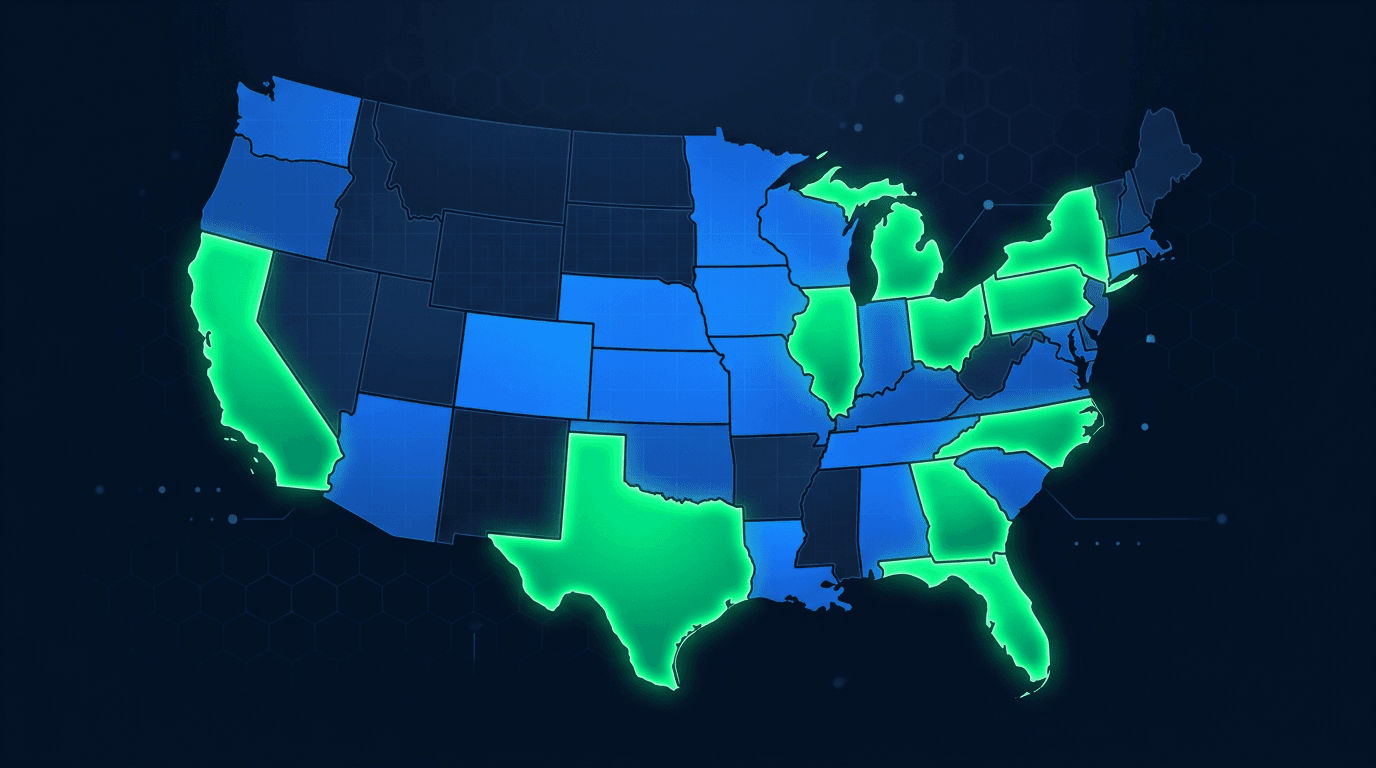
Not all final expense markets are created equal. The state where you buy leads has a direct impact on how much you pay per lead, how many leads are available, how competitive the market is, and ultimately how many policies you place. Yet many agents choose their target markets based on convenience or habit rather than data. That is a costly mistake.
This guide breaks down final expense leads by state, ranking the top markets by volume and demand, analyzing the factors that drive geographic differences, and providing actionable data to help you choose the right markets for your business. Whether you are a field agent working a single territory or a virtual agent licensed in multiple states, understanding state-level lead dynamics is essential for maximizing your return on every dollar you spend on leads.
Why Geography Matters for Final Expense Lead Buying
Geography is one of the most underappreciated variables in final expense lead generation. Agents often focus on lead type (exclusive vs. shared, real-time vs. aged) and lead source (web, Facebook, direct mail) while ignoring the geographic dimension entirely. Here is why that matters:
- Demand varies dramatically: Some states produce 10-15x more final expense leads than others due to population size, demographics, and cultural attitudes toward funeral planning. Texas and Florida alone account for a disproportionate share of national final expense lead volume.
- Pricing is not uniform: A final expense lead in rural Alabama costs significantly less than an identical lead type in South Florida or the Dallas-Fort Worth metro. Understanding these price differences helps you stretch your budget further.
- Competition varies by market: High-volume states attract more agents, which can offset the advantages of larger lead pools. Some mid-tier states offer better ROI because the ratio of available leads to competing agents is more favorable.
- Regulatory environments differ: State insurance regulations affect everything from advertising compliance to product availability. Some states are more agent-friendly than others when it comes to selling simplified issue and guaranteed issue products. For a state that needs its own playbook on regulation, demographics and lead pricing before you buy a single record, see our guide to the New York market.
- Close rates differ by region: Cultural factors, income levels, and familiarity with final expense insurance all influence how readily prospects convert. Agents who track their close rates by state consistently find meaningful differences across markets.
The bottom line: choosing the right state or combination of states for your lead buying can be the difference between a profitable practice and a struggling one. The data below will help you make that decision with confidence. Territory is only half of that decision; once the map is settled, the burial insurance lead companies comparison covers who actually carries inventory in the states you picked.
Top 10 States by Final Expense Lead Volume
Based on industry data, search volume trends, and lead provider reporting, these are the ten states that generate the highest volume of final expense insurance leads. If you are looking for scale and consistent lead flow, these are the markets to consider.
1. Texas
Texas is the single largest market for final expense leads in the country. With nearly 30 million residents, a large and growing senior population, significant Hispanic and African American communities (demographics with strong cultural connections to funeral planning), and moderate household incomes, Texas checks every box for final expense demand. The major metros of Dallas-Fort Worth, Houston, San Antonio, and Austin each generate substantial lead volume independently. Rural East Texas and the Rio Grande Valley are also productive markets with less competition. View available Texas markets.
2. Florida
Florida's massive retiree population makes it a perennial top-two final expense market. The state has the second-highest percentage of residents aged 65+ in the nation, and many of those seniors are on fixed incomes, making affordable burial coverage particularly appealing. Miami-Dade, Broward, Palm Beach, Orlando, Tampa, and Jacksonville are the primary volume centers. Competition is fierce in South Florida, but Central and North Florida offer strong volume with less agent saturation.
3. North Carolina
North Carolina consistently ranks among the top final expense lead states, driven by a combination of a growing senior population, moderate incomes, and strong cultural emphasis on family and funeral traditions across both urban and rural communities. Charlotte, Raleigh-Durham, Greensboro, and Fayetteville are the major lead-producing metros, but rural counties across the Piedmont and Coastal Plain also generate reliable volume.
4. Georgia
Georgia's large African American population and strong Southern funeral traditions create outsized final expense demand relative to the state's total population. Metro Atlanta dominates lead volume, but Augusta, Savannah, Macon, and Columbus are all meaningful secondary markets. Georgia also benefits from relatively moderate lead pricing compared to Florida and Texas. Explore the best states for selling final expense insurance for more detail.
5. Ohio
Ohio is often overlooked by agents focused on Sun Belt states, but it consistently ranks in the top five for final expense lead volume. The state has a large senior population, moderate incomes, and significant blue-collar communities where final expense insurance is a natural fit. Cleveland, Columbus, Cincinnati, Dayton, and Akron-Canton all generate strong lead flow. Ohio's lead pricing tends to be below the national average, making it an excellent value market.
6. Pennsylvania
Pennsylvania's combination of large metro areas (Philadelphia, Pittsburgh) and extensive rural communities creates diverse final expense lead opportunities. The state has an aging population, with many counties in the central and western regions having some of the highest median ages in the Eastern United States. Lead pricing is moderate, and competition, while present in Philadelphia and Pittsburgh, is manageable in smaller markets like Scranton, Allentown, and Erie.
7. Michigan
Michigan's industrial heartland demographics align perfectly with the final expense buyer profile. Detroit, Grand Rapids, Flint, Lansing, and Saginaw drive lead volume. The state's manufacturing heritage means many residents are on fixed incomes from pensions and Social Security, and funeral planning is a practical priority. Lead costs in Michigan are typically below the national average.
8. Tennessee
Tennessee offers strong final expense demand across both its major metros (Nashville, Memphis, Knoxville, Chattanooga) and its rural counties. Memphis in particular is one of the highest-indexing metro areas in the country for final expense interest per capita. The state's moderate cost of living and strong cultural emphasis on family and church community make it a receptive market for burial insurance agents.
9. Alabama
Alabama punches above its population weight in final expense lead generation. Birmingham, Montgomery, Mobile, and Huntsville are the primary metro markets, but rural Alabama generates disproportionately strong demand due to lower incomes and deep cultural traditions around funeral planning. Lead pricing in Alabama is among the lowest in the country, making it one of the best value markets for cost-conscious agents.
10. South Carolina
South Carolina has emerged as a top-ten final expense market, driven by rapid population growth (particularly among retirees relocating from the Northeast and Midwest), a growing senior demographic, and cultural factors similar to neighboring Georgia and North Carolina. Charleston, Columbia, Greenville, and Myrtle Beach are the primary lead-producing areas. The market is less saturated than Florida, offering better agent-to-lead ratios.
Top 15 States: Volume, Pricing, and Key Markets
The following table summarizes the top 15 states for final expense leads by state, including relative lead volume, typical pricing ranges for exclusive real-time leads, and the key metropolitan areas driving demand in each state.
| State | Lead Volume | Avg. Lead Cost (Exclusive) | Key Metro Areas |
|---|---|---|---|
| Texas | Very High | $20 - $35 | Dallas-Fort Worth, Houston, San Antonio, Austin |
| Florida | Very High | $22 - $40 | Miami, Tampa, Orlando, Jacksonville |
| North Carolina | High | $18 - $30 | Charlotte, Raleigh-Durham, Greensboro, Fayetteville |
| Georgia | High | $18 - $30 | Atlanta, Augusta, Savannah, Macon |
| Ohio | High | $16 - $28 | Cleveland, Columbus, Cincinnati, Dayton |
| Pennsylvania | High | $18 - $32 | Philadelphia, Pittsburgh, Allentown, Scranton |
| Michigan | High | $16 - $28 | Detroit, Grand Rapids, Flint, Lansing |
| Tennessee | High | $17 - $28 | Nashville, Memphis, Knoxville, Chattanooga |
| Alabama | Medium-High | $14 - $25 | Birmingham, Montgomery, Mobile, Huntsville |
| South Carolina | Medium-High | $16 - $28 | Charleston, Columbia, Greenville, Myrtle Beach |
| Virginia | Medium | $18 - $30 | Virginia Beach, Richmond, Norfolk, Roanoke |
| Louisiana | Medium | $15 - $26 | New Orleans, Baton Rouge, Shreveport, Lafayette |
| Mississippi | Medium | $13 - $22 | Jackson, Gulfport, Hattiesburg, Tupelo |
| Indiana | Medium | $16 - $27 | Indianapolis, Fort Wayne, Evansville, South Bend |
| Illinois | Medium | $18 - $32 | Chicago, Rockford, Springfield, Peoria |
Note: Lead volume classifications are relative to national averages. "Very High" indicates states in the top tier of national lead production. Pricing reflects exclusive, real-time web leads; aged leads and shared leads will be priced lower. Actual costs may vary by provider, lead type, and specific ZIP codes within each state.
Factors That Drive State-Level Demand
Why do some states generate far more final expense leads than others? The answer lies in a combination of demographic, economic, and cultural factors that create the conditions for strong burial insurance demand.
Senior Population Size and Growth
The most obvious driver is the number of people aged 50-85 in a given state. Final expense insurance is primarily purchased by seniors who want to ensure their burial and funeral costs do not burden their families. States with large or rapidly growing senior populations — Florida, Texas, Pennsylvania, Ohio — naturally produce more lead volume. But raw population size does not tell the whole story. Maine has one of the oldest median ages in the country but generates relatively modest final expense lead volume because its total population is small.
Household Income Levels
Final expense insurance is designed for people who cannot afford or do not need large whole life or term life policies. The typical final expense buyer has a household income of $20,000-$50,000 per year. States with large populations in this income bracket — particularly across the Southeast and Rust Belt — tend to produce stronger final expense demand per capita. High-income states like Connecticut, Massachusetts, and New Jersey have smaller final expense markets relative to their population because more residents can access traditional life insurance products.
Cultural Attitudes Toward Funeral Planning
Cultural and religious traditions play a significant role in final expense demand. In the American South, funerals are major community and family events with deep cultural significance. African American, Hispanic, and Southern church communities place particular emphasis on dignified burial services, creating strong motivation to ensure funeral costs are covered. This cultural factor helps explain why states like Georgia, Alabama, Mississippi, Tennessee, and the Carolinas punch above their population weight in final expense lead generation.
Existing Insurance Coverage Gaps
States with lower rates of employer-sponsored life insurance and lower overall life insurance penetration tend to produce more final expense demand. Many workers in service, retail, and agricultural industries do not receive life insurance through their employers, leaving a coverage gap that final expense products fill. States with higher concentrations of these industries — again, primarily in the Southeast and parts of the Midwest — see proportionally higher demand.
Funeral Cost Awareness
The average funeral cost in the United States is approximately $8,000-$12,000, but costs vary by region. States where funeral costs are rising fastest or where media coverage of funeral costs has been prominent tend to see increased lead activity. Consumer awareness campaigns by funeral homes and insurance companies also contribute to lead generation in specific markets.
Pricing Variations by State
The cost of final expense leads by state varies significantly based on supply, demand, and competitive dynamics. Understanding these variations helps you allocate your lead budget more effectively.
What Makes Leads More Expensive in Certain States
- Agent density: States with more licensed insurance agents competing for leads drive prices up. Florida, Texas, and California have the highest agent density in the country, which increases lead costs, particularly in major metros.
- Consumer advertising costs: The cost of generating leads through Google Ads, Facebook, and other digital channels varies by market. Keywords like "final expense insurance" cost more per click in competitive metros like Miami, Dallas, and Atlanta than in smaller markets like Tupelo, Mississippi, or Erie, Pennsylvania.
- Urban concentration: Metro areas have higher lead costs than rural areas due to increased competition and higher advertising costs. A lead in downtown Houston will cost more than a lead in a rural East Texas county.
- Lead provider coverage: States with fewer lead providers may have higher prices due to limited competition among vendors. Conversely, states where many providers actively generate leads tend to have more competitive pricing.
Best Value States for Final Expense Leads
Based on the combination of lead volume, pricing, and competition levels, these states offer the best overall value for final expense lead buyers:
- Ohio: High volume, below-average pricing ($16-$28), and moderate competition make Ohio one of the best value markets in the country.
- Michigan: Similar dynamics to Ohio with solid volume and competitive lead pricing.
- Alabama: Among the lowest lead costs nationally ($14-$25) with strong per-capita demand and less agent competition.
- Mississippi: The lowest average lead costs in the country ($13-$22) with meaningful volume in key markets.
- Tennessee: Good volume across multiple metros with pricing below the national average.
Agents who are willing to work markets outside the traditional high-volume states can often achieve better cost-per-acquisition numbers by focusing on these value markets. Browse available markets by location.
Rural vs Urban Markets
The rural-urban divide creates distinct dynamics in final expense lead generation that every agent should understand.
Urban Markets
Major metropolitan areas offer high lead volume, consistent supply, and the ability to scale quickly. However, they also come with higher lead costs and more competition. In a metro like Atlanta or Houston, you may be one of dozens of agents working the same ZIP codes. Urban leads also tend to have more choices — they have seen more ads, received more calls, and may be harder to reach and convert because of lead fatigue.
Best for: Virtual agents who can handle volume, agents with strong phone skills and fast follow-up systems, and agents who want consistent daily lead flow without geographic limitations.
Rural Markets
Rural areas generate fewer total leads, but competition is dramatically lower. In many rural counties, you may be one of only a handful of agents actively working final expense leads. Rural prospects are often more receptive to phone conversations, more trusting of agents, and less likely to be experiencing lead fatigue from multiple competing agents. Lead costs in rural areas are typically 20-40% lower than in nearby urban markets.
Best for: Field agents who can travel to homes, agents willing to work smaller territories with deeper relationships, and agents looking for the best cost per acquisition even if total volume is lower.
Suburban Sweet Spot
Many experienced agents find the best balance in suburban areas surrounding major metros. These markets offer moderate volume, moderate pricing, and less competition than the urban core while still providing enough lead flow to sustain a full-time practice. Suburbs of cities like Nashville, Charlotte, Columbus (OH), and Indianapolis are particularly productive for final expense agents.
Underserved and Emerging Markets
While the top 10 states dominate national final expense lead volume, several emerging and underserved markets offer compelling opportunities for agents willing to think beyond the usual targets.
States with Growing Opportunity
- Arkansas: Strong cultural alignment with final expense products, low lead costs, and minimal agent competition in most markets outside Little Rock. The state's aging rural population creates steady demand that is underserved by the industry.
- West Virginia: One of the oldest median-age states with lower household incomes and limited access to traditional life insurance. Lead volume is modest, but competition is nearly nonexistent in many counties, creating excellent close-rate opportunities.
- Kentucky: Louisville, Lexington, and the Appalachian region all produce meaningful final expense lead volume. The state shares many demographic characteristics with Ohio and Tennessee but with less agent saturation.
- Oklahoma: Oklahoma City and Tulsa drive volume, but smaller markets like Lawton, Muskogee, and Enid are underserved. The state's mix of Native American, African American, and rural white communities creates diverse demand drivers.
- Missouri: Kansas City and St. Louis are the primary markets, but mid-Missouri and the Ozarks region offer opportunities for agents willing to work less populated areas. Lead costs are moderate and competition is manageable.
- New Mexico: A growing senior population, significant Hispanic community with strong family and funeral traditions, and relatively low agent competition make New Mexico an emerging market worth watching.
Why Underserved Markets Matter
The math is straightforward: in a saturated market like South Florida, you might pay $30-$40 per exclusive lead and close 6-8% because prospects are being contacted by multiple agents. In an underserved market like rural Alabama or West Virginia, you might pay $14-$20 per lead and close 10-15% because you have less competition and prospects are more engaged. The cost per acquisition can be 40-60% lower in underserved markets even though the total volume is smaller.
For agents who prioritize profitability over raw volume, building a portfolio of underserved markets can be a powerful strategy.
Multi-State Strategies for Virtual Agents
The rise of virtual selling has fundamentally changed how final expense agents think about geography. If you are licensed in multiple states and selling over the phone, you can build a diversified lead portfolio that optimizes for both volume and value.
Building a Multi-State Portfolio
A well-constructed multi-state strategy typically includes three tiers of markets:
- Volume states (40-50% of budget): High-volume states like Texas, Florida, and North Carolina that provide consistent daily lead flow. You will pay more per lead, but the supply is reliable and scalable.
- Value states (30-40% of budget): Mid-volume states with below-average lead costs and moderate competition, such as Ohio, Michigan, Alabama, and Tennessee. These states often deliver the best cost per acquisition.
- Emerging states (10-20% of budget): Lower-volume but underserved markets like Arkansas, West Virginia, and Kentucky. These states offer the best close rates and lowest lead costs, but volume is limited.
Licensing Considerations
Before buying leads in a new state, ensure you are properly licensed. Most states require a resident or non-resident insurance license to sell final expense products. The National Insurance Producer Registry (NIPR) simplifies the non-resident licensing process. Many successful virtual agents hold licenses in 10-20 states to maximize their market access. Prioritize licensing in the top 15 states listed above, as they represent the vast majority of national final expense lead volume.
Time Zone Management
When working leads across multiple states, time zone management becomes critical. A virtual agent in North Carolina working leads in Texas, Michigan, and Alabama is dealing with three time zones. Structure your calling schedule to match peak contact times (9:00 AM - 11:00 AM and 4:00 PM - 7:00 PM local time) in each market. Most CRM systems can segment leads by time zone and queue them accordingly.
State-Specific Product Knowledge
Final expense products and carrier availability vary by state. Before entering a new market, ensure you have:
- Carrier appointments with companies that are competitive in that state.
- Knowledge of state-specific regulations around simplified and guaranteed issue products.
- Understanding of local funeral costs so you can recommend appropriate coverage amounts ($5,000-$7,000 in low-cost areas, $10,000-$15,000 in higher-cost markets).
- Awareness of any state-specific disclosure or documentation requirements.
Tracking Performance by State
Multi-state agents must track performance metrics separately by state to identify which markets deliver the best ROI. Key metrics to track include:
- Cost per lead by state and metro area.
- Contact rate (percentage of leads you reach on the phone).
- Close rate (percentage of leads that result in a placed policy).
- Average premium by state (this varies based on local funeral costs and income levels).
- Cost per acquisition (CPA) — the total lead cost divided by placed policies.
Review these metrics monthly and reallocate your lead budget toward the states delivering the best CPA. An agent who diligently tracks state-level performance and adjusts their strategy accordingly will consistently outperform an agent who spreads budget evenly across all markets.
Ready to start building your multi-state lead pipeline? Explore final expense lead options and filter by state to see what is available in your licensed markets.
Frequently Asked Questions
Which states have the highest demand for final expense leads?
Texas and Florida have the highest absolute demand for final expense leads, followed by North Carolina, Georgia, Ohio, Pennsylvania, Michigan, Tennessee, Alabama, and South Carolina. These states consistently rank in the top 10 for lead volume due to their large senior populations, moderate income levels, and strong cultural connections to funeral planning. However, the "best" state for your business depends on the balance between lead volume, pricing, and competition in your chosen markets.
Why do final expense lead prices vary by state?
Lead prices vary by state due to several factors: the number of agents competing for leads in that market (agent density), the cost of digital advertising in that region (Google and Facebook ad costs vary by metro), urban vs. rural concentration, and the overall supply of leads relative to demand. High-competition states like Florida and Texas tend to have higher lead costs, while less saturated states like Alabama, Mississippi, and Ohio offer more affordable pricing. Lead type (exclusive vs. shared, real-time vs. aged) also affects pricing within any given state.
Should I buy final expense leads in the state where I live?
Not necessarily. If you are a field agent doing in-home presentations, your state of residence is a natural starting point. But if you are a virtual agent selling over the phone, you should choose states based on data — lead volume, pricing, competition, and your close rates — rather than geography. Many of the most successful virtual final expense agents buy leads in 10-15 states, selecting markets based on performance metrics rather than proximity. That said, starting with your home state allows you to build experience and refine your process before expanding.
What are the best states for final expense leads with low competition?
States with strong demand but lower agent saturation include Alabama, Mississippi, Arkansas, West Virginia, Kentucky, and Oklahoma. These markets offer lower lead costs, higher contact rates, and often better close rates because prospects are not being contacted by multiple competing agents. The trade-off is lower total lead volume compared to mega-markets like Texas and Florida. For agents who prioritize profitability over scale, these underserved markets can deliver superior ROI.
How many states should a virtual final expense agent be licensed in?
Most successful virtual final expense agents hold non-resident licenses in 10-20 states. Start by getting licensed in the top 10 states listed in this guide (Texas, Florida, North Carolina, Georgia, Ohio, Pennsylvania, Michigan, Tennessee, Alabama, and South Carolina), as they represent the majority of national lead volume. From there, add value and emerging market states based on your performance data. The cost of non-resident licenses (typically $25-$100 per state through NIPR) is minimal compared to the market access they provide. Review your state-by-state CPA data quarterly and add or drop states based on results.